Biology 3.4 - 3.5 - DNA, genes and genomes
Explore how nucleotide units form the two complementary strands of DNA. Connect this molecular structure to a gene, which codes for a specific protein, and to the genome, which contains all of an organism’s DNA.
DNA: polymer to double helix
Polymer
A polymer is a large molecule made by joining many repeating smaller units. In DNA, those repeating units are nucleotides.
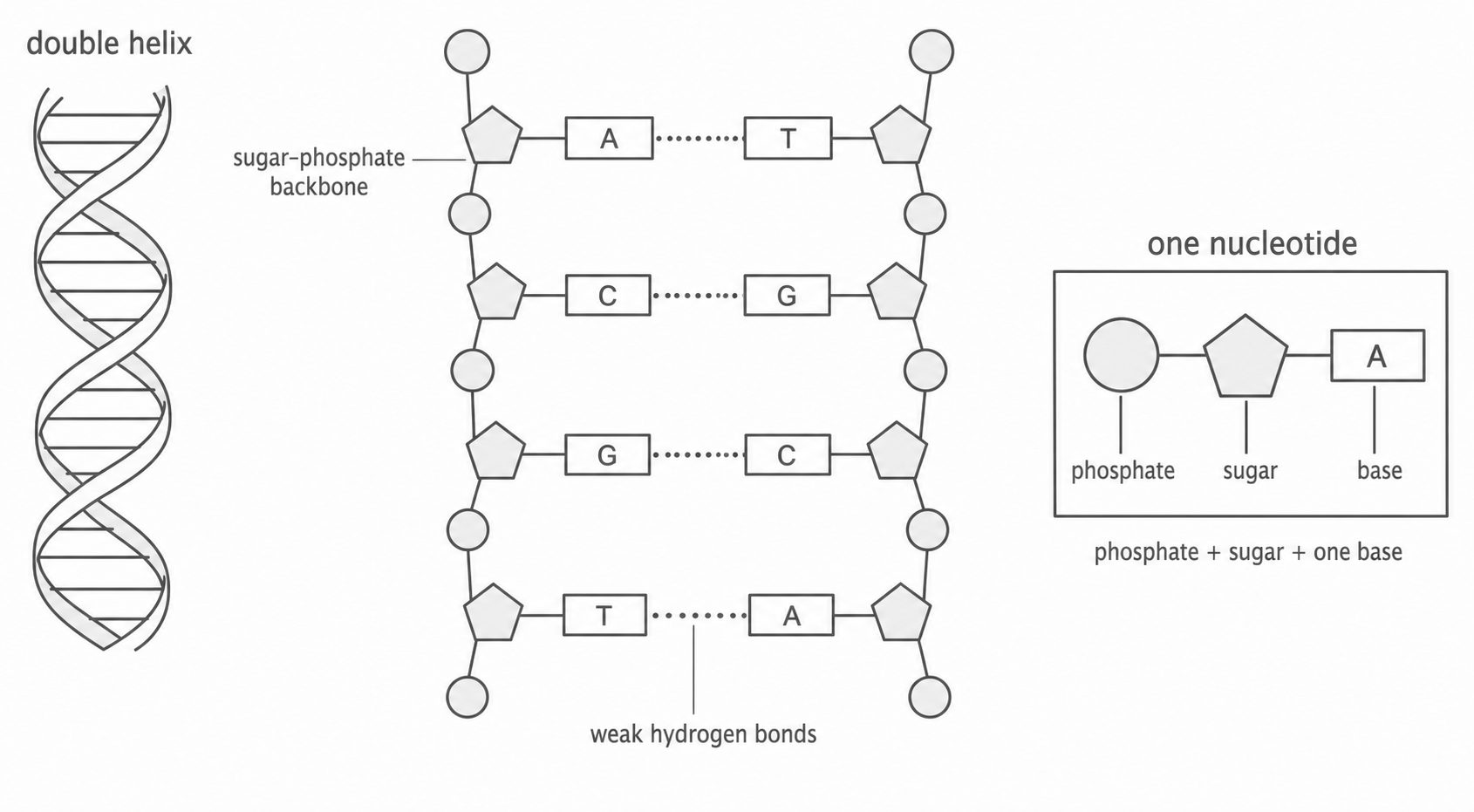
Each DNA nucleotide has three components:
- a phosphate group;
- a sugar;
- one of four bases attached to the sugar: adenine (
A), thymine (T), cytosine (C) or guanine (G).
Many nucleotides join to form a strand with an alternating sugar-phosphate backbone. DNA contains two strands, and the two strands coil around each other to form a double helix.
The bases point inwards from the two backbones. A base on one strand pairs with a base on the other strand. The pairing is complementary because only particular partners fit:
- adenine pairs with thymine:
A-T; - cytosine pairs with guanine:
C-G.
The complementary bases are joined across the two strands by weak hydrogen bonds. A base pair is therefore two bases, one from each strand. It is not one nucleotide: each nucleotide contains only one base.
[DIAGRAM: asset_name: Biology 3.3-3.6 - Meiosis, DNA and genomes - diagram 02; asset_slug: biology_3_3_3_6_meiosis_dna_and_genomes_diagram_02; recommended_method: image_gen; description: Clean monochrome DNA structure diagram on white: a small double-helix overview connects to an enlarged untwisted ladder section. The enlarged section must show two sugar-phosphate backbones, bases attached to sugars, complementary A-T and C-G pairs, dotted weak hydrogen bonds only between paired bases, and one clearly bracketed nucleotide containing phosphate, sugar and one base. Labels must be exact and leaders unambiguous. Do not add replication, RNA, chromosomes, proteins, colour coding or chemical structures beyond GCSE scope.]
Genes and the genome
DNA can be described at two different scales:
| Term | Meaning | Scale relationship |
|---|---|---|
| Gene | A section of a DNA molecule that codes for a specific protein | One particular section of DNA |
| Genome | The entire DNA of an organism | All of that organism's DNA |
A gene is therefore made of DNA, but it is not a whole genome. A genome includes all the organism's DNA, including its many genes. The order of bases in a gene carries the information used to make its specific protein; that protein can contribute to a cell's structure or activity.
The word entire is important. Saying that the genome is simply "all the genes" is incomplete because the genome means all DNA, not only the sections identified as genes.