Biology 5.1-5.3 - Health and disease
Health includes physical, mental and social well-being. Learn to classify diseases by transmission and explain why one disease can increase the chance of another.
Health is more than being disease-free
Imagine two people whose medical tests show no diagnosed disease. One feels physically comfortable, can manage everyday activities, feels able to cope with thoughts and emotions, and has supportive relationships. The other is physically comfortable but is experiencing severe distress and isolation. Describing both people as equally healthy would miss important parts of health.
Health
The World Health Organization (WHO) describes health as a state of complete physical, mental and social well-being, not merely the absence of disease or infirmity.
Each phrase matters:
- Physical well-being concerns how well the body is functioning and a person's physical comfort and capacity for everyday life.
- Mental well-being concerns thoughts and emotions, including being able to cope with the ordinary demands of life.
- Social well-being concerns supportive relationships and being able to take part in family, friendship or community life.
These are dimensions of one person's health, not three separate boxes. A physical illness can restrict social contact; isolation can affect mental well-being; poor mental well-being can make everyday physical activity harder. The exact effects differ between people, but the example shows why health cannot be judged only by asking whether a disease has been diagnosed.
Classifying diseases by transmission
A disease is a condition that disrupts normal functioning in the body or mind. Diseases can be grouped in several ways, but Biology 5.2 uses one specific question: can the disease be transmitted from one organism to another?
| Disease group | Defining feature | Familiar example |
|---|---|---|
| Communicable disease | It can be transmitted from one organism to another, directly or indirectly. | the common cold |
| Non-communicable disease | It cannot be transmitted from one organism to another. | cancer |
The examples help with classification; they are not definitions. A communicable disease is not necessarily more severe or more common, and communicable does not mean that transmission must involve touching. A non-communicable disease is not necessarily inherited or caused by lifestyle, and it may be short- or long-lasting. Transmission is the deciding criterion.
Suppose a person develops a disease after spending time near someone who has the same disease. That observation may suggest the disease is communicable, but it does not by itself prove transmission: other shared factors could be involved. Evidence must support the claimed route from one organism to another.
Why one disease can increase susceptibility
Susceptibility is the likelihood that a person will develop a disease. Higher susceptibility means a greater chance; it does not mean the disease will definitely develop.
One disease can sometimes make the body's defences work less effectively. If a disease-causing organism associated with a second disease then enters the body, it is less likely to be removed and more likely to survive and reproduce. The second disease is therefore more likely to become established.
[DIAGRAM: asset_name: Biology 5.1-5.3 - Health, disease and susceptibility - diagram 01; asset_slug: biology_5_1_5_3_health_disease_and_susceptibility__diagram_01; recommended_method: image_gen; description: Monochrome left-to-right causal process on white: 'Disease 1 already present' -> 'Body defences become less effective' -> 'A second disease-causing organism is more likely to survive and reproduce' -> outcome 'Disease 2 is more likely to develop'. Use solid #6A6B6E arrows with clear arrowheads; add a separate note 'Higher chance, not certainty'. Exclude named diseases, microorganism types, transmission routes, immune-cell details, treatment and decorative biological imagery.]
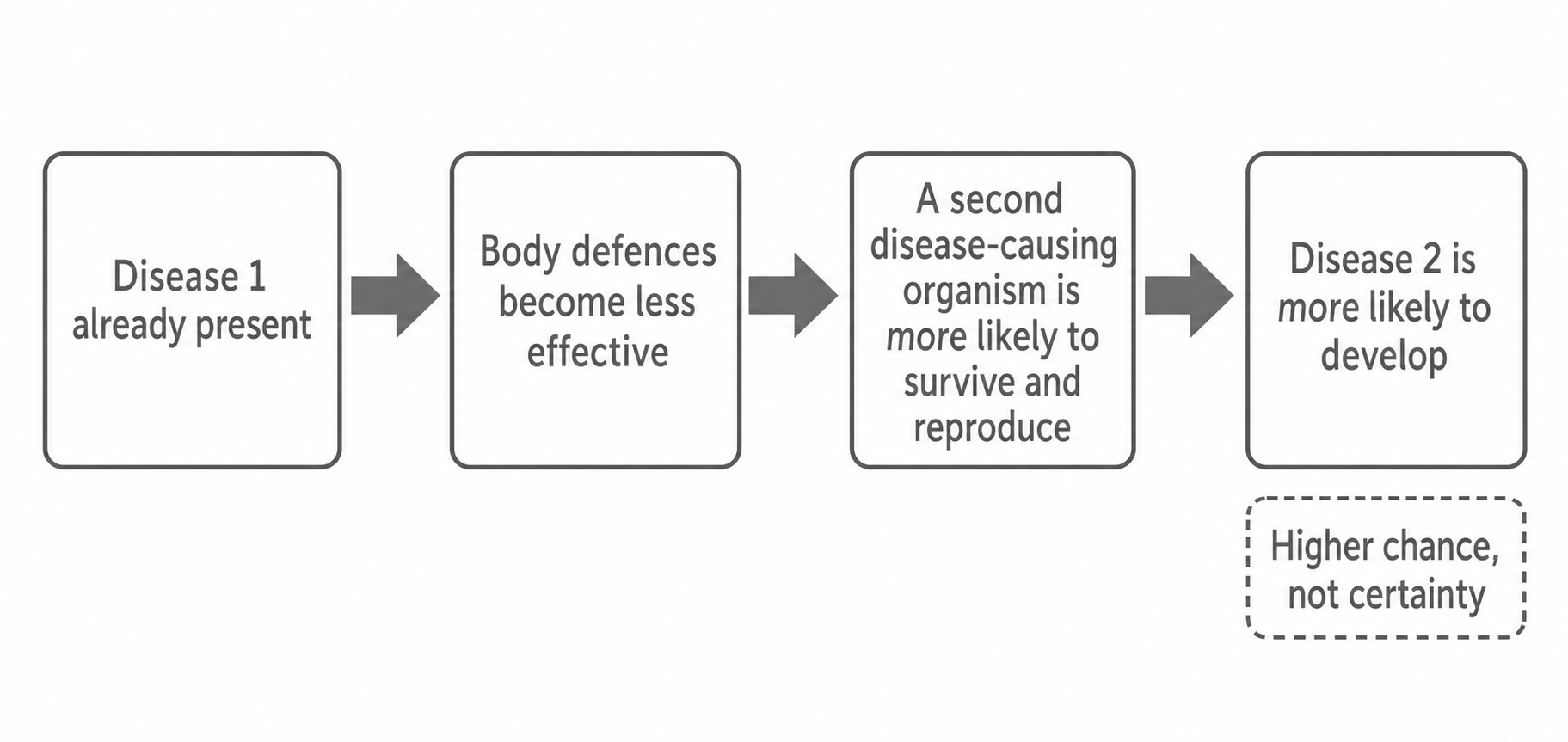
The logic has three linked stages:
- Change: the first disease impairs the body's defences. In some cases, damage to protective tissues can have the same effect.
- Biological consequence: a disease-causing organism linked to a second disease is less likely to be destroyed, so it may survive and reproduce more successfully.
- Outcome: the chance that the second disease develops increases.
This relationship must not be overstated. Not every first disease weakens defences in this way, and people with the same first disease do not all develop a second one. The first disease does not turn into the second disease; it changes the conditions in the body and therefore changes risk.
Health includes physical, mental and social well-being and is more than the absence of disease. Communicable diseases can be transmitted between organisms; non-communicable diseases cannot. One disease can increase susceptibility to another by weakening defences, but an increased chance is not a guarantee.