Biology 4.7 - Classification and the three domains
Similar-looking cells can have very different evolutionary histories. Follow how comparisons of inherited molecular sequences revealed two distinct prokaryotic groups and led to the three-domain classification proposal.
The five-kingdom starting point
Classification is the organisation of living organisms into groups. A useful classification does more than make a tidy list: it brings together organisms that share important features and, as far as the evidence allows, reflects their evolutionary relationships. A classification method is therefore a scientific model. It can change when new evidence reveals that its groups do not represent relationships well.
Before genetic sequences could be compared widely, scientists relied heavily on observable features, cell organisation and ways of obtaining nutrition. One influential method divided cellular life into five kingdoms:
| Kingdom in the five-kingdom method | Broad basis for the group |
|---|---|
| Prokaryotae (Monera) | Organisms with prokaryotic cells, which lack a nucleus |
| Protoctista (Protista) | A broad group of mostly simple eukaryotic organisms |
| Fungi | Eukaryotic organisms including yeasts, moulds and mushrooms |
| Plantae | Eukaryotic plants |
| Animalia | Eukaryotic animals |
The important starting point is the first row. The five-kingdom method placed all organisms with prokaryotic cells together in Prokaryotae/Monera. The other four kingdoms contained organisms with eukaryotic cells, whose genetic material is enclosed in a nucleus.
This was a reasonable model from the evidence then available, but similar-looking cells are not necessarily close relatives. Scientists needed evidence that could compare organisms at the molecular level.
How sequence evidence reveals relationships
DNA carries inherited information. Corresponding sections of DNA can be compared between organisms. When populations separate and evolve along different lineages, mutations can produce sequence differences that are passed on.
Scientists can align the same inherited sequence from several organisms and compare corresponding positions. When the same sequence is being compared, fewer differences usually support a closer evolutionary relationship and a more recent common ancestor. More differences usually support a more distant relationship. This is an inference from evidence: it does not mean that one of the living organisms must be the direct ancestor of another.
Worked sequence comparison
The following short sequences are already aligned. Each column represents the same position in the inherited sequence.
| Organism | Aligned base sequence |
|---|---|
| P | A C G T T A C G A A |
| Q | A C G T T A C A A A |
| R | T T A C C G G T C T |
- Compare P with Q one position at a time. They differ only at position 8, so there is 1 base difference.
- Compare P with R. Every shown position differs, so there are 10 base differences.
- P and Q therefore have the most similar sequence of the three. The data support the inference that P and Q are more closely related to each other than either is to R.
- Sense-check the conclusion: the chosen pair has the fewest differences, so the evidence and inference agree. The ten-base sample is illustrative rather than a complete measure of all genetic relatedness.
Genetic analysis is especially useful for organisms whose cells look broadly alike. Molecular differences can reveal distinct evolutionary groups that visible features had hidden.
Why three domains were proposed
For very distant relationships, scientists compared nucleotide sequences in ribosomal RNA (rRNA), or the DNA sequences of the genes that produce it. Ribosomes occur in all cellular organisms, so corresponding rRNA sequences could be compared across very different groups. The sequence is inherited molecular information produced from rRNA genes, making this an example of genetic analysis.
The comparisons revealed that the old Prokaryotae/Monera kingdom contained two deeply distinct genetic groups. Although both groups have cells without a nucleus, their molecular sequences showed that they should not be treated as one natural group. Scientists proposed separating them as Bacteria and Archaea.
The eukaryotic organisms formed a third broad group, Eukaryota (also called Eukarya or, historically, Eucarya). This group contains the eukaryotic kingdoms from the older method: Protoctista/Protista, Fungi, Plantae and Animalia.
Domain
A domain is a very broad classification group above the level of kingdom. The three-domain proposal names Bacteria, Archaea and Eukaryota.
| Domain | Cell organisation | Connection to the five-kingdom method |
|---|---|---|
| Bacteria | Prokaryotic cells | One major part of the old Prokaryotae/Monera kingdom |
| Archaea | Prokaryotic cells | The other genetically distinct part of the old Prokaryotae/Monera kingdom |
| Eukaryota | Eukaryotic cells | Contains Protoctista/Protista, Fungi, Plantae and Animalia |
[DIAGRAM: asset_name: Biology 4.7 - Classification and the three domains - diagram 01; asset_slug: biology_4_7_classification_and_the_three_domains__diagram_01; recommended_method: image_gen; description: Side-by-side left-to-right update from the five-kingdom method to the three-domain method: left labels Prokaryotae (Monera), Protoctista (Protista), Fungi, Plantae and Animalia; right labels Bacteria, Archaea and Eukaryota (Eukarya). Two clear arrows show Prokaryotae splitting to Bacteria and Archaea, while four clear arrows show the four eukaryotic kingdoms grouping within Eukaryota. Domains must be labelled as broader than kingdoms; omit organisms, viruses, branch lengths and any suggestion that domains are kingdoms.]
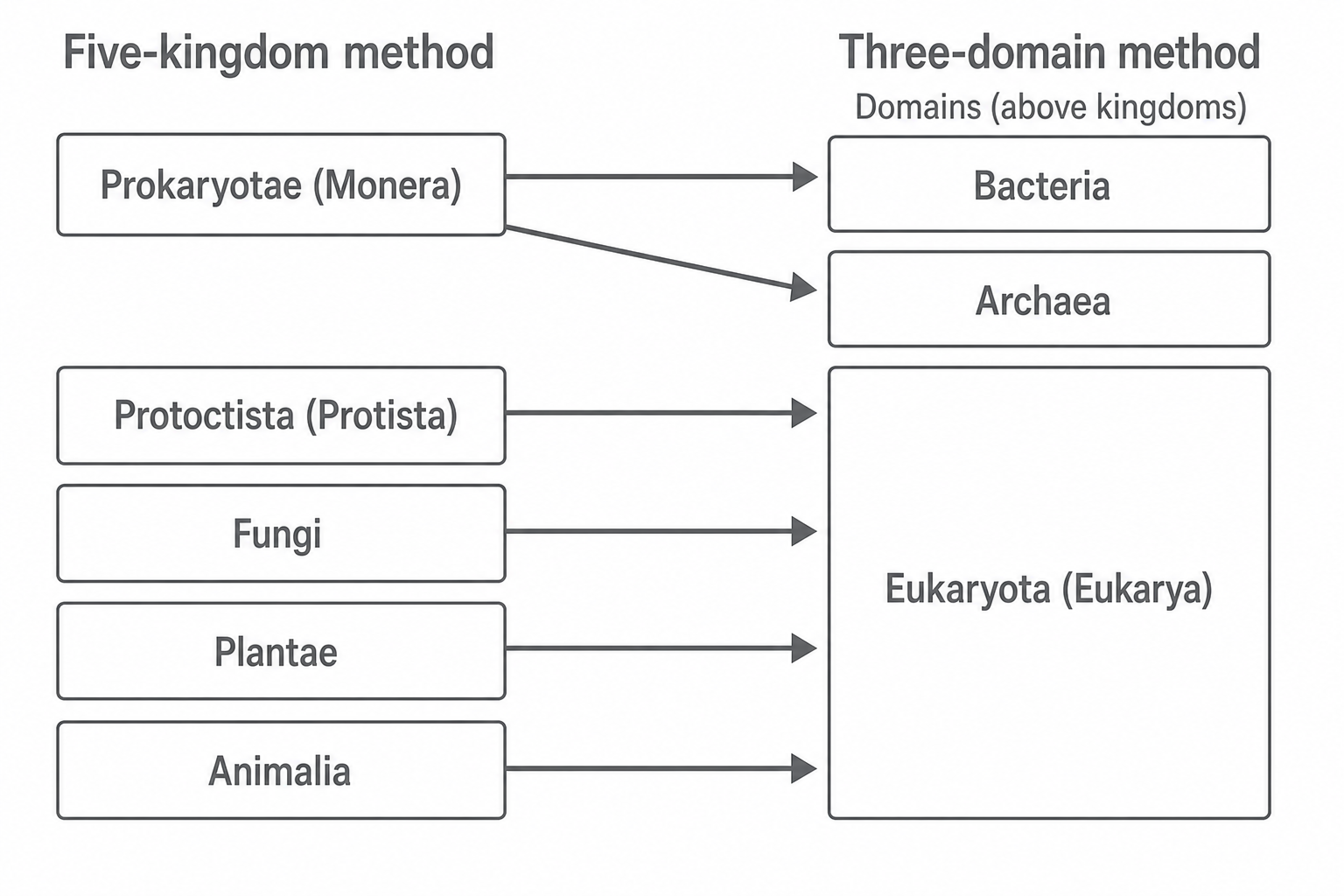
Read the arrows from left to right as a change in classification supported by new evidence. They do not show organisms changing from one kind into another. Most importantly, five kingdoms were not simply renamed as three kingdoms: genetic analysis supported a new, broader domain level and exposed the hidden split within the old prokaryote kingdom.
From evidence to classification
The scientific reasoning can be followed in four linked stages:
- Scientists compared corresponding inherited nucleotide sequences, including rRNA sequences, from many organisms.
- Patterns of similarity and difference provided evidence about evolutionary relationships: more similar sequences generally supported a closer relationship.
- The organisms formerly combined in Prokaryotae/Monera fell into two strongly distinct genetic groups, so the old kingdom did not represent their relationships well.
- Scientists suggested a classification with the domains Bacteria and Archaea for those two groups, alongside Eukaryota for organisms with eukaryotic cells.
Notice the difference between evidence and conclusion. The observation was a pattern of sequence similarities and differences. The inference was that the organisms formed three deep evolutionary groups. The classification decision was to name those groups as domains above kingdoms.
Genetic analysis changed classification because it revealed evolutionary relationships that cell appearance alone had hidden. It split the old Prokaryotae/Monera group into Bacteria and Archaea and placed all eukaryotic groups within Eukaryota.