Biology 7.1 - Endocrine glands
Locate the six endocrine glands and follow a hormone from its production into the blood. Explain why the same circulating hormone changes some cells while others do not respond.
Hormone messages
Cells in one part of the body sometimes need to change the activity of cells somewhere else. The endocrine system coordinates some of these changes using chemical messages called hormones.
Hormone
A hormone is a chemical messenger produced by an endocrine gland and carried in the blood to cells on which it has an effect.
An endocrine gland contains cells that make hormones and release them directly into the blood. The blood circulation then transports the hormone molecules around the body. The route is:
endocrine gland → hormone enters blood → circulation → target organ → response
A hormone does not steer itself towards just one organ. It can be carried past many tissues, but only particular cells respond. These target cells have receptors with a suitable shape to bind that hormone. A target organ is an organ containing target cells for the hormone.
This gives target specificity: transport is widespread through the blood, while the response is restricted to cells with the relevant receptor. A cell without that receptor does not produce the hormone's specific response.
Endocrine glands produce hormones, the bloodstream transports them, and receptor-bearing target cells respond.
Endocrine gland locations
The endocrine glands in this lesson are spread from the brain to the pelvis. Their positions matter because an exam question may identify a gland by location rather than by name.
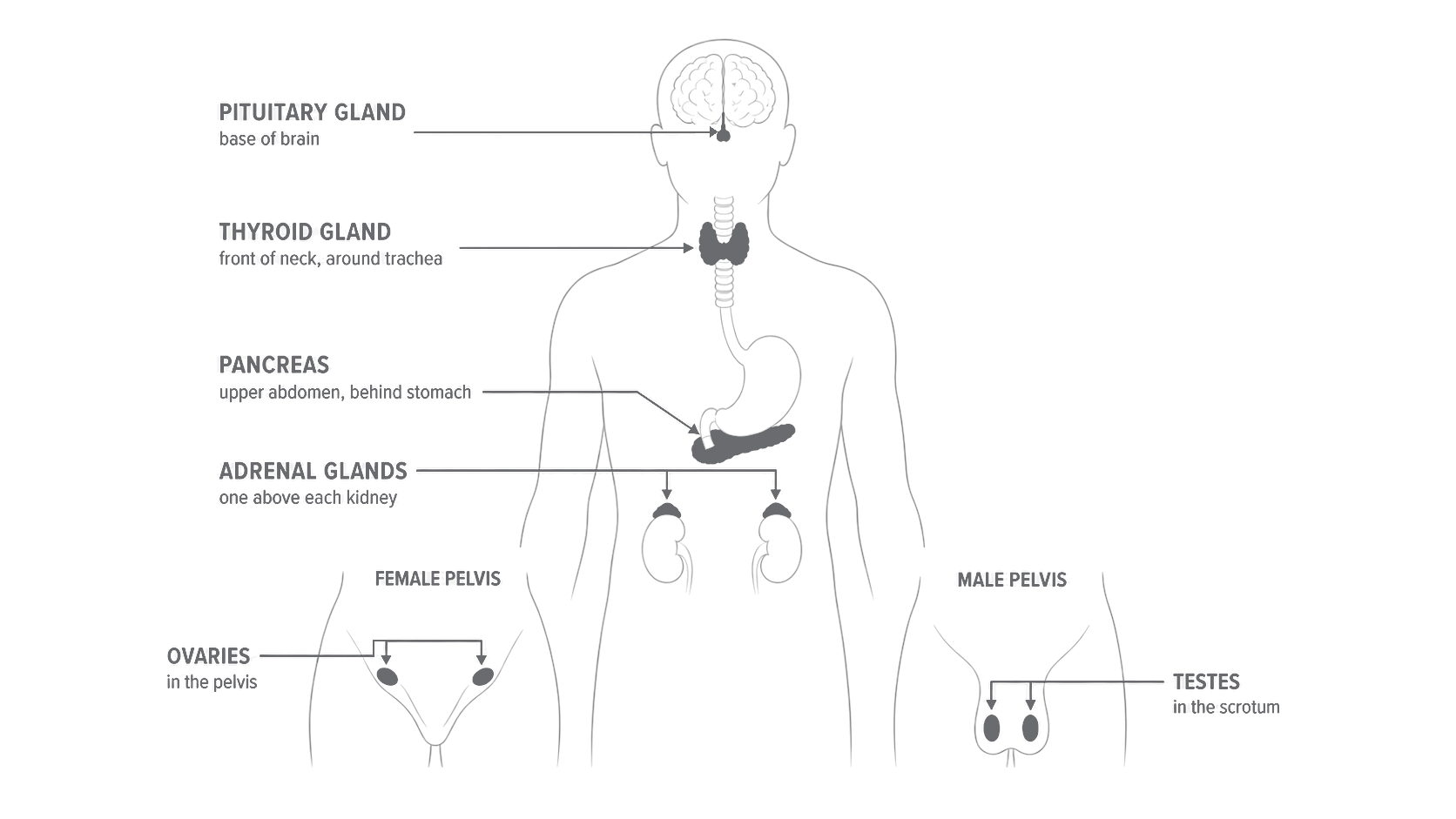
The six endocrine glands and their locations. Schematic, not to scale.
| Endocrine gland | Location cue |
|---|---|
| Pituitary gland | At the base of the brain |
| Thyroid gland | At the front of the neck |
| Pancreas | In the upper abdomen, close to the stomach and small intestine |
| Adrenal glands | A pair of glands, one above each kidney |
| Ovaries | A pair in the pelvis, one on each side of the uterus |
| Testes | A pair in the scrotum |
The ovaries and testes are shown as separate pelvic alternatives. The pancreas has more than one role in the body, but it is included here because some of its cells act as an endocrine gland and release hormones into the blood.