Biology 4.11 - The genetic engineering toolkit
Higher tier: follow how a desired gene is cut out, matched to a plasmid and joined into a DNA vector. Distinguish the roles of restriction enzymes, sticky ends, DNA ligase and the vector that carries the gene into a host cell.
The genetic engineering toolkit
Higher tier only
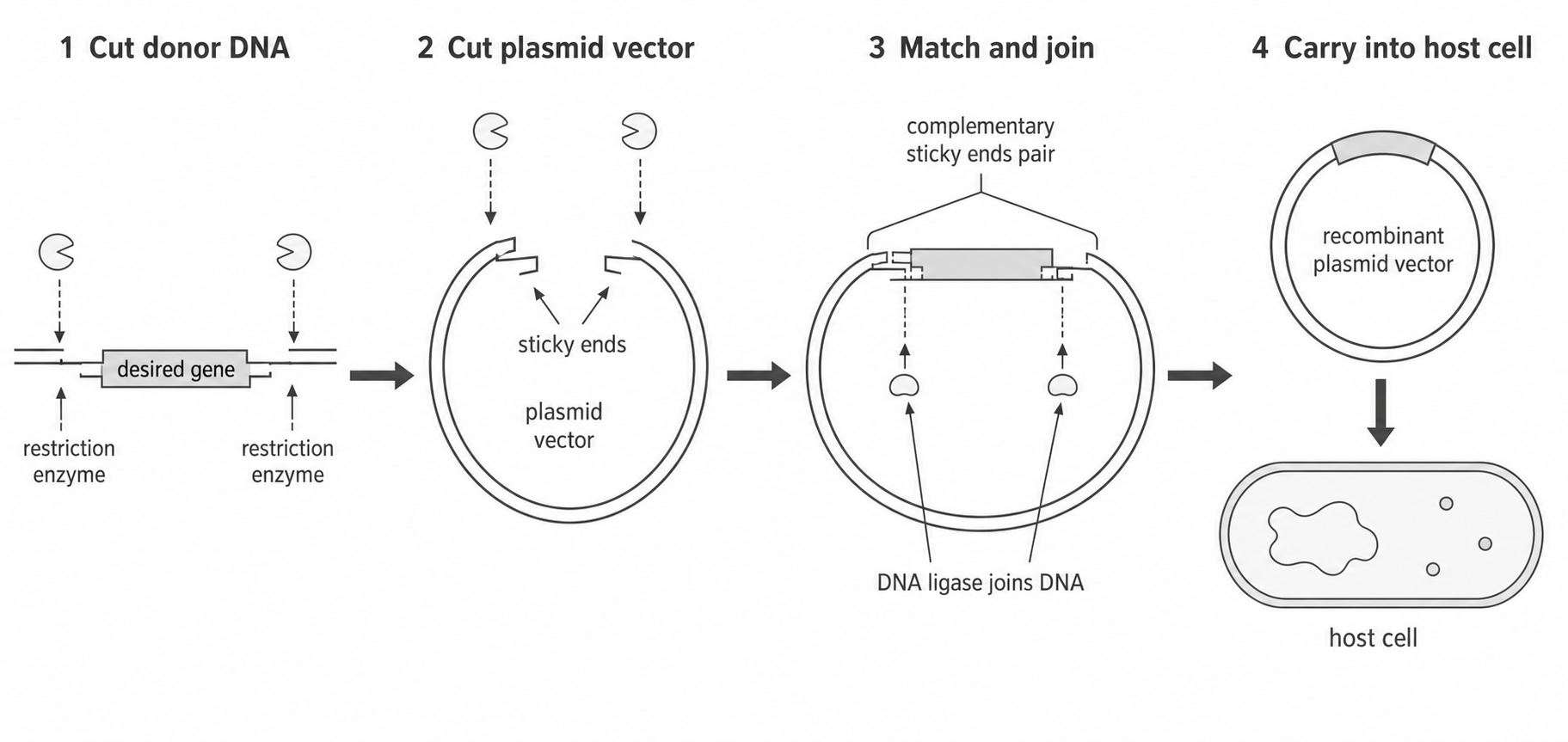
One way to insert a desired gene into a host uses a vector. A vector is a DNA carrier; a small circular bacterial DNA molecule called a plasmid is one example.
The main stages are:
- A suitable restriction enzyme recognises a specific DNA sequence and cuts the donor DNA on both sides of the desired gene.
- The same suitable restriction enzyme cuts open the plasmid vector. In this example it makes staggered cuts, leaving short single-stranded overhangs called sticky ends. Not every restriction enzyme makes sticky ends.
- The desired-gene fragment and plasmid have complementary sticky ends, so their exposed bases pair. This holds the pieces in the correct relative position, but it does not permanently seal them.
- DNA ligase joins the DNA backbones at both junctions. The result is a recombinant plasmid containing DNA from more than one source.
- The recombinant plasmid acts as the vector that carries the desired gene into a host cell. The new DNA can then be copied and, when expressed, can give the desired characteristic.
[DIAGRAM: asset_name: Biology 4.8, 4.10-4.11, 4.14 - Selective breeding and genetic engineering - diagram 01; asset_slug: biology_4_8_4_10_4_11_4_14_selective_breeding_and_genetic_engineering__diagram_01; recommended_method: image_gen; description: Four-stage monochrome Higher-tier process: donor DNA with the desired gene is cut by a suitable restriction enzyme to leave sticky ends; the same suitable restriction enzyme cuts a plasmid vector to create complementary sticky ends; the ends pair and DNA ligase seals both junctions; the closed recombinant plasmid vector moves into a bacterial host cell. Arrows run left to right and then into the host cell. Exclude promoters, antibiotic-resistance markers, tissue culture, gene guns and separate-science cloning detail.]
| Component | Its role | A wrong role to avoid |
|---|---|---|
| Restriction enzyme | Cuts DNA at a specific recognition sequence; a suitable one can make sticky ends | It does not join DNA or carry the gene. |
| Sticky ends | Complementary single-stranded overhangs pair and align DNA fragments | They are not enzymes and do not permanently seal DNA. |
| DNA ligase | Joins the DNA backbones to make a continuous recombinant DNA molecule | It does not make the initial cuts. |
| Vector | Carries the desired DNA into a host cell; a plasmid is one example | It is not the desired gene itself. |