Biology 3.3 - Meiosis and gametes
Meiosis halves the chromosome number and produces genetically different haploid cells. Follow a chromosome-count example and explain how this preserves the chromosome number when gametes fuse.
Meiosis and haploid gametes
Chromosomes are packages of DNA. A cell with two sets of chromosomes is diploid; a cell with one set is haploid. Gametes, such as sperm and egg cells, must be haploid because two gametes join at fertilisation. Their two single sets then make the two sets of the new diploid cell.
Meiosis is the type of cell division that produces gametes. One diploid starting cell produces four daughter cells. Each daughter cell has half the chromosome number of the starting cell, so each is haploid. The four cells carry different combinations of the original genetic material, so they are genetically different, not identical copies.
This halving has an essential role. If gametes kept the full diploid number, fertilisation would double the chromosome number in every generation. Meiosis halves the number first; fertilisation then restores the diploid number.
Worked chromosome-count example
A diploid gamete-producing cell has 18 chromosomes. How many chromosomes will each daughter cell have after meiosis?
- The quantity being changed is the chromosome number in each cell.
- A meiotic daughter cell has half the starting number: .
- The outcome is four haploid daughter cells, each with 9 chromosomes.
- Sense-check: 9 is half of 18. Do not calculate ; four cells are produced, but each cell receives half the starting chromosome number.
The named stages of meiosis are not required here. The important model is its role and outcome: one diploid cell gives four genetically different haploid gametes.
[DIAGRAM: asset_name: Meiosis outcome; asset_slug: bio_c_meiosis_outcome_v2; recommended_method: image_gen; description: Human chromosome-count model with one diploid starting cell labelled 46 chromosomes and four separate haploid daughter cells each labelled 23 chromosomes. The label states that they are genetically different. Arrows indicate the overall outcome, not named stages.]
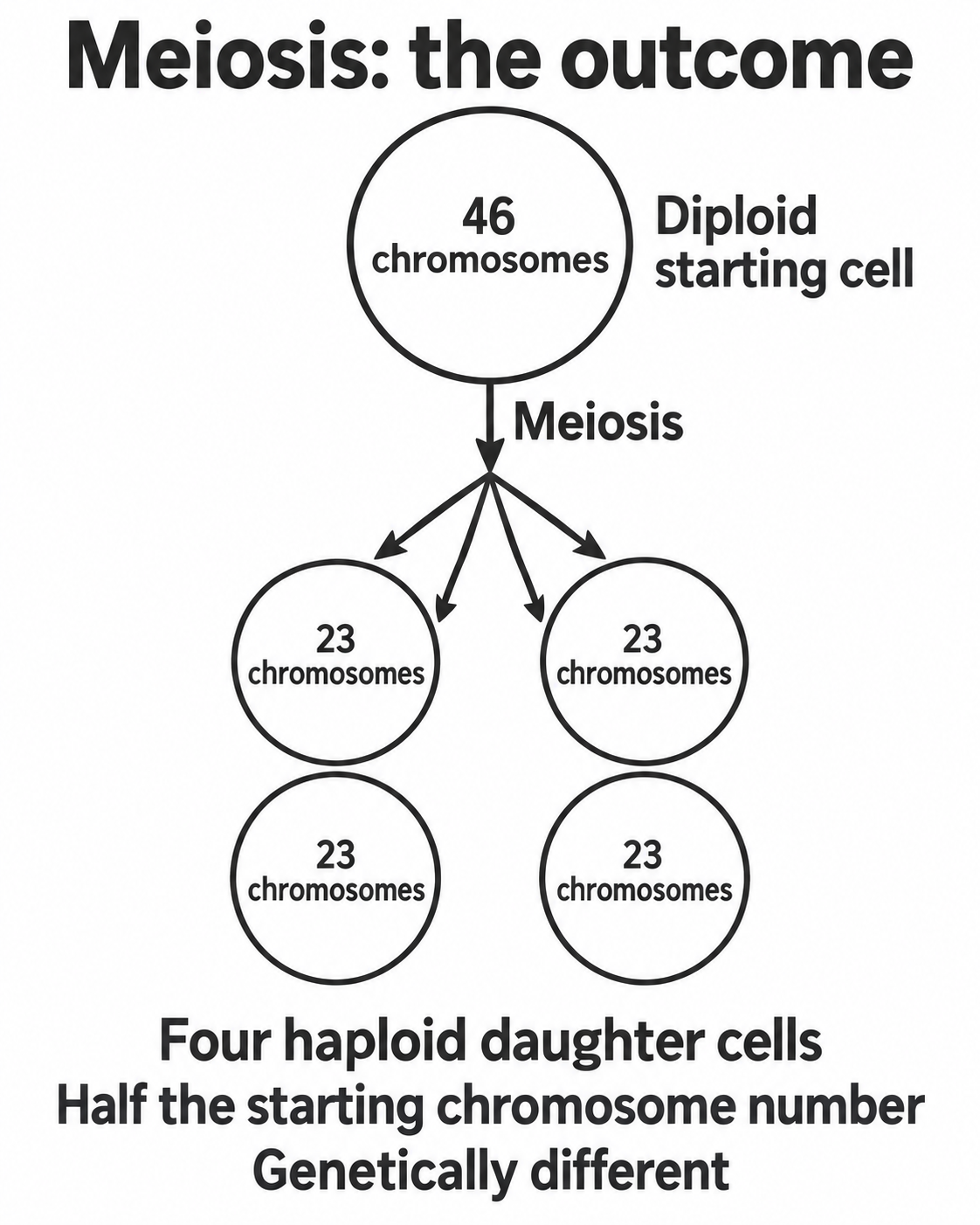
This is a chromosome-count model for a human cell. The cells have the same chromosome number, but carry different genetic information; the diagram does not draw that molecular variation.