Biology 2.8 - 2.9 - Stem cells in medicine
Explain how stem cells supply specialised cells in embryos, adult tissues and plants, then weigh the possible medical benefits against biological risks, evidence limits and ethical objections.
What makes a stem cell?
A skin cell and a stem cell contain the same basic cell structures, but they do not have
the same role. A skin cell is already specialised for a particular job. A stem cell is
unspecialised and has two linked abilities:
- it can divide by mitosis to make more cells, including cells that remain stem cells;
- its daughter cells can differentiate, developing structures and functions for a
particular job.
Stem cell
An unspecialised cell that can self-renew by cell division and can differentiate into one
or more specialised cell types.
These two abilities solve a biological supply problem. Self-renewal prevents the source
of new cells from being used up, while differentiation produces working cells for growth,
maintenance or repair. Signals around a daughter cell influence which type it becomes.
Once specialised, the cell is suited to its new function.
Being able to divide is not enough on its own: many ordinary body cells can divide, but
that does not make them stem cells. It is also wrong to say that every stem cell can make
every cell type. The range depends on where the stem cell comes from.
Three sources, three functions
Embryonic stem cells
Embryonic stem cells occur in a very early embryo. For laboratory work, they can be isolated from it. They can self-renew and can
differentiate into almost any specialised body-cell type. Their function during
development is to supply the many specialised cells from which tissues and organs form.
This wide range also makes them scientifically valuable, but obtaining a new embryonic
stem-cell line involves destroying the early embryo.
Stem cells in animals
After embryonic development, stem cells remain in some animal tissues. These adult
stem cells maintain and repair the tissue, but they usually produce a more limited range
of cell types. For example, blood-forming stem cells in bone marrow produce red blood
cells and several kinds of white blood cell, and lead to the production of platelets. Their
continued division replaces blood cells that are worn out or lost.
Meristems in plants
A meristem is a region of unspecialised, dividing cells, not one specialised cell.
Meristems at root and shoot tips continually produce new cells. Some daughter cells remain
in the meristem; others elongate and differentiate into specialised plant cells, allowing
roots and shoots to keep growing and form new tissues.
[DIAGRAM: asset_name: Biology 2.8-2.9 - Stem cells in medicine - diagram 01; asset_slug: biology_2_8_2_9_stem_cells_in_medicine__diagram_01; recommended_method: image_gen; description: Three parallel top-to-bottom monochrome pathways on white: embryonic stem cells to many specialised animal cells; adult animal bone-marrow stem cells to a limited range of blood cells; plant meristems at root and shoot tips to new specialised plant cells and continued growth. Every arrow points from stem-cell source toward its products; use only the exact labels 'Embryonic stem cells', 'Adult animal stem cells', 'Plant meristems', 'many body cell types', 'limited range of cell types', and 'new plant cells and growth'; no medical claim, colour coding, embryo anatomy, organs or unrelated plant structures.]
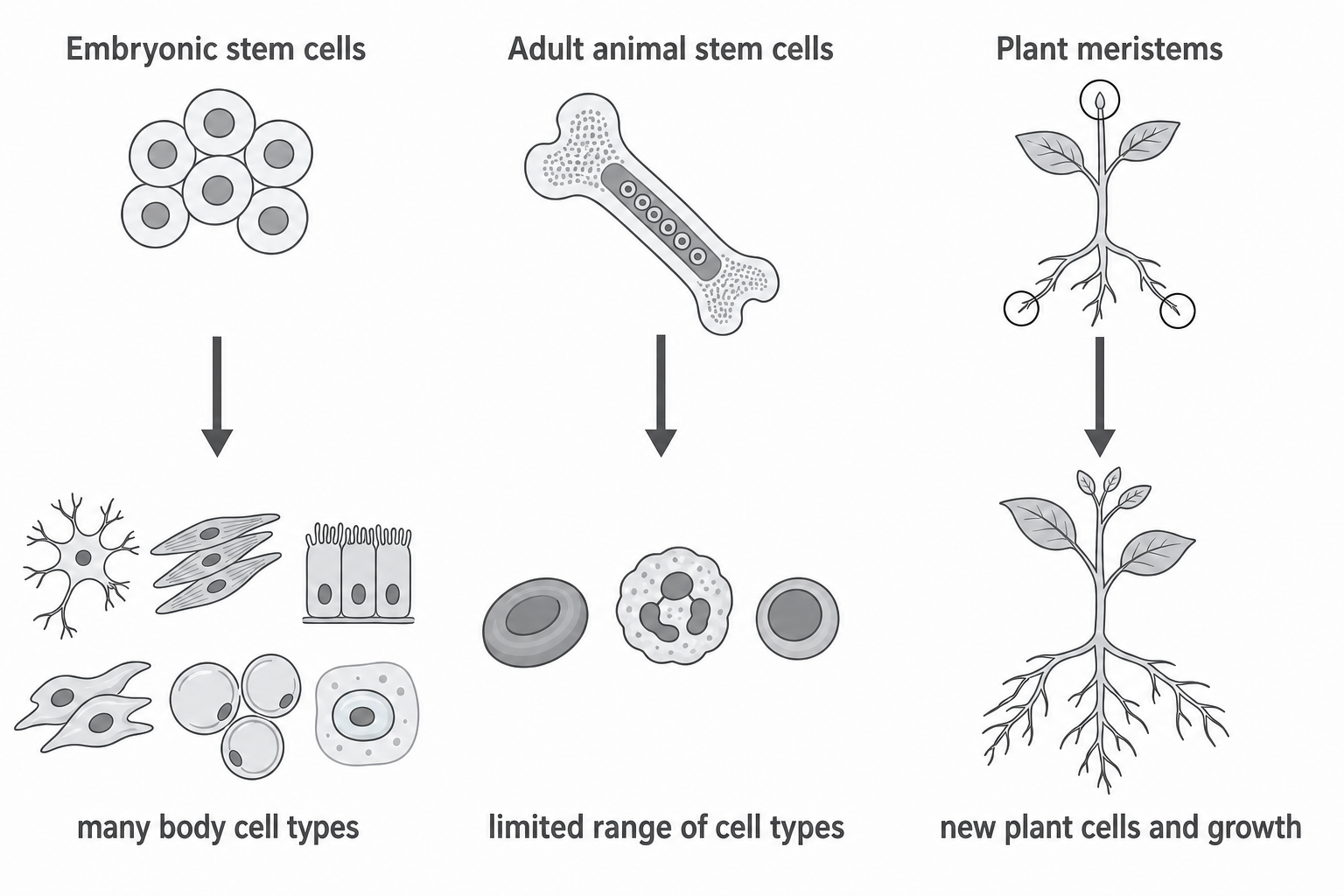
The visual comparison is about range and function, not size. Embryonic stem cells have
the broadest developmental range; adult animal stem cells maintain particular tissues;
plant meristems keep supplying cells for plant growth.
From stem cell to treatment
The medical idea is cell replacement. If disease or injury has removed a specialised
cell type, stem cells may provide a renewable source of new cells. The intended causal
chain is:
stem cells collected → cells multiply → differentiation is directed → required specialised cells are selected → cells are transplanted → damaged cells are replaced → some function may return
Each arrow matters. Multiplication supplies enough cells, controlled differentiation
produces the correct type, and transplantation puts those cells where they may contribute
to the tissue. The outcome is described as potential because transplanted cells must
survive, stay controlled and work with the patient's existing tissue.
An established use: blood-forming stem cells
Stem-cell or bone-marrow transplants are used for some blood cancers and blood disorders.
Unhealthy blood-forming cells may first be destroyed by treatment. Healthy stem cells from
the patient or a suitable donor are then introduced into the blood, move to bone marrow,
and produce new healthy blood cells. This is an existing treatment. NHS: stem-cell and bone-marrow transplants.
Potential replacement tissues
Scientists can investigate directing stem cells to form specialised cells such as nerve
cells or insulin-producing pancreatic cells. In principle, these could replace lost or
damaged cells and help restore nerve signalling or blood glucose control. These uses must
not be described as guaranteed cures: making the right-looking cell is not enough unless
it survives, connects and functions safely in the body.
The benefit does not come from a cell simply being called a stem cell. It comes from
producing the right specialised cells, in sufficient numbers, and having them work safely
in the damaged tissue.
Benefits and biological risks
A useful discussion connects every claim to a mechanism. "Stem cells are promising" is
not yet a benefit, and "stem cells are dangerous" is not yet a risk.
| Potential outcome | Biological reasoning |
|---|---|
| Replace cells lost through disease or injury | Stem cells can multiply and differentiate into a required specialised cell type. |
| Restore some tissue function | Correctly specialised transplanted cells may take over work that damaged cells can no longer perform. |
| Supply many replacement cells | Self-renewal allows a large number of cells to be produced from a smaller starting population. |
| Reduce rejection when a patient's own suitable cells are used | The cells carry the patient's own surface markers, so the immune system is less likely to identify them as foreign. |
Potential benefit must be weighed against biological risk:
- Tumour formation: if transplanted stem cells or unspecialised cells continue dividing
when they should stop, uncontrolled cell division can produce a tumour. - Immune rejection: donor cells have surface markers that may be recognised as
foreign. The immune system may attack and destroy them, so the treatment fails and may
damage tissue. Tissue matching and immune-suppressing medicines can reduce this risk. - Infection: cells can be contaminated while being collected, grown or transplanted.
In addition, suppressing the immune system to limit rejection makes it harder for the
body to fight pathogens. - Wrong behaviour or no benefit: cells may differentiate into the wrong type, move,
fail to connect to surrounding tissue or die. A treatment can therefore fail even if no
tumour or rejection occurs.
The risks are not identical for every treatment. Using a patient's own cells may reduce
immune rejection, but it does not automatically remove the need to control division,
differentiation, sterility and long-term safety.
Worked evaluation: benefit is not the whole result
In an illustrative trial of 50 people, 23 improved and 8 had a serious adverse effect. Some people may be in both groups. As a quick estimate, is close to , so roughly half improved. The exact improvement percentage is . State which is an estimate and which uses the exact counts.
A conclusion must weigh the size and seriousness of the benefit against the adverse effects. Do not subtract the two counts to invent a number of people who benefited safely: overlap is unknown. Ask whether the groups were comparable, whether the sample was large enough, and whether follow-up was long enough to reveal delayed risks. A small early study can support further investigation without proving a safe cure.
Making a balanced decision
Biological risks concern what may physically happen to a patient. Ethical objections
concern what people judge to be right or acceptable. They should not be blurred together.
Obtaining a new embryonic stem-cell line destroys the early embryo. Some people regard
that embryo as potential human life and believe it should not be used in this way. Others
give greater weight to the possibility of reducing suffering, especially when embryos no
longer needed for fertility treatment are donated with informed consent. Adult animal stem
cells do not require an embryo, but their more limited range means they cannot simply
replace embryonic stem cells in every proposed use.
Safeguards matter. In the UK, human embryo research needs a licence and the donors
must consent. HFEA: research licensing. Regulation can reduce risks such as use without consent or poorly
controlled research, but it cannot decide how much moral status every person should give
an early embryo.
To discuss a use of stem cells:
- give a relevant potential benefit and explain who or what may benefit;
- give a relevant biological risk or ethical objection and explain why it matters;
- judge the strength of the evidence and whether safeguards reduce the concern;
- reach a conclusion that follows from the reasons, while recognising uncertainty.
Two reasoned positions
Support with conditions: research could reduce serious suffering by producing replacement cells. Donated embryos no longer needed for fertility treatment may otherwise be discarded. A supporter may judge that consent, independent scrutiny and use only where a suitable alternative is unavailable make this use acceptable, while still requiring evidence of safety.
Oppose the use of embryos: someone who gives the embryo a strong moral status may judge its destruction unacceptable even when donors consent and a treatment might help patients. They could support adult-stem-cell research instead while acknowledging that its cell range is more limited. This is a values-based objection; it does not require denying the possible medical benefits.
A scientifically valid conclusion can support or oppose a proposal. Its quality depends on
the reasoning, not on choosing a predetermined side.
Stem-cell medicine is a controlled biological proposal, not a promise: source determines
what cells can be made, and a sound decision weighs possible repair against tumour,
rejection, infection, failure and ethical concerns.