4.5.2 - Taxation
Taxation is the compulsory transfer of income from households and firms to the government. It finances public expenditure, can be used to correct market failure, and helps shape the distribution of income. In UK policy debates, governments usually want a tax system that raises enough revenue while keeping the burden reasonably low, protecting incentives, using taxes seen as equitable, and sometimes shifting more of the burden from income towards spending.
How Tax Systems Are Classified
Economists often classify taxes by asking what happens to the proportion of income paid as income rises. This matters because two taxes can raise similar revenue but have very different effects on fairness and behaviour.
Definition: Progressive taxation
A tax system in which the proportion of income paid in tax rises as income rises.
A progressive tax does more than make higher earners pay more in cash terms. It makes them pay a larger share of their income. UK income tax is the clearest example because higher slices of taxable income are charged at higher marginal rates. In 2025/26, in England, Wales and Northern Ireland, the first £12,570 is tax-free (the personal allowance), income up to £50,270 is taxed at 20%, income above that at 40%, and income above £125,140 at 45%. Someone earning £20,000 pays £1,486, about 7% of their income; someone earning £60,000 pays £11,432, about 19%. Many other direct taxes also lean this way: capital gains tax tends to fall mainly on wealthier households, and inheritance tax is strongly progressive because larger estates bear more of the burden.
Definition: Proportional taxation
A tax system in which all taxpayers pay the same proportion of income in tax as income rises.
A proportional tax, sometimes called a flat tax, takes the same percentage from low and high earners. The richer person still pays more money overall, but not a higher share of income. The UK does not use a pure flat income tax, although National Insurance contributions can look roughly proportional within some earnings ranges. In 2025/26, employees pay a flat 8% on earnings between £12,570 and £50,270 a year, but only 2% on earnings above that, so above that level the share of income paid falls as income rises.
Regressive Taxes and Incentives
Definition: Regressive taxation
A tax system in which the proportion of income paid in tax falls as income rises.
Regressive taxes usually hit lower-income households harder relative to their income. VAT is the standard example. A richer household may pay more VAT in pounds because it spends more overall, but a poorer household often pays a larger percentage of its income in VAT because it spends a greater share of what it earns. For example, a household on £20,000 that pays £1,600 a year in VAT gives up 8% of its income, while a household on £100,000 that pays £5,000 pays more in pounds but only 5% of its income. The same logic helps explain why excise duties on fuel, alcohol, and tobacco are usually regressive, and why council tax is often described as regressive relative to income: households in similar property bands pay similar bills even if their incomes are very different.
| Tax type | As income rises | Typical examples |
|---|---|---|
| Progressive | Share of income paid rises | Income tax, inheritance tax, many other direct taxes |
| Proportional | Share of income paid stays the same | Flat taxes, some National Insurance bands |
| Regressive | Share of income paid falls | VAT, excise duties, council tax |
In practice, governments use a mixture. The UK combines progressive direct taxes with indirect taxes on spending. That balance matters because taxing spending often weakens equality more than taxing income, but it may damage work incentives less directly.
That link to incentives is one reason tax policy is controversial. Higher marginal income tax reduces the reward from an extra hour of work, overtime, or promotion, so free-market economists argue that high tax rates can discourage labour supply. High income tax may also encourage skilled workers to move abroad, creating a brain drain, and when higher earnings are combined with benefit withdrawal the result can be a poverty trap, where taking work or increasing hours barely raises net income.
The effect is not automatic, though. Evidence on labour supply is mixed. Some workers respond strongly to incentives, but others have limited choice over hours or still need to work to maintain living standards. That is why economists distinguish between the substitution effect, which makes leisure relatively more attractive when post-tax pay falls, and the income effect, which may push people to work more to protect their take-home income. High-tax Nordic economies have long combined relatively high taxes with high employment and strong living standards, so tax alone does not determine labour supply or growth. Even so, changes in income tax usually matter more for work incentives than changes in VAT, because income tax changes the return to work directly. That is also why a government may prefer shifting some taxation from direct taxes towards indirect taxes rather than simply raising all taxes across the board.
Tax Rates and Tax Revenue
Higher tax rates do not always mean higher tax revenue. That is the intuition behind the Laffer curve.
Definition: Laffer curve
A curve showing the relationship between the tax rate and the amount of tax revenue collected.
At a 0% tax rate, the government collects no revenue. At a theoretical 100% tax rate, revenue also falls to zero because people would have no incentive to earn declared income if the government took all of it. Between those two extremes, tax revenue first rises and then, after some point, starts to fall. The peak of the curve is the revenue-maximising rate.
[DIAGRAM: asset_name: 4.5.2 - Taxation - diagram 1; asset_slug: 4.5.2 - 1; recommended_method: retained_png; description: Retained source diagram supporting 4.5.2 - Taxation; the packaged PNG preserves the original educational visual.]
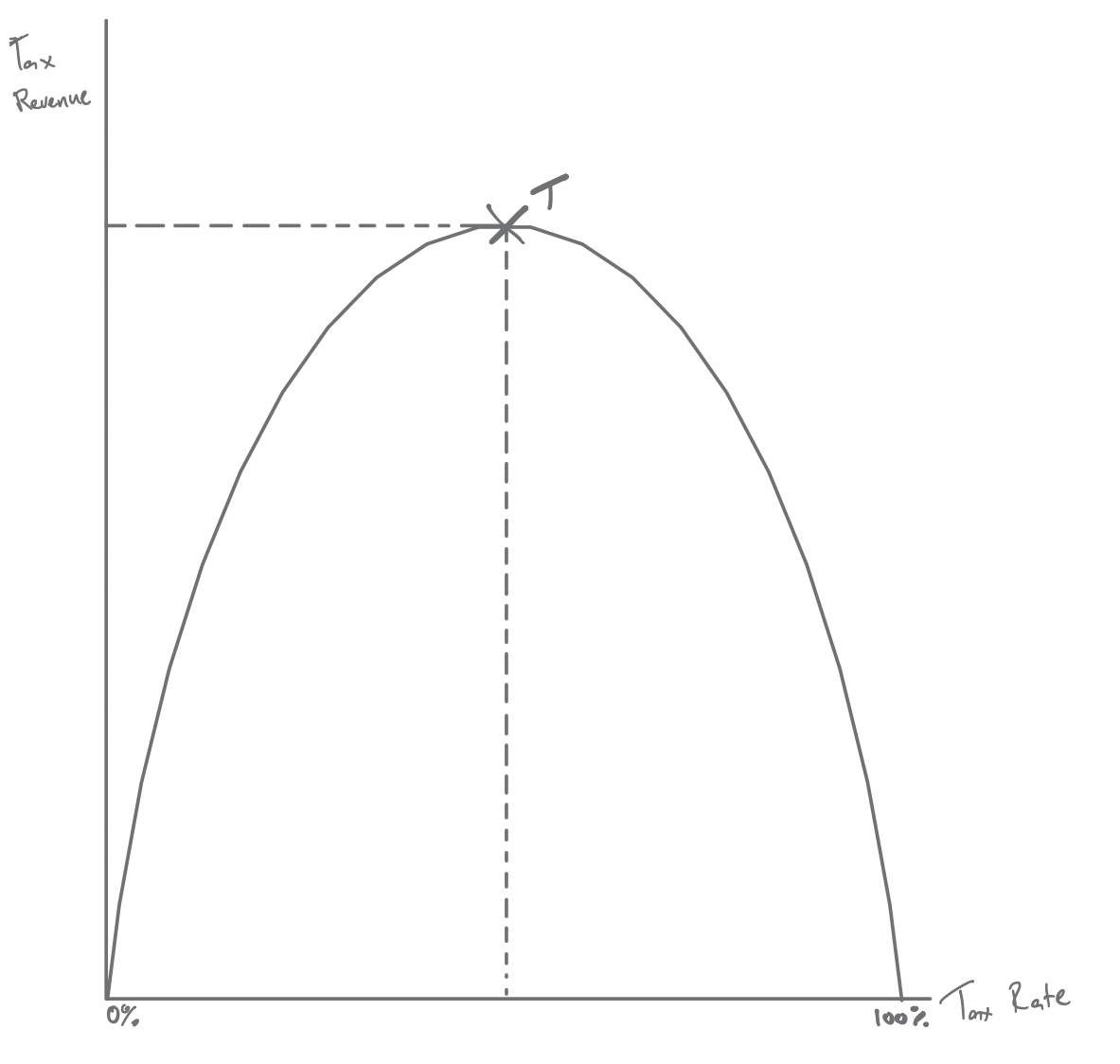
If the economy is on the left of the peak, a tax rise should increase revenue. Point T is the revenue-maximising tax rate on the curve, so if the economy is already to the right of T, a further rise may reduce revenue because the tax base shrinks. That can happen if people work less, invest less, shift income abroad, or use more tax avoidance. Tax avoidance is legal behaviour that reduces tax liability within the rules, while tax evasion is illegal non-payment. Both matter because they reduce the revenue actually collected.
This is a useful warning against assuming that every tax rise pays for itself, but it is not proof that every tax cut will raise revenue. The key issue is where the economy currently sits on the curve, and that is very hard to measure in practice. The position may vary by tax type and by country. Indirect tax revenue can be especially uncertain because it depends on how consumer spending patterns change, not just on the announced tax rate.
Continue this lesson.
You’re previewing NovaLearn without an account. Create a free account to read the rest.
Create free account