2.3.2 - Short-run AS
Short-run aggregate supply (SRAS) is about how much real output firms are willing to produce at different price levels in the short run. For this specification point, the key idea is that the position of the SRAS curve is mainly determined by costs of production. This lesson focuses on the three influences named in the specification: changes in the costs of raw materials and energy, changes in exchange rates, and changes in tax rates.
Costs Drive SRAS
SRAS slopes upward because, as firms expand output, marginal costs tend to rise, so firms need a higher price level to make extra production worthwhile. So a change in the price level causes a movement along the existing SRAS curve. But the bigger exam issue here is what happens when firms' costs change for reasons other than current output: that shifts the whole curve.
If production becomes more expensive across the economy, firms are willing to supply less at every price level, so SRAS shifts left. If production becomes cheaper, firms can supply more at every price level, so SRAS shifts right.
[DIAGRAM: asset_name: 2.3.2 - Short-run AS - diagram 1; asset_slug: 2.3.2 - 1; recommended_method: retained_png; description: Retained source diagram supporting 2.3.2 - Short-run AS; the packaged PNG preserves the original educational visual.]
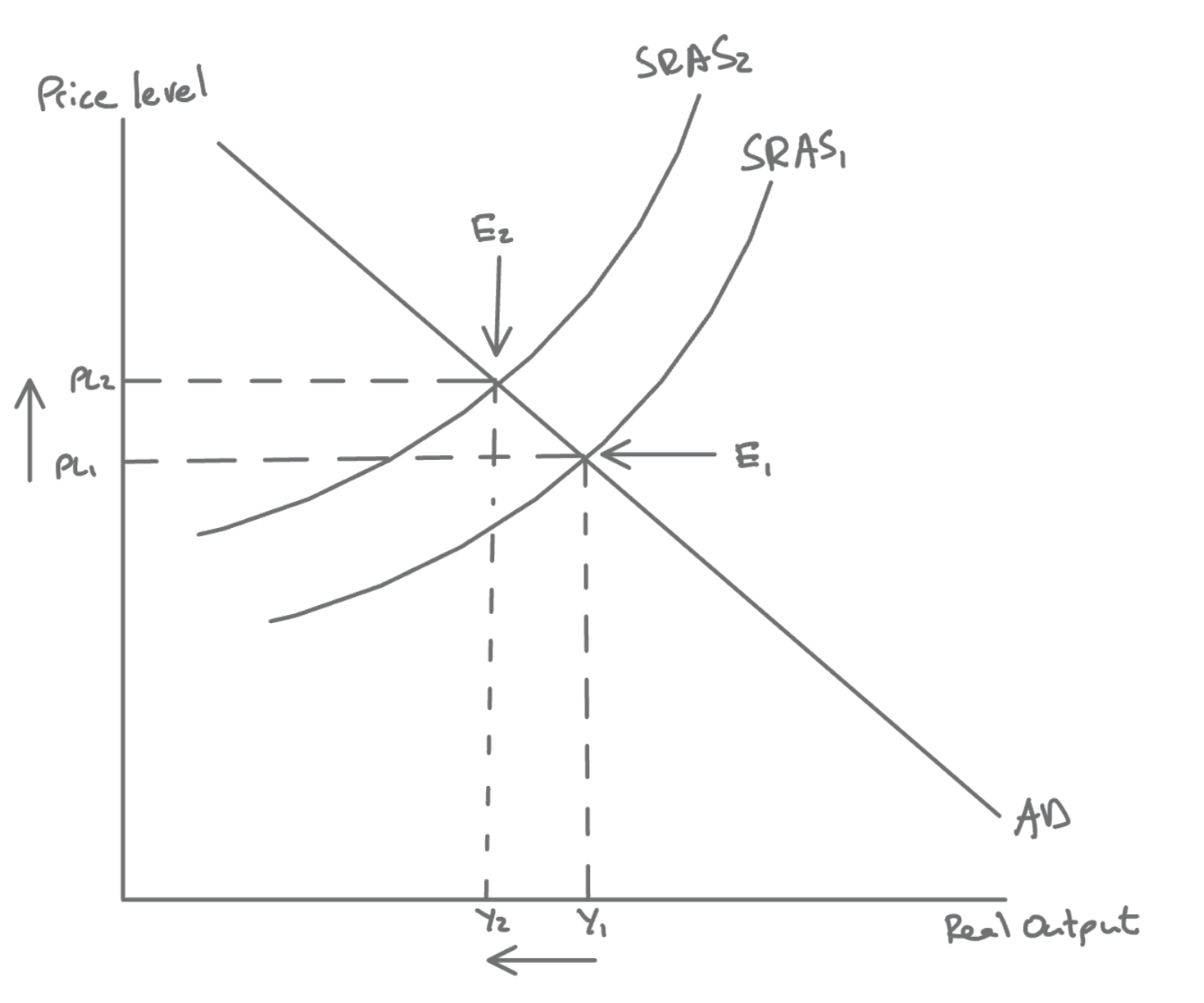
Read the shift from SRAS1 to SRAS2 in two linked ways. At the original price level PL1, firms now supply less real output than before. Equally, to produce the old output Y1, firms would now need a higher price level than before to cover those higher costs. Both readings capture the same mechanism. With aggregate demand unchanged, the economy moves from E1 to E2: the price level rises from PL1 to PL2 and real output falls from Y1 to Y2.
Raw Materials and Energy
Raw materials and energy are essential inputs for huge parts of the economy, so changes in their prices can shift SRAS significantly. Oil is especially important because it affects direct fuel costs for transport, energy bills for heating and machinery, and the price of petrochemical inputs such as plastics. The same logic applies to other commodities: higher steel prices raise costs for construction and manufacturing, higher agricultural prices raise costs for food producers, and higher copper prices raise costs for electronics firms.
When these input prices rise, firms face higher costs at every level of output. Production is less profitable at each price level, so firms supply less and SRAS shifts left. If input prices fall, the reverse happens and SRAS shifts right because production becomes cheaper.
Economists often call a sudden large change in production costs a supply-side shock, or supply shock. These shocks are often linked to geopolitical disruption to commodity supplies, natural disasters that reduce production, or sudden changes in global demand for key resources. When the shock pushes costs up, it can create cost-push inflation: prices rise not because aggregate demand is booming, but because supplying output has become more expensive.
The 1970s oil crises and the UK's 2022 energy shock are strong examples. In 1973-74 the price of crude oil roughly quadrupled, and in 2022 UK CPI inflation peaked at 11.1% in October. In both cases, sharply higher energy prices raised costs for factories, transport firms, retailers, and service businesses, so the effect was economy-wide rather than confined to one industry.
Exam tip
If inflation rises after an energy shock, the clean chain is: higher production costs -> SRAS shifts left -> upward pressure on the price level.
Evaluation
The size of the SRAS shift depends on how large, widespread and persistent the cost change is. A temporary rise, costs that firms have hedged with fixed-price contracts or can absorb in their profit margins, or a shock confined to one sector will shift SRAS less than a lasting rise in costs across many industries.
Exchange Rates and Import Costs
The exchange rate is the price of one currency in terms of another, and it matters because the UK imports large quantities of raw materials, fuel, components, and finished goods. If the pound depreciates, those imports become more expensive in sterling terms, so production costs rise for UK firms.
Continue this lesson.
You’re previewing NovaLearn without an account. Create a free account to read the rest.
Create free account