3.3.4 - Normal profits, supernormal profits and losses
In economics, profit is more than sales minus wages and rent. Economists also count the opportunity cost of the owner's time and capital, which is why a business can appear profitable in accounting terms but still only be earning normal profit. This lesson explains how firms choose output, how to tell whether they are earning normal profit, supernormal profit, or a loss, and why a loss-making firm may still keep producing in the short run.
Choosing Output
Definition: Profit maximisation
The objective of producing at the level of output where profit is greatest.
A firm's profit is:
So the firm wants the output where the gap between total revenue and total cost is as large as possible. The usual marginal rule is the quicker way to find that point.
If the extra revenue from one more unit is greater than the extra cost of producing it, output should rise because profit is still increasing. If the extra cost is greater than the extra revenue, output should fall because the last unit is reducing profit. The firm stops expanding where those two are equal, which is the condition .
A good exam detail to keep in mind is that the correct point is where the MC curve cuts the MR curve from below, with MC rising. If MC meets MR while falling, that is not a profit maximum. It is a profit minimum.
You can say the same thing using totals: profit is maximised where the vertical gap between and is widest, with above .
Reading Profit Levels
Definition: Normal profit
The minimum return needed to keep factors of production in their current use.
Normal profit is part of economic cost. If a business is earning normal profit, it is covering wages, materials, rent, and also the opportunity cost of the entrepreneur's own time and capital. In formula terms, normal profit exists when average revenue equals average cost, so and .
That is why a firm can have zero economic profit but still have no reason to leave the industry. A business might even look healthy in the accounts, but once the owner's next best alternative is included, it may only be earning normal profit rather than anything above it. For example, suppose a cafe owner's accounts show £30,000 profit after wages, rent and materials. If she could instead earn £28,000 as a salaried manager, and her £50,000 of savings tied up in the cafe could earn £2,000 a year in interest, her next best alternative is worth £30,000. Her economic profit is zero: the £30,000 is exactly normal profit.
Exam tip
Keep the accounting and economic meanings separate.
| Measure | What is subtracted from revenue? |
|---|---|
| Accounting profit | Explicit costs such as wages, rent, and materials |
| Economic profit | Explicit costs and implicit costs such as the owner's next best alternative use of time and capital |
So normal profit means zero economic profit, not "no reward" and not necessarily zero accounting profit.
Definition: Supernormal profit
Profit above normal profit.
Supernormal profit is sometimes called abnormal profit or economic profit. It exists when average revenue is above average cost at the chosen output, so and . Here average revenue () is revenue per unit sold and, on most firm diagrams, is read as price.
[DIAGRAM: asset_name: 3.3.4 - Normal profits, supernormal profits and losses - diagram 1; asset_slug: 3.3.4 - 1; recommended_method: retained_png; description: Retained source diagram supporting 3.3.4 - Normal profits, supernormal profits and losses; the packaged PNG preserves the original educational visual.]
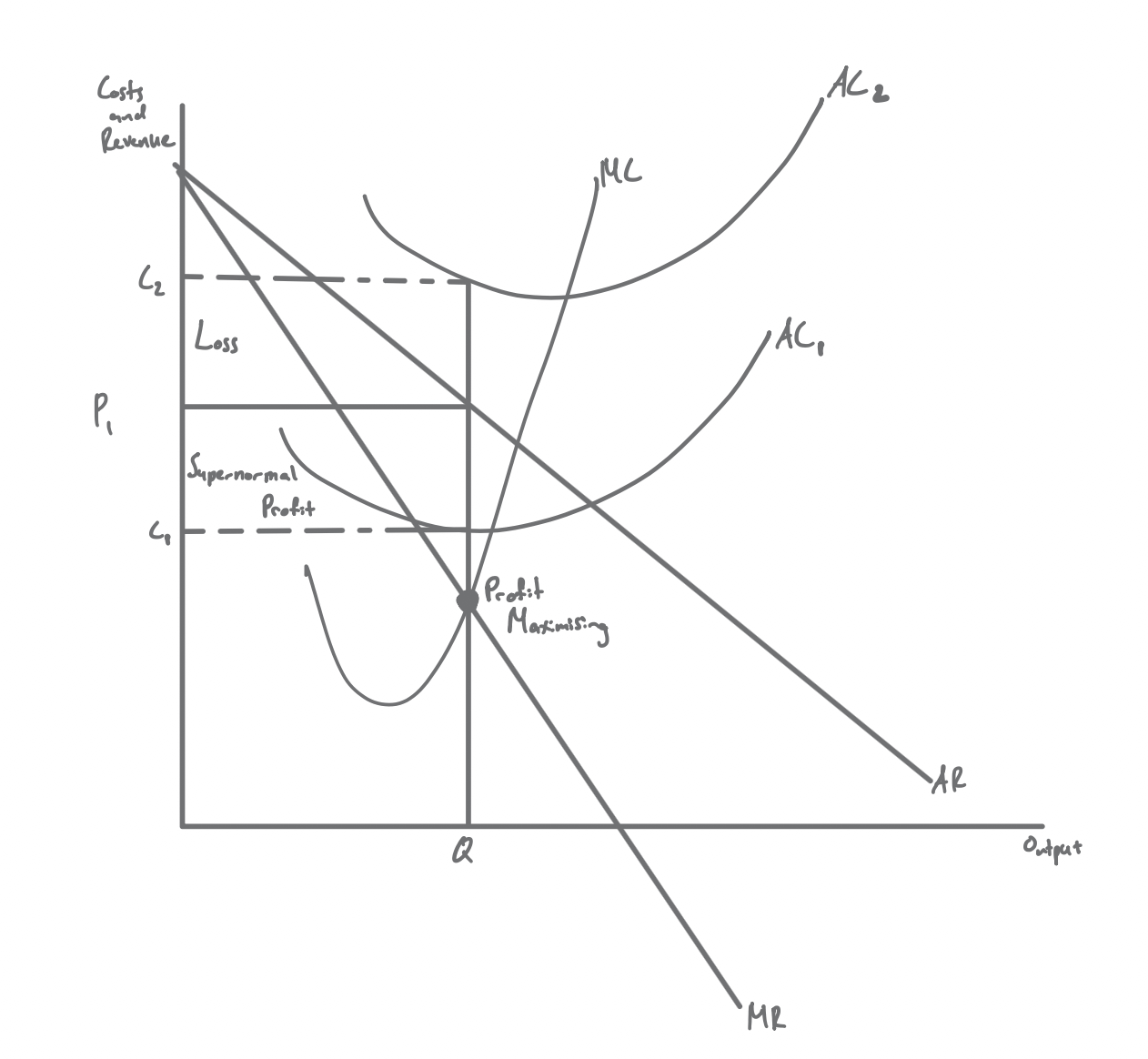
The diagram shows a firm with downward-sloping and curves and two possible average cost curves, and . The reading method is always the same. First find the output Q where (marked "Profit maximising"). Then read price P1 from at Q and compare it with at that same output. With the lower cost curve , average cost at Q is C1, below P1, so the rectangle between P1 and C1 across Q is supernormal profit. With the higher cost curve , average cost at Q is C2, above P1, so the rectangle between C2 and P1 is a loss. If equals at Q, the firm earns normal profit.
Definition: Loss
A situation where total revenue is less than total cost.
A loss means and , so the firm is earning less than normal profit. The total amount of supernormal profit or loss is the gap between and multiplied by output. For example, if , , and output is 1,000, supernormal profit is 2,000. If were 9 instead, the firm would make a loss of 1,000.
Continue this lesson.
You’re previewing NovaLearn without an account. Create a free account to read the rest.
Create free account