3.5.1 - Demand for labour
Firms do not demand labour for its own sake. They demand workers because workers help produce goods and services that can be sold. That is why product-market conditions, productivity, and the wider economy all matter when we analyse labour demand.
Derived Demand
The demand for labour is closely tied to what firms expect to sell. If a product is popular and profitable, firms usually want more workers. If demand for the product weakens, firms need fewer workers because there is less output to produce.
Definition: Derived demand
Demand for a factor of production that depends on the demand for the goods and services it helps to produce.
This is the key difference between labour and an ordinary consumer good. Households buy coffee because they want coffee. Firms hire baristas because customers want coffee. In the same way, the demand for warehouse workers depends on demand for online orders, and the demand for construction workers depends on demand for new housing and infrastructure.
This also means consumer preferences in product markets feed through into the labour market. If demand rises for electric vehicles, firms making batteries, software, and components are likely to increase hiring. Nissan Sunderland is a useful UK example: stronger demand for its vehicles can raise the derived demand for assembly and engineering labour at the plant, while weaker car sales would reduce it.
Marginal Revenue Product and Hiring
To decide how many workers to employ, a profit-maximising firm compares what an extra worker adds to revenue with what that worker adds to cost. The key concept is marginal revenue product, which means the extra revenue generated by employing one more worker.
Formula: Marginal revenue product
Where MPP is the extra output from one more worker and MR is the extra revenue from selling one more unit. In a competitive product market, MR = P, so:
Suppose one extra worker allows a cafe to sell 10 extra coffees and each coffee sells for GBP4 in a competitive market. The worker's marginal revenue product is GBP40. If employing that worker costs less than GBP40 per period, taking them on adds to profit. If the wage cost is above GBP40, the worker adds less to revenue than to cost.
Exam tip
In a competitive product market, MR = P, so MRP is the same as the value of marginal product. In an imperfect product market, MR < P, so MRP is lower than the value of the worker's output. That means labour demand is lower than students often expect if the firm has product-market power.
This gives the standard employment rule:
Firms hire workers up to the point where marginal revenue product equals the wage rate. This assumes the firm hires in a competitive labour market, where it can take on as many workers as it wants at the going wage, so the wage is the extra cost of one more worker. If MRP > W, another worker adds more to revenue than they cost, so employing more labour raises profit. If MRP < W, the last worker costs more than the revenue they generate, so the firm should reduce labour. The firm's demand curve for labour is therefore its MRP curve.
Why Labour Demand Slopes Downward
The demand curve for labour slopes downward because, as wages fall, it becomes profitable to employ additional workers whose marginal revenue product is lower. The main reason is that the extra revenue generated by successive workers usually falls as more labour is added in the short run.
Definition: Diminishing marginal productivity
The fall in the extra output produced by each additional worker when at least one other factor of production is fixed.
In the short run, capital is often fixed. A firm may have only one shop, one kitchen, or one production line. At first, extra workers can raise output sharply, but as more labour is added to the same fixed machinery and workspace, each additional worker tends to add less extra output than the previous one. If marginal physical product falls, marginal revenue product falls too. Firms will therefore employ extra workers only if the wage rate is lower.
For example, suppose a cafe with one coffee machine sells coffee at GBP4 in a competitive market. The first barista adds 9 coffees an hour (MRP GBP36), the second 7 (GBP28), the third 5 (GBP20) and the fourth 4 (GBP16). At a wage of GBP20 an hour the cafe employs three baristas, because the third barista's MRP just equals the wage. If the wage rose to GBP28, only two would be worth employing; it would take a wage of GBP16 to make the fourth worthwhile.
There is also a substitution effect. When wages rise, labour becomes relatively more expensive compared with machinery or technology, so firms have a stronger incentive to substitute capital for labour where possible. When wages fall, labour becomes relatively cheaper, so firms are willing to employ more workers.
[DIAGRAM: asset_name: 3.5.1 - Demand for labour - diagram 1; asset_slug: 3.5.1 - 1; recommended_method: retained_png; description: Retained source diagram supporting 3.5.1 - Demand for labour; the packaged PNG preserves the original educational visual.]
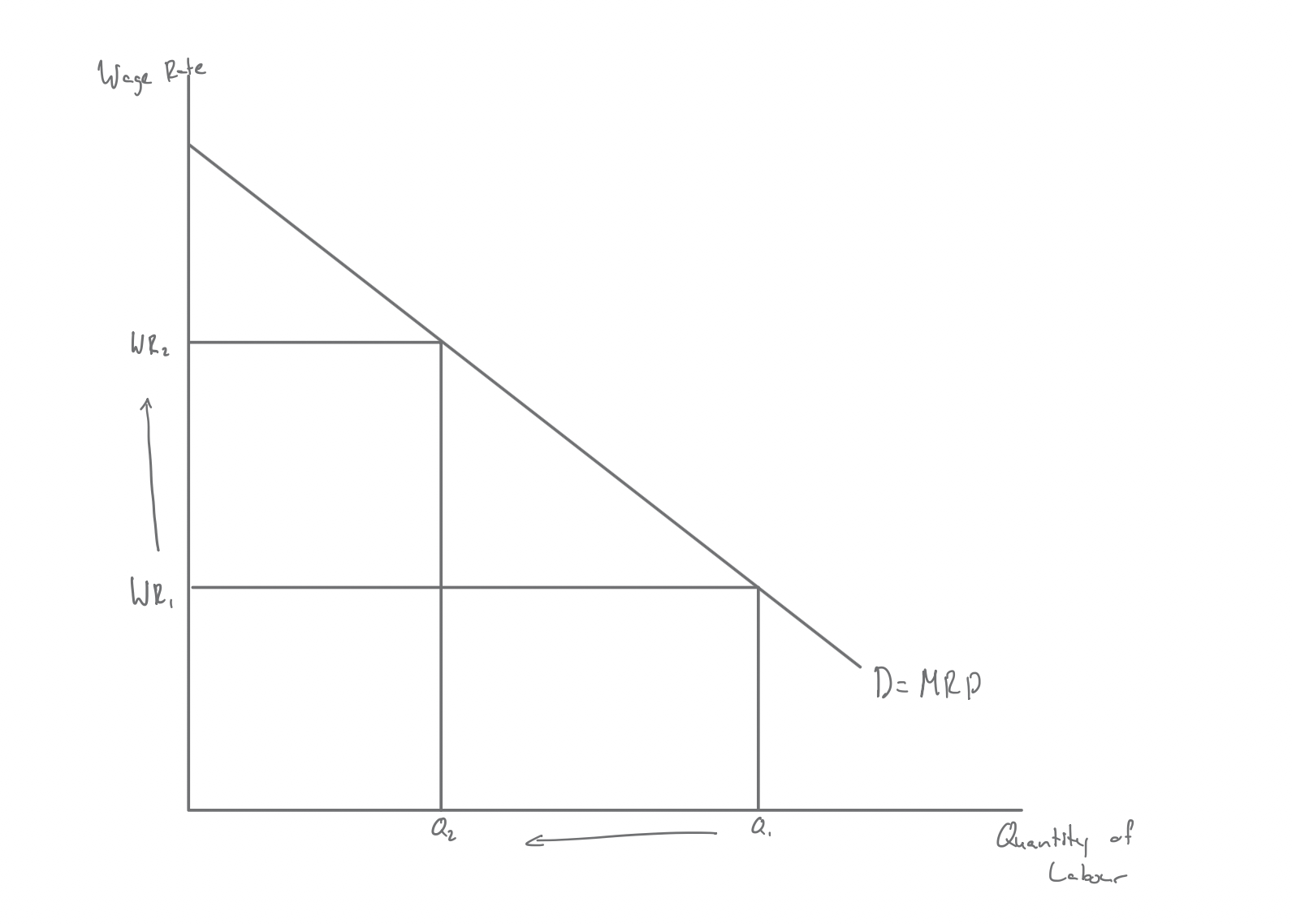
The diagram matters because it shows that labour demand is not arbitrary. At the wage rate WR1, firms employ Q1 workers. When the wage rises to WR2, they move up along D = MRP and employ only Q2, because fewer workers now have an MRP at least as high as the wage. Read the other way, a fall in the wage from WR2 to WR1 raises employment from Q2 to Q1. Either way, a wage change causes a movement along the curve, not a shift. That is why the curve is normally labelled D = MRP.
Continue this lesson.
You’re previewing NovaLearn without an account. Create a free account to read the rest.
Create free account