3.4.3 - Monopolistic competition
Monopolistic competition sits between perfect competition and monopoly. There are many firms and entry is relatively easy, but products are differentiated, so each firm has some control over its own price. That combination explains why firms can earn short-run profit, why those profits are usually competed away in the long run, and why the market gives consumers variety without achieving full efficiency.
Features and Differentiation
Definition: Monopolistic competition
A market structure in which many firms supply differentiated products and there is freedom of entry and exit.
The key word is differentiated. Firms are not selling identical output, even though their products are close substitutes. A cafe may compete on atmosphere, location, loyalty schemes, or coffee quality. A hairdresser may differ by stylist reputation, booking convenience, or salon experience. A restaurant may compete through menu, service, and brand image.
That is why a monopolistically competitive firm is not a pure price taker. If it raises price, some customers switch away, but not all of them do. If it cuts price, it wins some customers from rivals, but it does not capture the whole market. Each firm's demand curve is therefore downward sloping, and its marginal revenue curve lies below average revenue, just as it does for a monopoly: to sell one more unit, the firm must lower its price on every unit it sells, not just on the extra one.
At the same time, this is still a competitive market structure. There are many buyers and sellers, firms are small relative to the whole market, and there is no strong interdependence of the kind usually associated with oligopoly. Entry and exit are also much easier than under monopoly because legal, technical, or financial barriers are usually low.
The UK branded coffee-shop market is a useful example. Costa, Starbucks, Caffe Nero, and many independents all sell close substitutes, but they do not sell an identical experience. That helps explain why one branch can charge a little more than another without losing every customer immediately.
Short-Run Pricing and Profit
In the short run, the number of firms is taken as given, so each business behaves like a small monopolist over its own brand or version of the product. It still follows the normal profit-maximising rule:
Once the firm has found that output, it reads the price from the AR or demand curve. Because demand slopes downward, the price will be above marginal revenue.
Definition: Normal profit
The minimum profit needed to keep a firm or factor of production in its current use.
Normal profit is part of economic cost, so a firm earning normal profit is covering the opportunity cost of the owner's time and capital as well as its explicit costs.
Definition: Supernormal profit
Profit above normal profit.
That creates three possible short-run outcomes. If average revenue is above average cost at the profit-maximising output, the firm earns supernormal profit. If average revenue equals average cost, it earns normal profit. If average revenue is below average cost, it makes a loss. A loss-making firm may still continue in the short run if average revenue remains above average variable cost, because it is then covering running costs and contributing something towards fixed costs.
[DIAGRAM: asset_name: 3.4.3 - Monopolistic competition - diagram 1; asset_slug: 3.4.3 - 1; recommended_method: retained_png; description: Retained source diagram supporting 3.4.3 - Monopolistic competition; the packaged PNG preserves the original educational visual.]
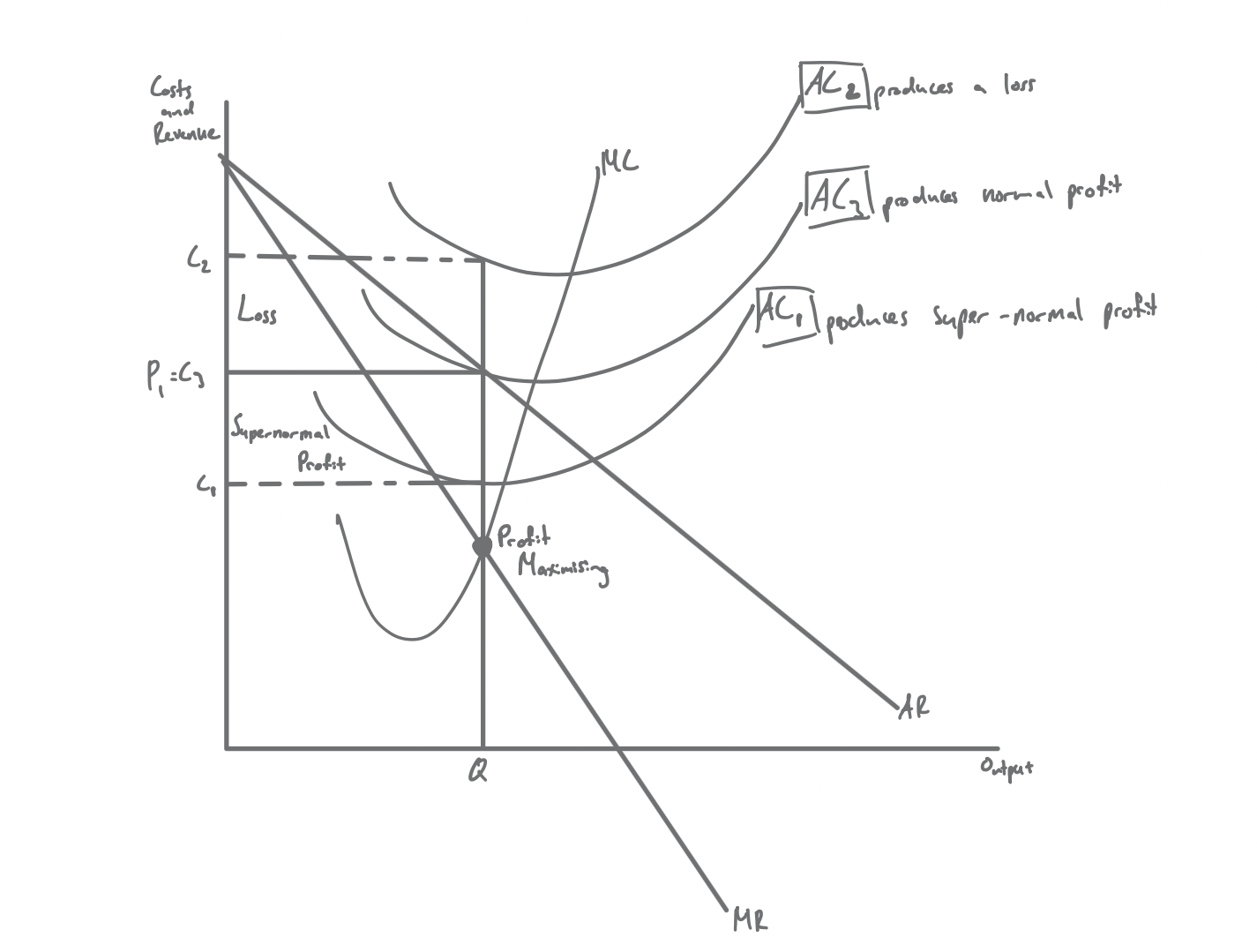
The diagram is read in the same way as any standard firm diagram with downward-sloping demand. First identify the output Q where . Then read price P1 from AR and compare AR and AC at that output. If , the gap multiplied by output is supernormal profit. If , the firm is earning only normal profit. If , the firm is making a loss.
The diagram shows all three outcomes by drawing three possible average cost curves against the same demand. With AC1, average cost at Q is C1, below P1, so the shaded rectangle is supernormal profit. With AC3, average cost at Q is C3, equal to P1, so the firm earns only normal profit. With AC2, average cost at Q is C2, above P1, so the rectangle is a loss.
Long-Run Adjustment
The long run is where monopolistic competition starts to look very different from monopoly. Because barriers to entry are low, short-run profit attracts new firms into the market.
If existing firms are earning supernormal profit, new entrants are attracted in. Consumers now have more substitutes to choose from, so the demand facing each existing firm becomes more elastic and shifts leftward. Its marginal revenue curve shifts with it. That continues until the extra profit has been competed away and firms are earning only normal profit.
Continue this lesson.
You’re previewing NovaLearn without an account. Create a free account to read the rest.
Create free account