3.3.3 - Economies and diseconomies of scale
As firms grow, their average cost does not usually stay fixed. Costs often fall at first because larger-scale production brings advantages, but beyond a certain point size can create coordination problems and rising unit costs. This lesson explains that pattern, distinguishes internal from external economies of scale, and shows why minimum efficient scale matters for market structure.
How Scale Changes Costs
Definition: Economies of scale
The fall in average cost that can occur as a firm's scale of output increases.
Economies of scale are closely linked to increasing returns to scale. If a firm increases all inputs by, say, 10% and output rises by more than 10%, cost per unit tends to fall. If output rises by exactly the same proportion as inputs, the firm is experiencing constant returns to scale, so average cost is broadly unchanged. If output rises by less than inputs, the firm is moving into decreasing returns to scale and average cost starts to rise.
A simple calculation shows why, assuming input prices stay the same. A bakery spends £1,000 a week on inputs and makes 1,000 loaves, so its average cost is £1.00. It scales up every input by 10%, so its costs rise to £1,100. If output rises by 20% to 1,200 loaves, average cost falls to £1,100 ÷ 1,200 ≈ £0.92. If output had risen by only 5%, to 1,050 loaves, average cost would have risen to about £1.05.
That pattern is shown by the long-run average cost curve. At low levels of output, the LRAC usually slopes downward because the firm is gaining economies of scale. It then flattens once the scale advantages have been fully exploited. If the firm keeps expanding beyond that comfortable range, the curve may slope upward as diseconomies of scale appear.
Definition: Minimum efficient scale
The lowest level of output at which a firm fully exploits economies of scale.
[DIAGRAM: asset_name: 3.3.3 - Economies and diseconomies of scale - diagram 1; asset_slug: 3.3.3 - 1; recommended_method: retained_png; description: Retained source diagram supporting 3.3.3 - Economies and diseconomies of scale; the packaged PNG preserves the original educational visual.]
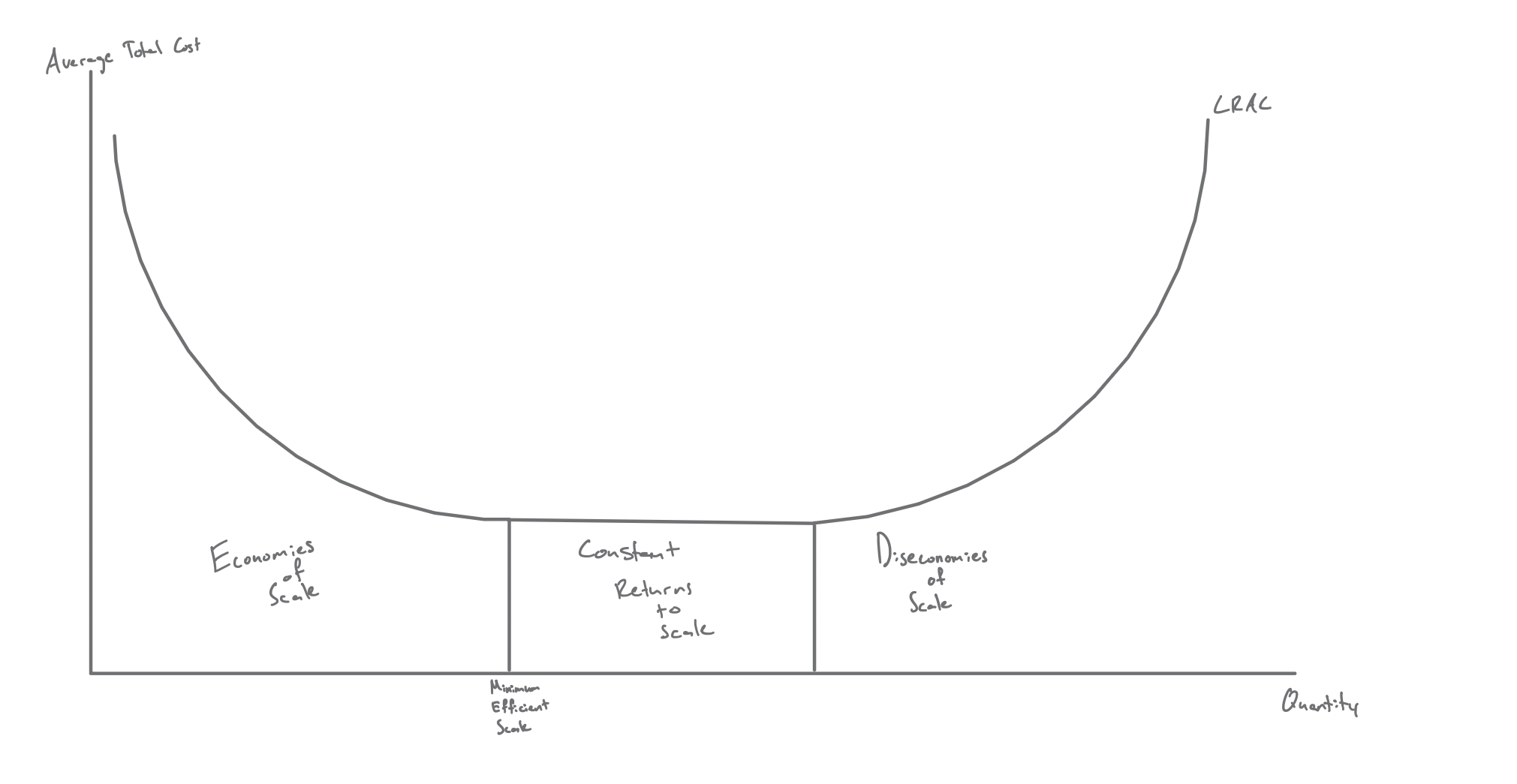
Read the diagram from left to right. The LRAC falls through the region labelled economies of scale, stays flat through the region labelled constant returns to scale, and rises through the region labelled diseconomies of scale. Minimum efficient scale is marked on the quantity axis where the flat section begins: the first output at which the lowest average cost is reached.
MES matters because it links costs to market structure. If MES is very large relative to total market demand, only a few firms can reach the lowest average cost, so entry is harder and the market is more likely to be oligopolistic or even monopolistic. If MES is small relative to market demand, many firms can reach an efficient scale, so competition is easier to sustain.
Internal Economies of Scale
Internal economies of scale come from the growth of the firm itself. They are under the firm's control, and they are shown as a movement down the firm's LRAC curve rather than a shift of the whole curve.
Technical economies are often the biggest source of falling average cost in manufacturing. A large firm can use specialisation, with specialist labour and specialist machinery making workers more efficient at a narrower range of tasks. It can also create balanced teams of machines, where each stage of production has enough capacity to keep the rest of the line busy instead of leaving equipment idle.
Large scale can also make capital equipment more economical. The container principle is the classic example: when dimensions increase, volume rises faster than surface area, so bigger oil tankers, storage tanks, pipelines, or aircraft can be proportionally cheaper to operate. Double every dimension of a tank and its surface area, and so roughly the material needed to build it, rises four times, but its volume rises eight times: the material cost per unit of capacity roughly halves. Indivisibilities matter too. Some machinery, software systems, and research facilities are so expensive that they only make economic sense when their fixed cost is spread across very high output. The same logic helps explain why large firms can afford dedicated research and development teams that a small firm could not justify.
Other internal economies are less about engineering and more about organisation:
- Financial economies: large firms are usually seen as safer borrowers, so they may access loans more easily, pay lower interest rates, or raise finance through share and bond markets.
- Risk-bearing economies: a firm selling in several markets or offering several products is less exposed if one product line performs badly.
- Managerial economies: a large business can employ specialist managers in finance, marketing, operations, and HR rather than relying on one general manager to do everything.
- Marketing and purchasing economies: buying in bulk, using specialist buyers and sellers, and distributing at scale can all reduce unit costs.
In the UK grocery market, Tesco benefits from purchasing and distribution economies that a single independent convenience shop cannot match. It can fill lorries, run regional distribution centres, and negotiate stronger terms from suppliers and logistics firms, so the transport and buying cost per item is lower.
Continue this lesson.
You’re previewing NovaLearn without an account. Create a free account to read the rest.
Create free account