2.2.4 - Government expenditure (G)
Government expenditure is the third component of aggregate demand. Unlike consumption and investment, it is influenced heavily by political decisions, but it also changes systematically with the state of the economy. The two key specification influences are the trade cycle and fiscal policy.
What G Means
In the aggregate demand equation,
G means direct government spending on goods and services. This includes spending such as paying teachers, funding NHS treatment, or building roads and schools.
Definition: Government spending
Spending by the government on goods and services, which is a component of aggregate demand.
Be careful with exam wording. Economists sometimes talk broadly about government expenditure, but transfer payments such as unemployment benefits and pensions are not counted directly in G because they are not payments for current output. They still matter because they affect household incomes and can make the overall fiscal position more expansionary in a downturn.
G and the Trade Cycle
Definition: Trade (business) cycle
Fluctuations in the level of real GDP over time.
The economy moves through recovery, boom, slowdown, and recession. Government expenditure often responds in a counter-cyclical way, meaning the public sector tends to become more supportive when private demand is weak and less supportive when the economy is strong.
[DIAGRAM: asset_name: 2.2.4 - Government expenditure (G) - diagram 1; asset_slug: 2.2.4 - 1; recommended_method: retained_png; description: Retained source diagram supporting 2.2.4 - Government expenditure (G); the packaged PNG preserves the original educational visual.]
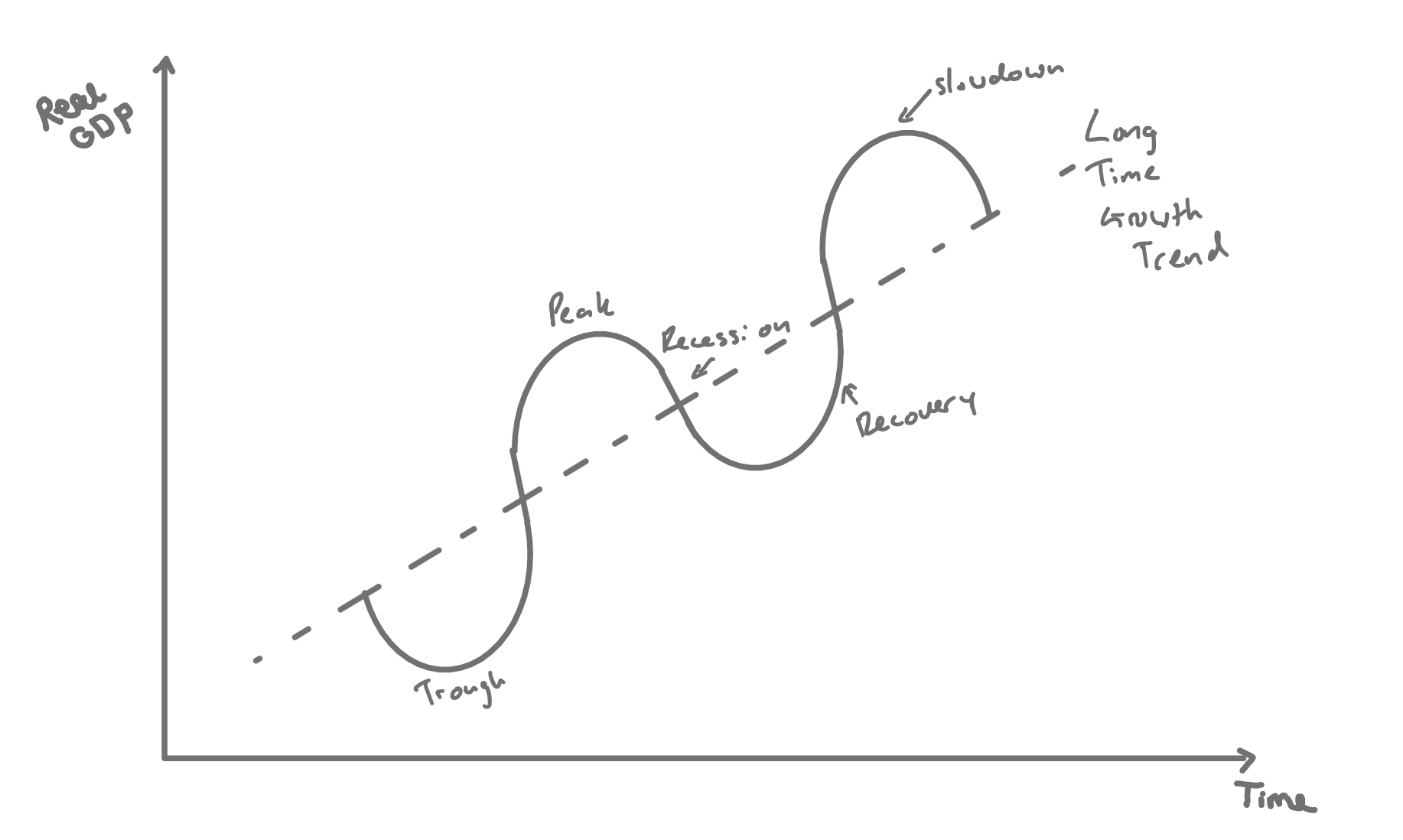
The diagram shows real GDP rising and falling around a dashed long-term growth trend. From a trough, recovery lifts output back up through the trend line, and in a boom output climbs above trend towards a peak. Growth then slows (the slowdown), and in a recession real output falls towards the next trough before the cycle repeats.
During a recession, real output falls and unemployment rises. Total public spending often increases because more people claim unemployment benefits and other welfare payments, and governments may also choose to raise direct spending to stimulate demand. At the same time, tax revenues usually fall, so the budget deficit tends to widen. Notice that the extra benefit payments raise total public spending but not G itself, because they are transfers; G rises only when the government buys more goods and services, such as new road or hospital projects.
During a boom, the opposite usually happens. Fewer people need income support, tax revenues rise as incomes and spending increase, and governments face less pressure to stimulate the economy. Public spending may therefore fall or grow more slowly, and the deficit may narrow.
This is why government expenditure is often seen as a stabilising force. It tends to rise when the economy contracts and to ease back when the economy expands.
Fiscal Policy in Action
Definition: Fiscal policy
The use of government spending and taxation to influence the economy.
Fiscal policy works through two distinct mechanisms.
Discretionary fiscal policy involves deliberate decisions by the government to change spending or taxation. After the 2008 financial crisis, many governments increased infrastructure spending and support programmes. During COVID-19, the UK sharply increased health spending and introduced large support schemes for households and firms, such as the furlough scheme, which paid most of the wages of employees who could not work.
Automatic stabilisers are built into the fiscal system and work without any new policy decision. When the economy slows, transfer payments such as unemployment benefits tend to rise and tax receipts from a progressive tax system tend to fall, because people on lower incomes pay a smaller share of their income in tax. In a boom, the reverse happens. This means automatic stabilisers support aggregate demand during downturns and restrain it when growth is stronger.
Continue this lesson.
You’re previewing NovaLearn without an account. Create a free account to read the rest.
Create free account