3.5.2 - Supply of labour
Labour market outcomes depend not just on how many workers firms want, but also on how willing and able people are to offer their labour. This lesson explains why supply to an occupation usually rises with wages, what shifts that supply, why labour often fails to move smoothly to where it is needed, and why some labour supplies are much more elastic than others.
Supply to an Occupation
The supply of labour shows the quantity of labour people are willing and able to offer at different wage rates. For a particular occupation or industry, the supply curve is usually upward sloping. If wages rise for electricians, teachers, or software engineers, more labour is likely to be offered to that occupation.
This happens for several reasons. Higher wages can attract workers away from other jobs, encourage people outside paid work to enter employment, tempt workers to move in from other regions, and persuade some existing workers to offer more hours or delay retirement. At the occupation level, all of those responses increase the quantity of labour supplied.
For an individual worker, the relationship can be more complicated. At relatively low wages, a rise in pay raises the opportunity cost of leisure, so the worker may choose to work more hours. This is the substitution effect. At higher wages, the worker may already have enough income and may prefer more leisure instead, so hours worked can fall. This is the income effect: higher income lets the worker afford more leisure, and once it outweighs the substitution effect, a pay rise reduces hours. That is the logic behind a backward-bending individual labour supply curve.
Common mistake
A backward-bending labour supply curve applies to an individual worker's hours, not usually to the supply of labour to a whole occupation. An occupation can still have an upward-sloping supply curve because higher wages attract additional workers into that market.
This distinction matters in exams. When the question is about the supply of labour to an occupation, you should think about the whole market for that type of work, not just one person's choice between work and leisure.
What Shifts Labour Supply
The wage rate is the price of labour, so a change in the wage rate causes a movement along the labour supply curve. A shift happens when something changes the attractiveness or availability of labour at every wage rate.
[DIAGRAM: asset_name: 3.5.2 - Supply of labour - diagram 1; asset_slug: 3.5.2 - 1; recommended_method: retained_png; description: Retained source diagram supporting 3.5.2 - Supply of labour; the packaged PNG preserves the original educational visual.]
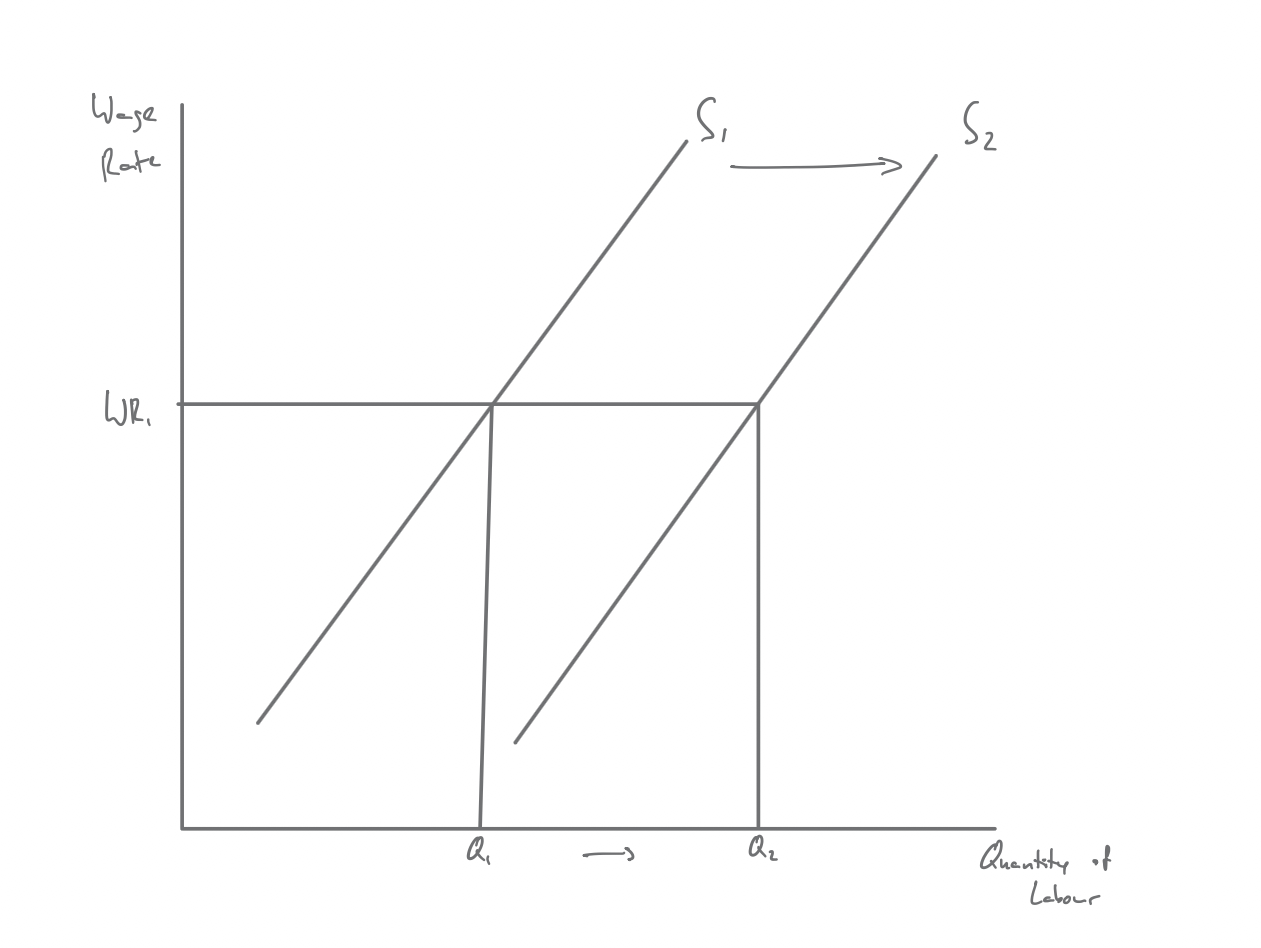
Population and demographics matter first. A wage change causes a movement along S1, but factors such as migration or a larger working-age population shift the whole curve right from S1 to S2. At the same wage rate WR1, the quantity of labour supplied rises from Q1 to Q2. UK sectors such as construction, agriculture, and hospitality have often relied heavily on migrant workers, so changes in migration flows can shift labour supply noticeably.
Non-monetary, or non-pecuniary, factors also matter because workers care about more than pay. Positive influences include job satisfaction, flexible hours, good working conditions, job security, status, career progression, a good location, and perks such as pensions or healthcare. Negative influences include danger, stress, antisocial hours, poor conditions, and low status. This is why some unpleasant jobs need a wage premium to attract workers, while some jobs such as teaching may keep attracting labour partly because of vocation, holidays, or a sense of social contribution.
Education, training, and qualifications are another major influence. If an occupation needs years of study or specialist skills, supply is limited because only a small pool is qualified. Over time, more training places, apprenticeships, or university places can raise supply. The reverse is also true: when apprenticeships decline or training takes too long, shortages can persist.
Barriers to entry can restrict labour supply as well. Professional bodies may require licences or registration, and unions have historically influenced entry through apprenticeship control or, in some sectors, closed shop arrangements. These barriers can keep wages higher by limiting supply, although they may also protect quality and safety in occupations such as law and medicine.
Labour supply to one occupation also depends on wages and conditions elsewhere. If graduate pay rises sharply in one sector, other graduate occupations may lose labour as workers switch. Government policy matters too. School leaving or education participation rules affect the supply of younger workers, pension and retirement rules affect older workers, immigration policy affects who can work in the country, and tax or benefit rules can change the incentive to supply labour. Those policy effects are not always one-way: a lower effective reward from working can reduce labour supply, but some workers may also work more to maintain income.
Occupational Immobility
Even if wages rise in a sector with shortages, labour supply does not always respond quickly. One reason is occupational immobility.
Definition: Occupational mobility of labour
The ability of workers to move between different jobs or occupations.
When that ability is weak, there is occupational immobility. Workers may want a better-paid job, but they cannot move easily because they do not have the right skills, qualifications, or experience. A redundant steelworker cannot become a software developer or radiographer overnight.
Skills mismatch is a major cause. Vacancies may exist, but unemployed workers may not have the training employers need. The time and cost of retraining make this worse, especially for older workers or people who cannot afford several years out of the labour market. Some skills are also highly specialised and do not transfer well to other industries.
Professional barriers matter too. Occupations such as medicine, teaching, and law require formal qualifications and registration, so supply cannot expand quickly even when shortages appear. That creates a trade-off. Restricting entry can cause immobility and keep wages high, but it can also protect standards, safety, and professional quality.
Continue this lesson.
You’re previewing NovaLearn without an account. Create a free account to read the rest.
Create free account