2.6.1 - Possible macroeconomic objectives
Governments do not judge the economy by one number alone. They care about whether output is rising, whether people who want work can find it, whether prices are stable, and whether today's growth is storing up problems for the future. The seven objectives in this lesson are economic growth, low unemployment, low and stable inflation, current account balance, a balanced government budget, environmental protection, and greater income equality.
Growth as the Broad Benchmark
Economic growth is often treated as the broadest macroeconomic objective because it expands what the economy can produce and therefore widens the choices open to households, firms, and the government.
Definition: Economic growth
An increase in the real output or productive capacity of an economy over time.
In practice, growth is usually tracked through real GDP, which adjusts output for inflation. If real GDP rises steadily, living standards can improve because more goods and services are available. But policymakers are not just looking for a one-off jump in spending. They want growth that can be sustained.
That is why the other objectives matter so much. Low inflation makes planning and investment easier. Low unemployment means labour is being used rather than wasted. A sustainable current account reduces the need to keep borrowing from abroad or selling domestic assets. Environmental protection and a sensible budget matter as well, because growth that damages future productive capacity is not a strong long-run outcome.
Employment and Spare Capacity
Another key objective is low unemployment. If people are willing and able to work but cannot find jobs, the economy is operating inside its production possibility frontier rather than on it. That means lost output, lost income, lower tax revenue and higher spending on unemployment benefits.
In AD/AS terms, macroeconomic equilibrium can still occur below full employment. If aggregate demand intersects short-run aggregate supply to the left of the economy's full-capacity level, there is a negative output gap. Firms are producing less than the economy could produce, so labour and other resources are underused.
[DIAGRAM: asset_name: 2.6.1 - Possible macroeconomic objectives - diagram 1; asset_slug: 2.6.1 - 1; recommended_method: retained_png; description: Retained source diagram supporting 2.6.1 - Possible macroeconomic objectives; the packaged PNG preserves the original educational visual.]
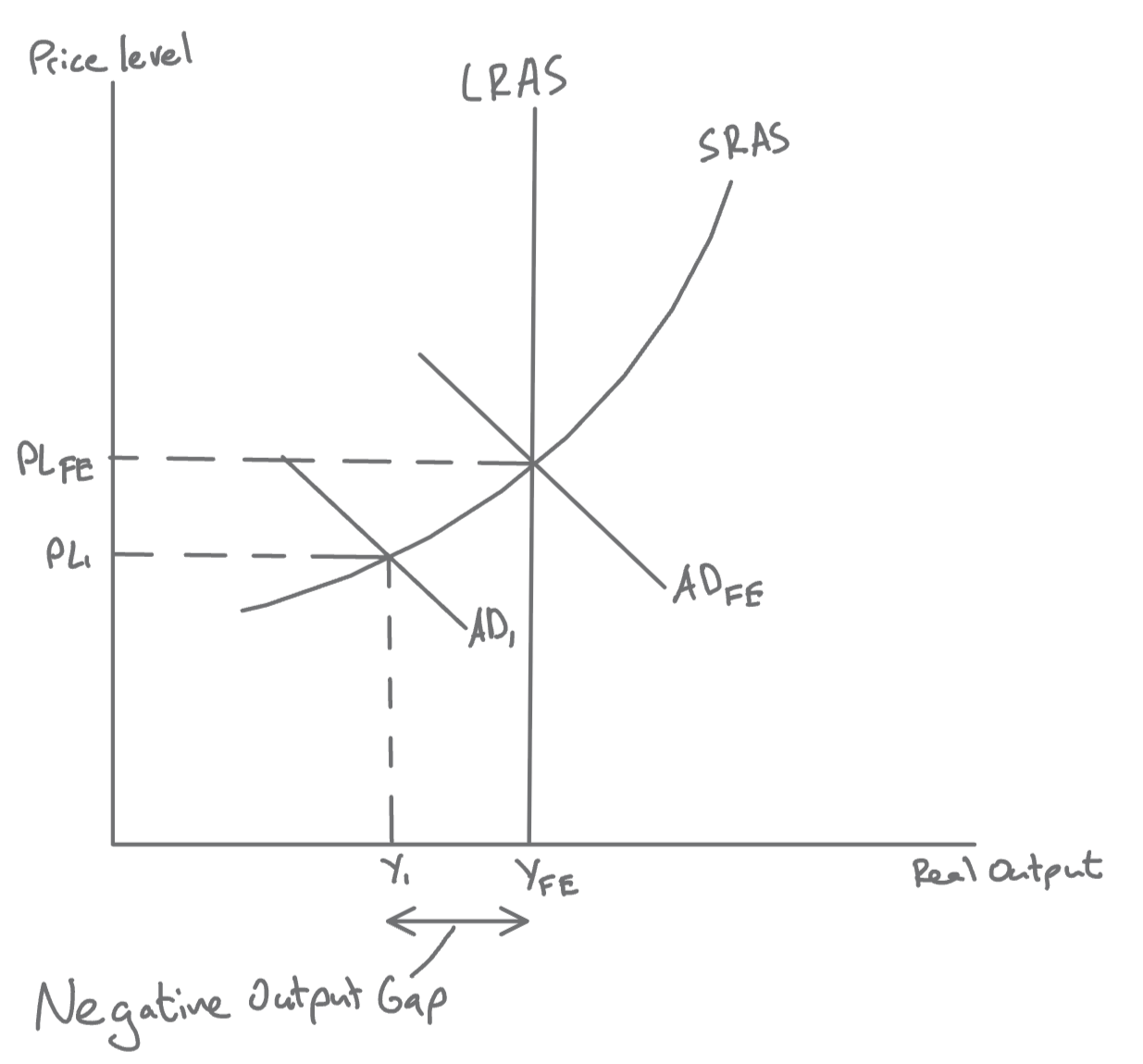
In the diagram, AD1 meets SRAS at price level PL1 and equilibrium output Y1, while full-employment output YFE lies on the vertical LRAS. The gap between Y1 and YFE is the negative output gap. Aggregate demand would have to reach ADFE to take the economy to full employment at price level PLFE.
The cost is not only macroeconomic. Long periods of unemployment can reduce workers' skills, confidence, and future employability, so a downturn can damage the economy's future potential as well as current output.
The objective is low unemployment, not zero unemployment. Even in a strong economy, some frictional unemployment exists while workers move between jobs, and some structural unemployment remains if workers' skills or location do not match available vacancies. Full employment therefore means that cyclical unemployment is very low, not that every person is employed at every moment.
Inflation and Price Stability
Governments usually aim for a low and stable rate of inflation rather than prices that never change. In the UK, the inflation target is 2% CPI, which shows that policymakers want price stability, not zero inflation.
Definition: Inflation
A sustained rise in the general price level over time.
Two standard causes matter. Demand-pull inflation happens when aggregate demand grows faster than the economy's ability to produce, especially when the economy is already close to full capacity. Cost-push inflation happens when firms face higher production costs, such as energy, wage, or raw material costs, so short-run aggregate supply shifts left.
A one-off rise in the price level is not the same as ongoing inflation. For inflation to persist, there usually has to be repeated upward pressure, such as continuing excess demand or money supply growth that is faster than real output. If money supply expands too quickly, households and firms have more purchasing power than they want to hold, so spending rises and prices keep being pushed upward.
High or unstable inflation creates several problems:
- firms face menu costs from changing prices frequently
- households and firms try to avoid holding cash, creating shoe-leather costs
- people on fixed incomes lose purchasing power
- price signals become less reliable, so resources are allocated less efficiently
- uncertainty over future costs and revenues discourages investment
- if inflation is higher than in rival countries, exports become less price competitive, which can worsen the current account
- in extreme cases, people may retreat towards barter, so the normal price mechanism works less effectively
A positive target is preferred to zero for three main reasons. First, measured inflation may slightly overstate the true rise in the cost of living because quality improvements are hard to capture perfectly. Second, wages are downwardly sticky, so a little inflation allows relative wages to adjust without firms having to cut nominal pay. Third, a small positive rate leaves a safety margin above deflation: if prices start falling, households may delay spending and the real burden of debt rises, which can deepen a downturn.
Continue this lesson.
You’re previewing NovaLearn without an account. Create a free account to read the rest.
Create free account