2.5.1 - Causes of growth
Economic growth affects living standards, employment, tax revenue, and the ability of an economy to provide goods and services over time. The key to this topic is separating short-run increases in output from long-run increases in productive capacity, then explaining what causes each of them.
What Economic Growth Means
Economic growth is commonly tracked using the annual percentage change in real GDP, so the measure focuses on changes in output after inflation has been removed. In exam answers, however, you should quickly separate two meanings of growth: the economy may be producing more now, or it may be capable of producing more in the future.
Definition: Economic growth
An increase in the productive potential of the economy over time, commonly tracked using the annual percentage change in real GDP.
That distinction matters because a rise in GDP does not always mean the economy has become more productive. Sometimes output rises simply because previously idle workers and machines are being used again.
Actual and Potential Growth
Actual growth is the measured rise in real GDP. It is mainly driven by aggregate demand. If consumption, investment, government spending, or exports increase, firms sell more and raise output. This can be quite volatile because demand rises in booms and weakens in recessions.
Definition: Actual growth
The annual percentage increase in real GDP.
Potential growth is different. It means the productive capacity of the economy has expanded, so the economy can sustain a higher level of output in the long run. This is a supply-side change and is shown by a rightward shift in long-run aggregate supply.
Definition: Potential growth
The long-run increase in the productive capacity of the economy.
[DIAGRAM: asset_name: 2.5.1 - Causes of growth - diagram 1; asset_slug: 2.5.1 - 1; recommended_method: retained_png; description: Retained source diagram supporting 2.5.1 - Causes of growth; the packaged PNG preserves the original educational visual.]
[DIAGRAM: asset_name: 2.5.1 - Causes of growth - diagram 2; asset_slug: 2.5.1 - 2; recommended_method: retained_png; description: Retained source diagram supporting 2.5.1 - Causes of growth; the packaged PNG preserves the original educational visual.]
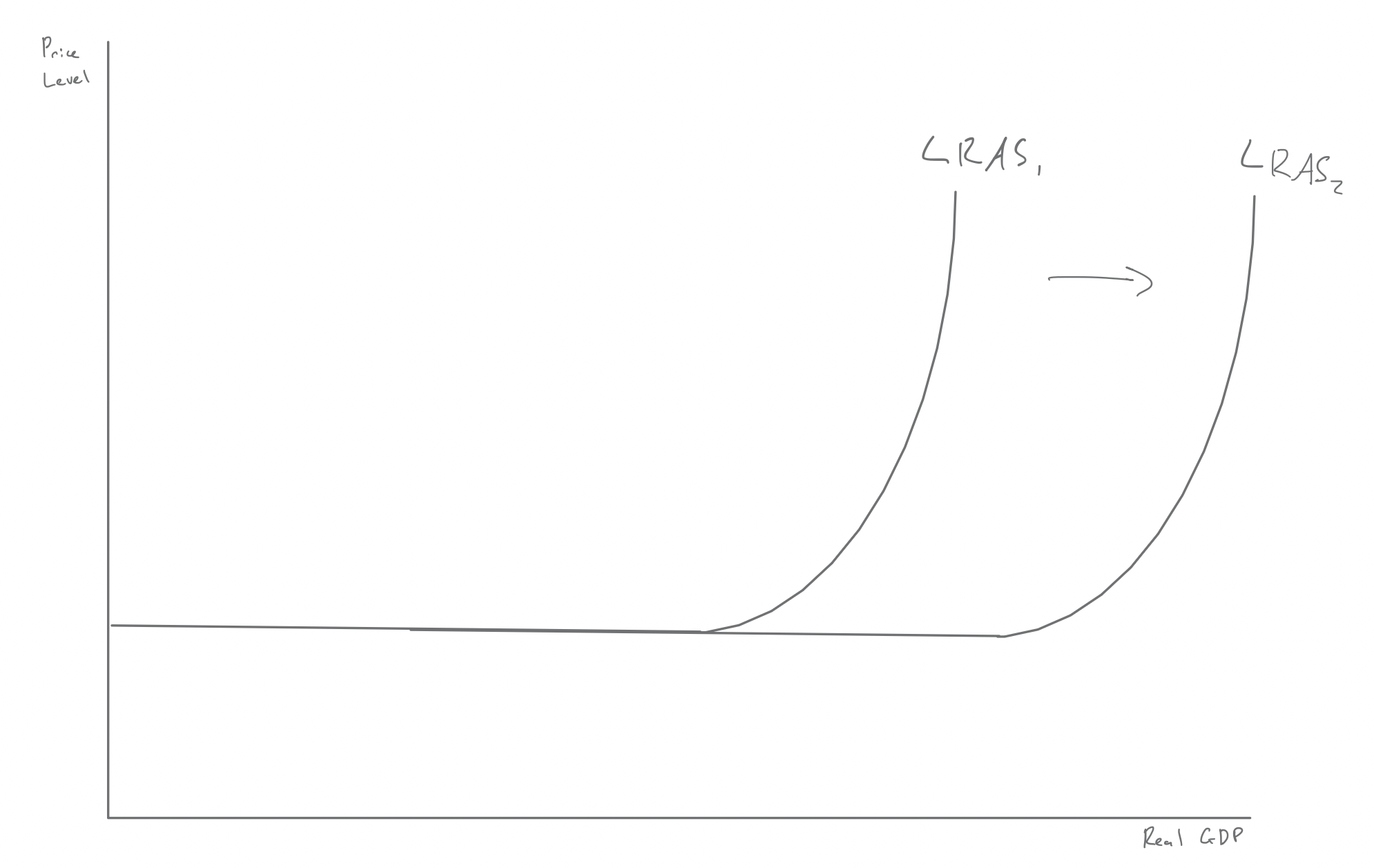
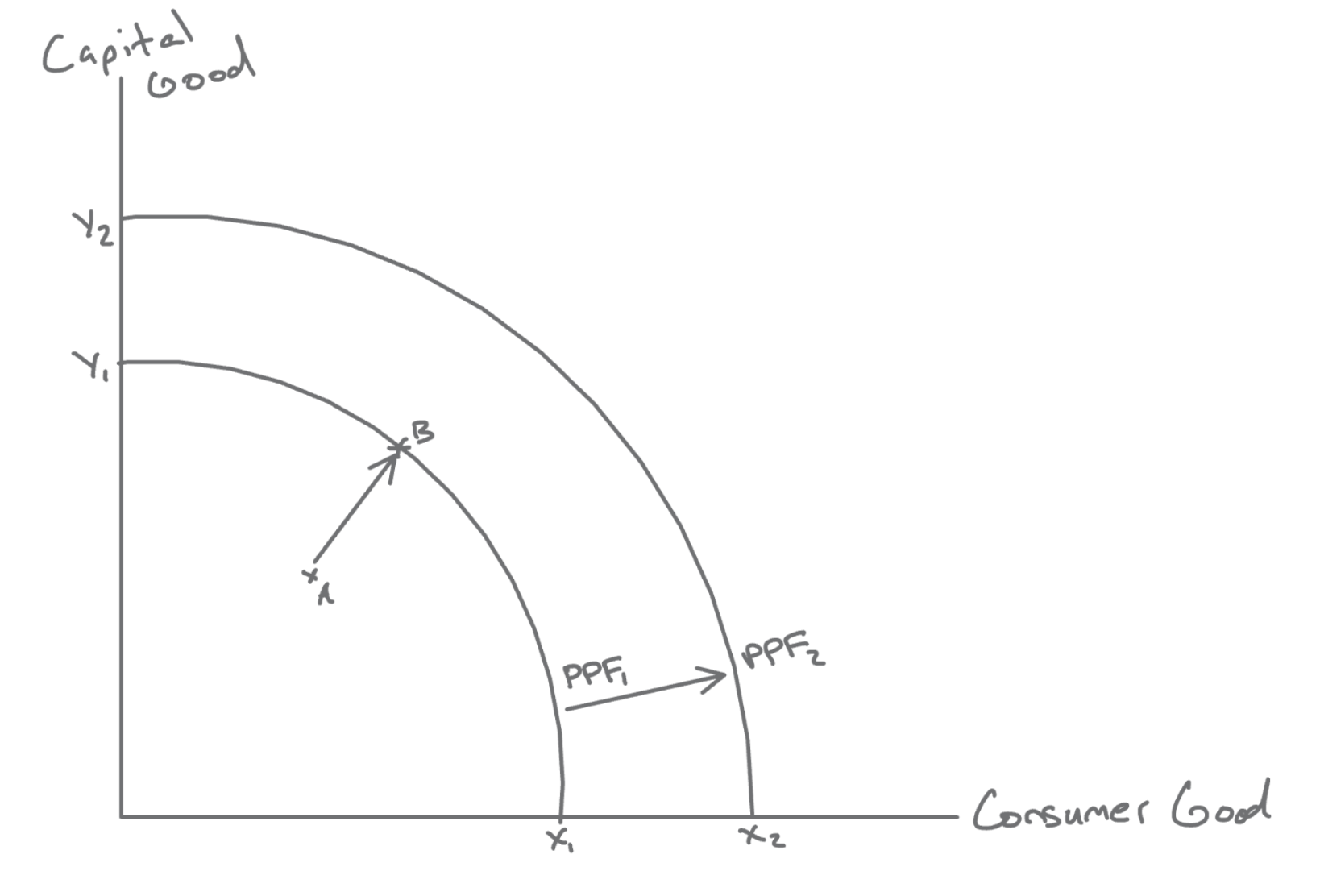
On the PPF diagram, a movement from a point inside the frontier, such as A, to a point on it, such as B, shows recovery or better use of existing resources: more is produced, but the frontier has not moved. An outward shift from PPF1 to PPF2 shows genuine growth in productive potential, because the economy can now produce more of both capital goods and consumer goods. The same logic applies on the LRAS diagram: only a rightward shift from LRAS1 to LRAS2, which moves the vertical, full-capacity section of the curve to a higher level of real GDP, shows higher long-run capacity.
Common mistake
Actual growth does not necessarily mean potential growth. An economy can grow by using spare capacity more fully, while its maximum possible output stays unchanged. Potential growth can also occur even when actual GDP is weak if productive capacity is still improving.
| Change | Type of growth | Why |
|---|---|---|
| The economy comes out of recession and re-employs idle labour | Actual growth | Existing capacity is used more fully |
| New training and new machinery lift output per worker | Potential growth | Productive capacity rises |
| Export demand rises for a few quarters | Actual growth first | Firms raise current output |
| Better infrastructure lowers business costs for years | Potential growth | LRAS shifts right |
What Causes Potential Growth
Potential growth happens when the quantity or quality of factors of production improves, or when those factors are combined more efficiently. A simple way to think about it is that output depends on land, labour, capital, technology, and efficiency.
Formula: Production function
Labour matters in both quantity and quality. A larger workforce can come from population growth, net immigration, higher participation rates, or later retirement. A more productive workforce comes from stronger human capital: education, training, experience, and the ability to adapt to new technology. This is why better schooling, apprenticeships, and lifelong learning can raise long-run growth.
Capital investment increases productive capacity by giving workers better tools, machinery, factories, transport links, and digital infrastructure. The quality of investment matters as well as the quantity. Spending on productive infrastructure can raise output across the economy, while investment in badly chosen projects or "white elephants" may add little to sustainable growth.
Land and natural resources can also matter. New discoveries of oil, gas, or minerals may raise an economy's productive potential, as happened when North Sea oil came on stream in the UK from the mid-1970s. In many developed economies, though, the bigger issue is not discovering more land but using existing resources more efficiently.
Technological progress is often the most important long-run cause of growth. It can reduce average costs, raise productivity, and create entirely new products and industries. Smartphones, cloud computing, and automation did not just replace older methods of production; they also created new markets and new ways of working.
Efficiency and institutions shape how well all the other factors are used. More competition pushes firms to innovate and cut costs. Secure property rights, political stability, and the rule of law make saving and investment more attractive because households and firms are more confident that contracts and assets will be protected. An economy may have plenty of resources, but if they are badly organised or incentives are weak, growth will still be slow.
Market economies often improve efficiency by shifting resources away from weaker firms towards more productive ones, although government intervention may still be needed when market failure prevents resources from being used well.
Continue this lesson.
You’re previewing NovaLearn without an account. Create a free account to read the rest.
Create free account