4.1.6 - Restrictions on free trade
Free trade can increase efficiency, but governments often choose to protect domestic industries instead. These restrictions are usually defended as a way to save jobs, support strategic sectors, or respond to unfair trade, yet they also raise prices and can reduce overall welfare. This lesson explains why governments intervene, how the main protectionist tools work, and why gains for one group often come with costs for others.
Why Governments Use Protectionism
Protectionism means deliberate government action to shield domestic producers from foreign competition or to give them an advantage over foreign rivals.
Definition: Protectionism
Government policies that restrict imports or support domestic producers in order to protect them from foreign competition.
One common argument is the infant industry case. A new domestic industry may start with high average costs because it has not yet achieved economies of scale, built experience, or recovered sunk costs. Temporary protection can give firms time to expand, learn by doing, and become competitive enough to survive without help. This is the logic often used to justify early industrial support in economies such as post-war Japan. The weakness is that "temporary" protection often becomes permanent once firms start lobbying to keep it, and governments do not always pick the right industries to back. Critics therefore argue that if support is needed, targeted subsidies or training may sometimes be less distortionary than broad trade barriers.
Governments also use protectionism to defend jobs. A surge of imports can reduce demand for domestic output, so employment falls in the industries exposed to foreign competition. That is economically painful and politically unpopular, especially when job losses are concentrated in one region. However, protecting one industry does not guarantee a net gain in employment across the whole economy.
Another set of arguments is about unfair or distorted competition. Dumping happens when exporters sell abroad below production cost or below the price charged in the home market. Firms may do this to clear excess stock, to drive rivals out before raising prices later, or because subsidies allow them to sell very cheaply abroad. This is why governments sometimes use anti-dumping tariffs, which WTO rules allow in specific cases. Foreign firms may also have lower costs because of lower wages, weaker health and safety rules, looser environmental standards, or government support. Supporters of protection say domestic firms should not be forced to compete on those terms, although critics argue that lower wages can simply reflect lower productivity or living costs rather than unfairness. That is why "unfair competition" can sometimes become a label for ordinary protectionism.
Application
Debates over the UK steel industry often combine several protectionist arguments at once. Supporters of anti-dumping action say cheap imports can threaten jobs, weaken supply-chain resilience, and leave the UK too dependent on foreign steel, while critics argue that dearer steel raises costs for construction and manufacturing firms that use it.
Protection can also be justified on strategic grounds. Governments may want to avoid over-specialisation so that the economy is not dangerously dependent on a few products or trading partners. Food, energy, defence, and key technologies are often treated as national-security industries, so governments may keep some domestic capacity even if imports are cheaper. US tariffs on steel and aluminium in 2018 were defended partly on national-security grounds. Some trade restrictions are also about health and safety, such as banning unsafe electrical goods, pharmaceuticals that do not meet safety standards, or products containing banned substances.
Finally, some economists point to the terms of trade argument. If a country is a large enough buyer in world markets, restricting imports can reduce world demand and push the world price down. That improves the country's terms of trade, but only if it has enough market power to influence price in the first place.
That basic definition matters, but exam questions usually go on to ask why governments intervene rather than just what the term means.
How Tariffs Work
A tariff is a tax on imports. In a simple trade diagram, the country can buy from world markets at a low world price, so domestic consumers buy more than domestic firms produce and the gap is filled by imports. When a tariff is added, the effective import price rises. Domestic consumers buy less, domestic producers supply more, and imports shrink.
Definition: Tariffs
Taxes placed on imported goods.
[DIAGRAM: asset_name: 4.1.6 - Restrictions on free trade - diagram 1; asset_slug: 4.1.6 - 1; recommended_method: retained_png; description: Retained source diagram supporting 4.1.6 - Restrictions on free trade; the packaged PNG preserves the original educational visual.]
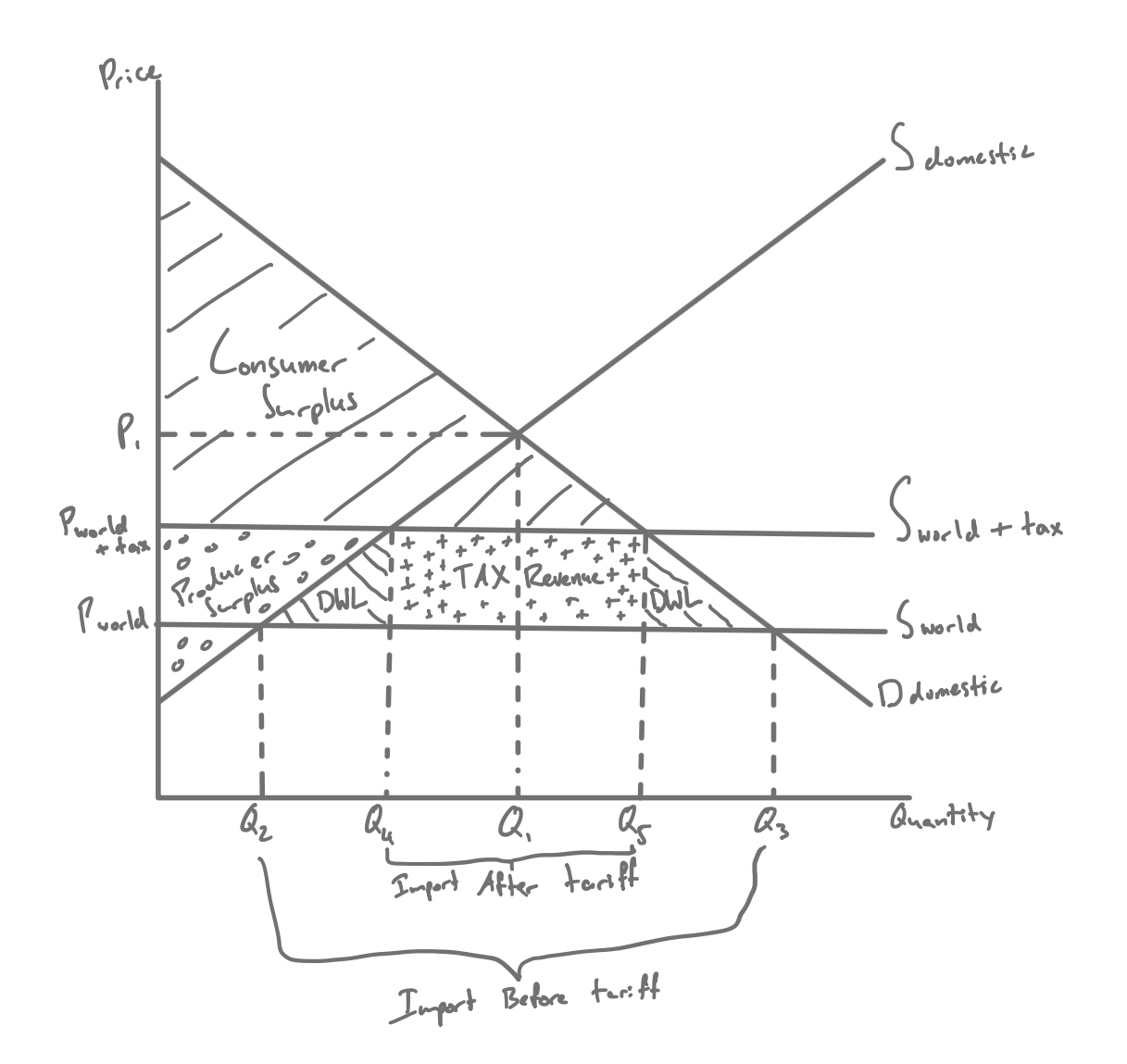
The diagram shows why tariffs are popular with some groups. Before the tariff, the world price is Pw and imports are Q3 - Q2; after the price rises to Pw plus tariff, domestic output rises to Q4, domestic consumption falls to Q5, and imports shrink to Q5 - Q4. Domestic firms receive a higher price and sell more output, the government gains tariff revenue on the remaining imports, and the two shaded triangles are the deadweight welfare losses from production and consumption inefficiency. But consumers lose the most because they pay more, buy less, and lose consumer surplus.
Two parts of that consumer loss are just transfers: some go to domestic producers and some go to the government as revenue. The crucial point is that not all of the loss is transferred. Some welfare disappears altogether. One triangle represents production inefficiency, because higher-cost domestic firms expand instead of lower-cost foreign producers supplying the market. The other triangle represents consumption inefficiency, because some mutually beneficial purchases no longer happen once the price rises.
For a small country, this is the standard result: a tariff creates a net welfare loss. The terms-of-trade argument is a qualification, not the default case. If the country is large enough to push down the world price, part of the burden may fall on foreign exporters, but that depends on market power.
Continue this lesson.
You’re previewing NovaLearn without an account. Create a free account to read the rest.
Create free account