4.1.8 - Exchange rates
Exchange rates matter because they change the relative prices of exports, imports, assets and holidays. That means they affect competitiveness, inflation, the current account, and even how much freedom a central bank has to set interest rates for domestic goals.
Exchange Rate Systems
An exchange rate is the price of one currency in terms of another. If the pound buys more dollars or euros than before, sterling has become stronger. If it buys less, sterling has become weaker.
Definition: Exchange rate
The price of one currency expressed in terms of another currency.
Exam tip
An exchange rate can be bilateral or effective. A bilateral rate compares one currency with one other currency, such as sterling against the dollar. An effective or trade-weighted exchange rate compares the currency against a basket of trading-partner currencies, so it is usually more useful when judging overall competitiveness or the current account. It is a weighted average of the bilateral changes, with each partner weighted by its share of trade: if sterling falls 8% against the euro and rises 4% against the dollar, and each accounts for half of UK trade, the effective rate falls by about 2%.
Countries can let that price move freely, peg it, or do something in between.
In a free floating system, the exchange rate is determined by demand and supply in the foreign exchange market. The main gain is flexibility: a trade deficit can put downward pressure on the currency, which can make exports cheaper and imports dearer. A floating rate also gives the central bank more monetary policy autonomy and removes the need to hold huge reserves simply to defend a target. Because there is no official peg to attack, speculators also have less scope to force a single formal change in parity. The downside is volatility. Firms face uncertainty, often hedge with forward contracts, and large capital flows can overwhelm the slower adjustment coming from trade.
In a fixed system, the government or central bank commits to a particular rate against another currency or against gold. Bretton Woods is the classic historical example: most major currencies were pegged to the US dollar, which was itself convertible into gold, until the system broke down between 1971 and 1973. Fixed rates can encourage trade and investment because firms face less exchange-rate risk, and they can help restrain inflation if the domestic economy must stay broadly in line with the anchor currency. A stable peg can also keep import prices steadier. But they are costly to maintain. The authorities need reserves, may lose control over domestic interest-rate policy, and can end up defending the wrong rate. If the currency is pegged too high, exports become uncompetitive; if it is pegged too low, inflationary pressure can build. Because the exchange rate cannot move freely, the currency stops acting as an automatic shock absorber. A fixed rate can also attract a speculative attack if markets think the peg is unsustainable.
Managed floating systems sit between those extremes. Day-to-day movements are mostly market determined, but the central bank may intervene to smooth excessive swings or lean against a move it dislikes. Some systems sit quite close to a peg, such as an adjustable peg or a crawling peg, where the official rate is moved occasionally or gradually.
The terminology also depends on the system being used. Under floating rates, a rise in value is an appreciation and a fall is a depreciation. Under a peg, an official upward adjustment is a revaluation and an official downward adjustment is a devaluation.
Definition: Depreciation
A fall in the value of a currency caused by market forces.
The opposite market-driven movement is an appreciation, while an official upward adjustment of a peg is a revaluation. Appreciation and revaluation both raise a currency's value, but only a revaluation is a deliberate policy decision.
Definition: Devaluation
A deliberate reduction in the official value of a currency under a pegged exchange-rate system.
How Floating Rates Are Determined
In a floating system, the exchange rate is set where demand for the currency equals supply. Demand for pounds comes from people and firms who need sterling to buy UK exports, invest in the UK, visit the UK, or speculate on the pound rising. Supply of pounds comes from UK residents who need foreign currency to buy imports, invest abroad, travel abroad, or speculate on the pound falling.
[DIAGRAM: asset_name: 4.1.8 - Exchange rates - diagram 1; asset_slug: 4.1.8 - 1; recommended_method: retained_png; description: Retained source diagram supporting 4.1.8 - Exchange rates; the packaged PNG preserves the original educational visual.]
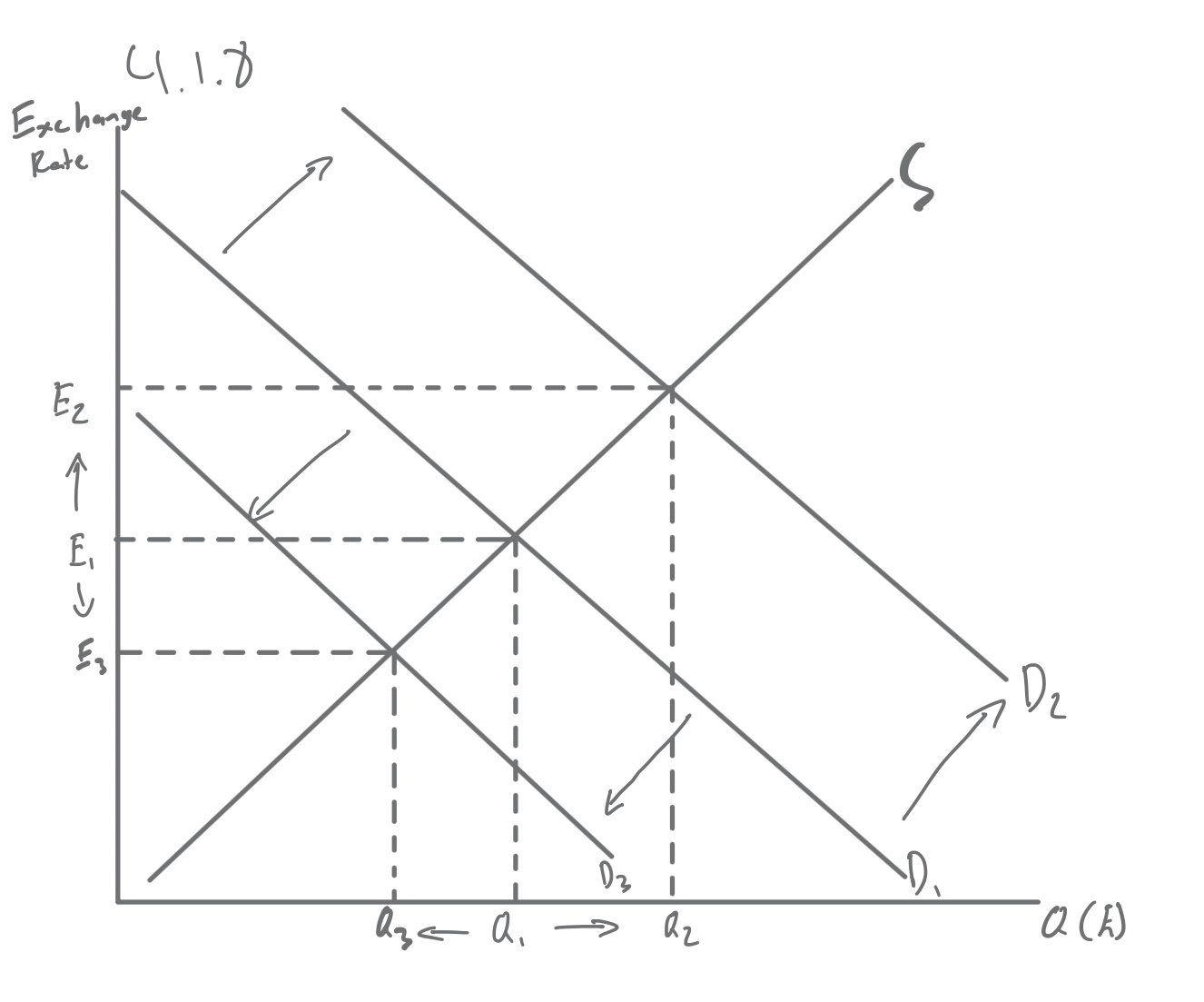
The vertical axis shows the exchange rate, read here as the foreign-currency price of 1 pound, and the horizontal axis shows the quantity of pounds traded. When demand shifts right to D2, the market moves from E1 at Q1 to E2 at Q2, so the foreign-currency price of 1 pound rises and sterling appreciates. When demand shifts left to D3, the exchange rate falls to E3 at Q3 and sterling depreciates. A rightward shift of supply would also cause a depreciation.
Common mistake
Always check how the exchange rate is quoted on the vertical axis. If it is the foreign currency price of 1 pound, a rise means sterling has appreciated. If it is quoted the other way round, such as pounds needed to buy 1 dollar or 1 euro, the same movement would be interpreted differently.
Several influences matter:
- Trade flows: stronger demand for UK exports raises demand for pounds, while strong UK demand for imports raises the supply of pounds.
- Interest rates: higher UK interest rates can attract short-term capital inflows ("hot money") because sterling assets now offer a higher return. Overseas savers must buy pounds to acquire those assets, so demand for sterling rises.
- Relative inflation: if UK inflation is persistently higher than abroad, UK goods become less competitive. Over time that can reduce exports, increase imports, and weaken sterling. This is the intuition behind purchasing power parity.
- Investment and confidence: strong growth prospects and political stability can attract inward foreign direct investment and portfolio flows, increasing demand for the currency. A loss of confidence can trigger capital outflows.
- Speculation: in the short run this can be decisive. If traders expect the pound to fall, they may sell now, helping to make that fall happen.
- Long-run competitiveness: over time, exchange rates tend to reflect underlying productivity, costs and export performance, not just daily news.
This is why exchange rates do not always move purely because of trade. Financial flows are often larger and faster than trade flows, so a currency may appreciate even when a country is running a current account deficit.
Continue this lesson.
You’re previewing NovaLearn without an account. Create a free account to read the rest.
Create free account