3.6.2 - The impact of government intervention
Government intervention in concentrated markets is usually trying to solve a real problem: monopoly power, weak competition, poor service, or underinvestment. The difficulty is that the same intervention that lowers prices or restrains profits can also weaken incentives, reduce choice, or be badly designed by regulators who do not know as much as the firms they oversee.
Prices and Profits
When a monopoly or dominant firm has market power, it can charge prices above costs and earn supernormal profit. Governments intervene to stop that outcome becoming exploitative.
Definition: Competition policy
Government action to prevent anti-competitive behaviour and promote competition in markets.
Competition policy can block mergers, force divestment, or challenge collusion, which increases competitive pressure and makes it harder for a firm to keep price far above cost. Regulators can also use price regulation, such as RPI - X, to cap how fast prices rise (when BT was privatised in 1984, its main charges were capped at RPI - 3, so they could rise by no more than inflation minus 3 percentage points a year), or rate-of-return regulation to stop firms earning what is judged an excessive return on capital. In some industries, governments may choose public ownership instead, so a nationalised business can be directed to price closer to marginal cost or prioritise consumer welfare rather than pure profit maximisation. Windfall taxes are another way of taking back unusually high profits after they have been made.
The intended result is lower prices and lower monopoly profit. Consumers gain in the short run because more of the benefit from the market goes to them rather than to shareholders. In England and Wales, water regulation is a good example: Ofwat reviews the prices regional water companies can charge, usually every five years, precisely because these firms operate as local monopolies and customers cannot easily switch supplier.
But lower prices and lower profits are not automatically a success. If a price cap is set too tightly, the firm may cut back investment, delay maintenance, or even leave a more contestable market. Household energy supply in Great Britain shows the exit risk: a price cap has limited standard tariffs since January 2019, and when wholesale gas prices soared in 2021, many suppliers could not pass on their higher costs. Twenty-nine suppliers failed between July 2021 and May 2022, including Bulb with 1.6 million customers. Many were thinly financed, so the cap was not the only cause, but it left them no room to absorb the shock. If public ownership weakens cost control, rising costs can push prices back up later. That is why intervention often improves short-run consumer outcomes while risking weaker long-run incentives.
Efficiency Trade-offs
Intervention is usually judged by whether it makes the market more efficient. The complication is that there is more than one kind of efficiency, and a policy can improve one while damaging another.
Definition: Productive efficiency
Producing output at the lowest possible average cost.
Regulation can improve productive efficiency by reducing X-inefficiency. A monopolist that faces no pressure may tolerate waste, overstaffing, or weak management. A well-designed price cap gives the firm a reason to cut avoidable costs because it can keep some of the efficiency gain. Promoting competition can have the same effect. However, nationalised industries may become less productively efficient if there is no competitive pressure, if losses are covered by the state, or if political aims matter more than cost minimisation. Over-regulation can also raise compliance costs and make efficient smaller firms unviable.
That still does not guarantee the right amount is being produced from society's point of view.
Definition: Allocative efficiency
A situation where price equals marginal cost, so resources are allocated to what consumers value most.
Intervention may also move the market closer to allocative efficiency. Breaking up monopoly power, encouraging entry, or controlling price can reduce the gap between the monopoly price and marginal cost. That means output rises and some of the deadweight welfare loss from monopoly is reduced. Regulators rarely observe marginal cost precisely, so policy usually pushes the market closer to allocative efficiency rather than delivering it perfectly.
[DIAGRAM: asset_name: 3.6.2 - The impact of government intervention - diagram 1; asset_slug: 3.6.2 - 1; recommended_method: retained_png; description: Retained source diagram supporting 3.6.2 - The impact of government intervention; the packaged PNG preserves the original educational visual.]
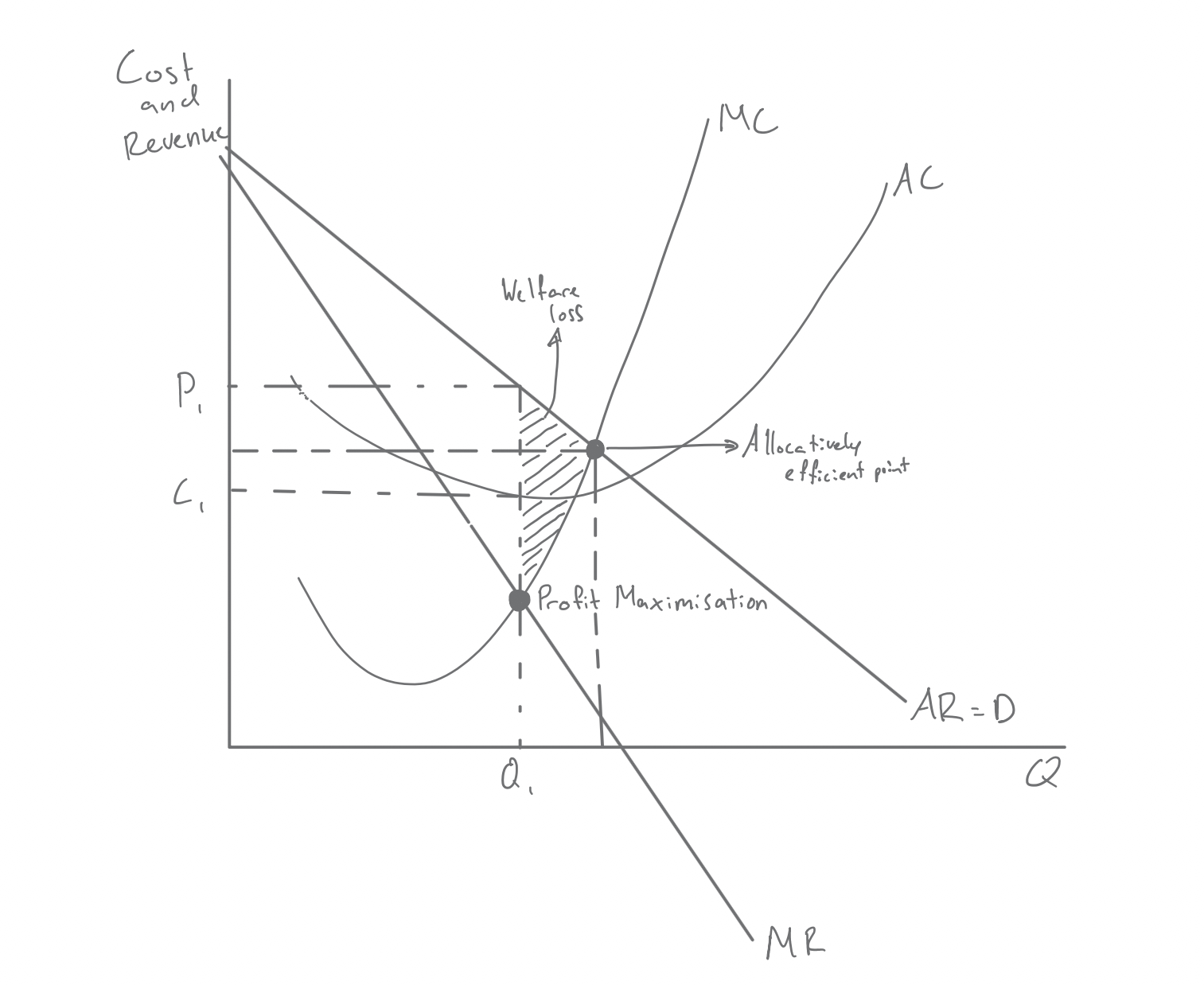
The diagram matters because it shows why governments target monopoly power in the first place. Left alone, the monopolist restricts output where MR = MC and then charges the higher price found on the AR curve, P1. Average cost at Q1 is only C1, so P1 - C1 is the supernormal profit on each unit. A regulator or competition authority is trying to push the outcome closer to the larger output where P = MC, so the welfare loss triangle between those two outputs is reduced. But that is not always easy. In a natural monopoly, forcing P = MC can leave the firm making losses because average cost is still above price, so subsidy or public ownership may be needed. (The diagram is not drawn as a natural monopoly: at its allocatively efficient point, price is still above AC.)
Definition: Dynamic efficiency
Efficiency gained over time through investment, innovation, and improvement.
The long-run problem is dynamic efficiency. Stronger competition can encourage firms to innovate in order to stay ahead. Some price-cap systems even allow extra investment spending, such as RPI - X + K, so firms are not punished for upgrading infrastructure. When the water industry in England and Wales was privatised in 1989, for example, its caps were set at RPI + K, with K between 3% and 7% a year at first, to pay for higher water-quality standards. But if intervention squeezes profit too much, firms may cut research, delay new technology, or become more cautious about investment. That is why a policy that improves allocative efficiency today can still harm consumers later if innovation falls.
Continue this lesson.
You’re previewing NovaLearn without an account. Create a free account to read the rest.
Create free account