2.2.1 - The characteristics of AD
Aggregate demand is central to short-run macroeconomics because changes in total spending help explain changes in real GDP, employment, and inflation. The key exam task is to keep four ideas separate and clear: what AD measures, what each component means, why the AD curve slopes downward, and what causes a movement along the curve rather than a shift of the whole curve.
What Aggregate Demand Measures
Aggregate demand (AD) is the total planned spending on domestically produced goods and services in an economy at a given price level over a given time period. The word "aggregate" just means we are adding together the main sources of spending across the whole economy rather than looking at one market in isolation.
Definition: Aggregate demand (AD)
The total demand for goods and services in an economy at a given price level and in a given time period.
The standard expenditure equation is:
This is not simply "all spending". Consumption, investment, and government spending can all include imported goods and services, so imports have to be subtracted. That leaves demand for domestic output only.
For example, if a UK household buys an imported laptop, that spending appears inside consumption at first, but it must be removed again in imports because the output was produced abroad. This is why M is subtracted rather than added.
The Components of Aggregate Demand
C is consumption: household spending on goods and services. This includes routine purchases such as food, transport, and clothing, as well as larger purchases such as cars or holidays. Consumption is influenced by disposable income, interest rates, consumer confidence, and wealth, so a change in household behaviour can have a large macroeconomic effect.
I is investment: spending on capital goods that help produce future output. This includes machinery, equipment, business software, buildings, stockbuilding, and residential construction. Investment is usually smaller than consumption, but it is often more volatile because firms can delay projects when expected profits weaken or when animal spirits, meaning business confidence, fall. It is also important for long-run growth because it helps determine the economy's future productive capacity.
G is government spending on goods and services. It includes current spending, such as paying teachers and nurses, and capital spending, such as building roads, schools, or hospitals. It does not include transfer payments such as pensions or unemployment benefits, because those payments redistribute income rather than directly buying current output. Government spending also matters because it can be changed deliberately by policymakers to influence total demand.
Exam tip
Transfer payments are excluded from G directly, but they can still shift AD indirectly. Higher benefits or tax credits raise some households' disposable income, which can increase consumption C; lower benefits can reduce it.
X - M is net exports. Exports add to AD because overseas buyers are spending on domestic output. Imports are subtracted because that spending leaks out to foreign producers.
Definition: Net exports
The value of exports minus the value of imports.
If X > M, the economy has a trade surplus and net exports add to AD. If X < M, the economy has a trade deficit and net exports reduce AD.
The relative importance of the components is not the same. In the UK, a useful exam shorthand is that consumption is often around 60-65% of GDP, government spending is around one fifth, investment is roughly 15-20%, and net exports are usually the smallest component and are often negative. Because consumption is so large, even a small percentage change in household spending can create a big absolute change in AD. Investment matters disproportionately because it is volatile and because it affects future productive capacity. This is why an economy that relies heavily on consumer spending is very sensitive to confidence shocks, while an economy that relies heavily on net exports is more sensitive to exchange rates and foreign demand.
Application
In the UK, a squeeze on household incomes or a sharp rise in mortgage costs can weaken consumption and quickly slow aggregate demand because consumption is the largest component. UK net exports have also often been negative, so trade has frequently acted as a drag on AD rather than a boost.
Why the AD Curve Slopes Down
[DIAGRAM: asset_name: 2.2.1 - The characteristics of AD - diagram 1; asset_slug: 2.2.1 - 1; recommended_method: retained_png; description: Retained source diagram supporting 2.2.1 - The characteristics of AD; the packaged PNG preserves the original educational visual.]
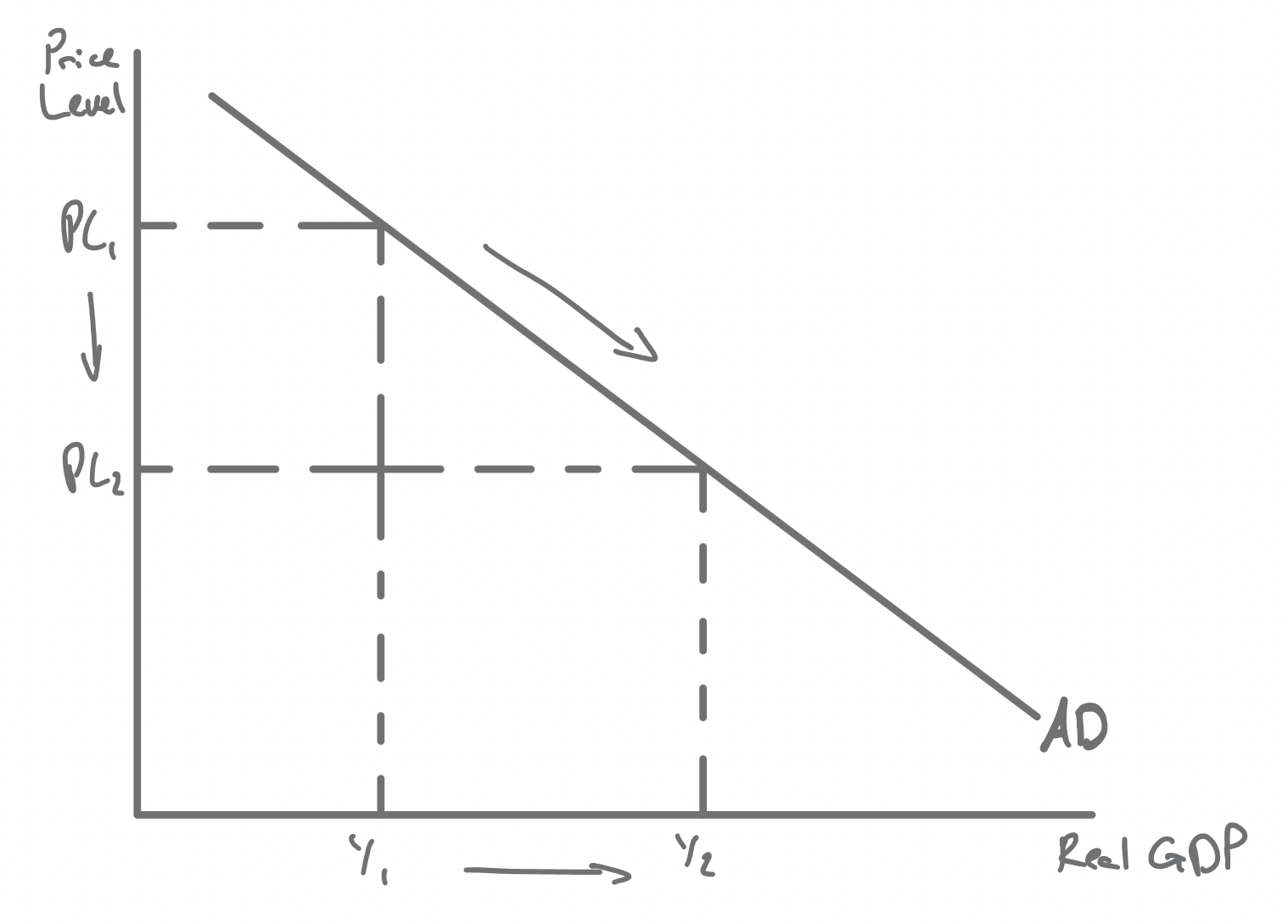
The aggregate demand curve shows the relationship between the average price level in the economy and the quantity of real output demanded, ceteris paribus. On AD, a fall in the price level from PL1 to PL2 is matched by a rise in real output (real GDP) from Y1 to Y2, so the movement is along the same curve rather than a shift. It slopes downward, so a higher price level is associated with a lower quantity of real output demanded.
Continue this lesson.
You’re previewing NovaLearn without an account. Create a free account to read the rest.
Create free account