2.4.1 - National income
National income makes more sense once we follow the flows behind it. The circular flow model shows where income comes from, where spending goes, and why output, expenditure, and income are three ways of measuring the same economic activity.
The Basic Circular Flow
Start with the simplest version of the economy: a closed economy with no government and no foreign trade. In this two-sector model, there are only households and firms. Households spend all of their income, and firms pay out all of their revenue as incomes, so nothing leaks out of the flow.
Definition: Circular flow
A model showing the flow of income and spending between different sectors of the economy.
Households own the factors of production. They supply land, labour, capital, and enterprise to firms. In return, firms pay households rent for land, wages for labour, interest for capital, and profit for enterprise. Households then spend that income on the goods and services firms produce, so the flow continues. For example, a baker supplies her labour to a bakery and is paid wages; she spends those wages in shops, and that spending becomes revenue for firms, which pay it out again as incomes.
[DIAGRAM: asset_name: 2.4.1 - National income - diagram 1; asset_slug: 2.4.1 - 1; recommended_method: retained_png; description: Retained source diagram supporting 2.4.1 - National income; the packaged PNG preserves the original educational visual.]
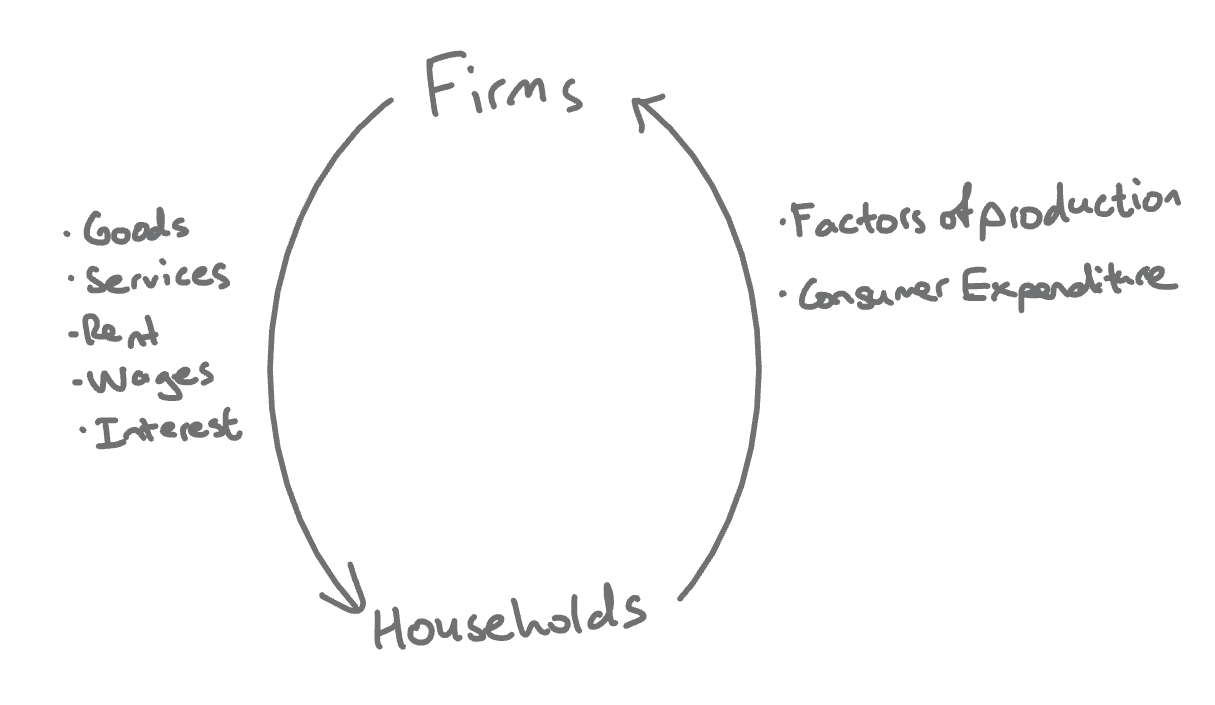
The diagram groups the flows by direction. The left arc lists what moves from firms to households: goods and services, and the factor payments rent, wages, and interest (profit, the reward for enterprise, is paid the same way). The right arc lists what moves from households to firms: factors of production and consumer expenditure. Inside these arcs are two different flows. The real flow is the movement of factors of production to firms and goods and services back to households. The money flow is the movement of income payments to households and expenditure back to firms. In every exchange, the money moves in the opposite direction to what it pays for: labour goes to firms while wages go to households, and goods go to households while spending goes to firms. Keeping those two flows separate is important because students often describe money moving when the question is really asking about resources, or vice versa.
Measuring National Income
The circular flow model also shows why economists can measure economic activity in three equivalent ways.
Definition: National income
The value of output, expenditure, or income in an economy over a period of time.
In the simple model, the same activity can be seen from three angles:
| Measure | What it captures |
|---|---|
| National output (O) | The value of goods and services produced by firms |
| National expenditure (E) | The value of spending on those goods and services |
| National income (Y) | The value of income paid for the factors of production used to make that output |
These are identical by definition in the simple circular flow:
Every pound spent on output becomes revenue to firms, and that revenue is then paid out as incomes to households. Whatever is left after paying wages, rent, and interest is profit, which is itself income for the firm's owners, so all of the revenue ends up as someone's income. If firms produce and sell GBP1 million of output, there is GBP1 million of expenditure and GBP1 million of income somewhere in the economy. That is why economists can move between output, expenditure, and income measures when calculating national income.
Exam tip
If firms produce output that is not sold immediately, that does not break the identity. The unsold output is counted as a change in inventories or stockbuilding, which is treated as investment. That is why measured output and expenditure still match in national accounts even when planned spending and actual sales differ for a time.
Injections, Withdrawals, and Equilibrium
The two-sector model is useful, but it is too simple to describe a real economy. Once we add the financial sector, government, and the foreign sector, some money enters the circular flow from outside normal household spending and some money leaves before it returns to domestic firms.
Definition: Injection
An addition of spending into the circular flow of income.
The three injections are investment, government spending, and exports. Investment means firms buying capital goods or adding to inventories. Government spending means public expenditure on things such as services and infrastructure. Exports are spending by foreign consumers or firms on goods and services produced domestically.
Definition: Withdrawal
A leakage of income out of the circular flow of income.
The three withdrawals are saving, taxation, and imports. Saving is income not spent on current consumption. Taxation removes income from households and firms until the government re-spends it. Imports are spending on foreign-produced goods and services, so the money leaves the domestic flow. For example, if UK households buy Samsung phones produced abroad, that spending counts as an import and a withdrawal from the UK circular flow. By contrast, spending by overseas visitors on hotel rooms in London counts as an export of services and an injection into the UK flow.
Continue this lesson.
You’re previewing NovaLearn without an account. Create a free account to read the rest.
Create free account