3.3.1 - Revenue
Revenue is the money a firm receives from selling output. In this topic, the key is not just learning the formulas, but seeing how total revenue, average revenue, and marginal revenue change when a firm faces different kinds of demand. Once that link is clear, the connection between revenue and price elasticity of demand becomes much easier to explain in exams.
Revenue Measures
Revenue questions become much easier if you separate three ideas: revenue altogether, revenue per unit, and revenue from one more unit.
Definition: Total revenue
The total amount of revenue a firm receives from selling its output.
Total revenue is found from price times quantity sold:
If a firm sells 100 units at GBP 5 each, its total revenue is GBP 500. Total revenue therefore changes whenever price changes, quantity changes, or both change together.
Definition: Average revenue (AR)
Revenue per unit sold.
Average revenue is:
If the firm charges the same price for every unit, then average revenue equals price:
That is why economists say the firm's AR curve is its demand curve. The curve shows the price consumers are willing to pay at each quantity, which is exactly the revenue per unit the firm receives.
Definition: Marginal revenue
The additional revenue gained from selling one more unit of output.
Marginal revenue is:
So MR is not the price of the extra unit on its own. It is the change in total revenue when output increases. That matters later when firms compare marginal revenue with marginal cost to choose output.
Demand Curves and Revenue
The relationship between TR, AR, and MR depends on the demand curve facing the firm. There are two exam cases you need to keep distinct.
If a firm is a price taker, it faces a perfectly elastic demand curve. This is the standard case for an individual firm in perfect competition, not for the market as a whole. The market sets the price, and the firm can sell as much as it wants at that price, but not above it. A wheat farmer selling into the UK grain market is close to this kind of situation because one farm is too small to change the market price.
[DIAGRAM: asset_name: 3.3.1 - Revenue - diagram 1; asset_slug: 3.3.1 - 1; recommended_method: retained_png; description: Retained source diagram supporting 3.3.1 - Revenue; the packaged PNG preserves the original educational visual.]
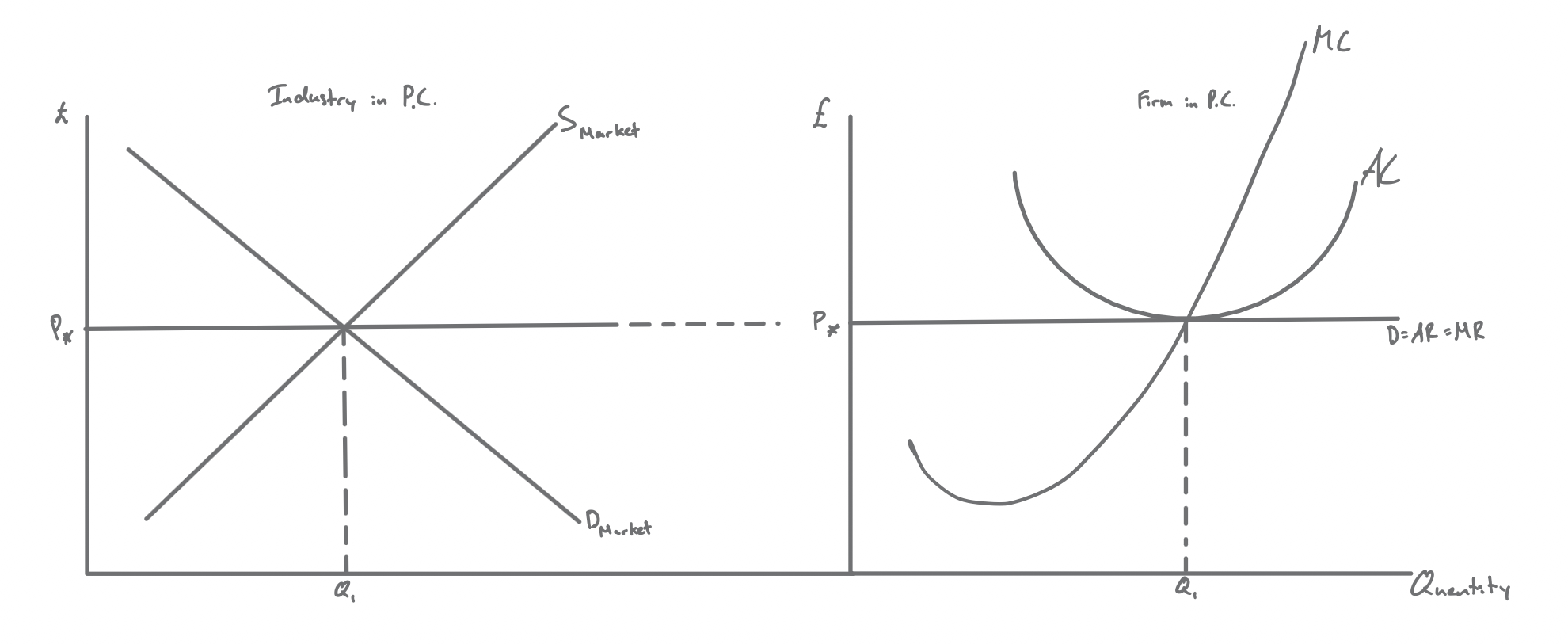
In the left panel, market demand and market supply fix the price P* (with market output Q1). The individual firm then takes that same P* as the horizontal D = AR = MR line in its own panel. The Q1 in the firm's panel is the firm's own output, a tiny fraction of the market's; its MC and AC curves belong to the costs and perfect competition topics, so here the line to focus on is the horizontal one. For the individual firm, price is constant, so every extra unit sold adds the same amount to revenue. That means AR = MR = price, and total revenue rises in a straight line through the origin as output increases.
Most firms do not face perfectly elastic demand. If demand slopes downward, the firm can sell more only by lowering price. That creates the key MR result: the firm must usually cut the price on all units, not just the extra one.
Suppose a firm sells 10 units at GBP 100 each, so total revenue is GBP 1,000. To sell 11 units, it has to lower price to GBP 95. Total revenue becomes GBP 1,045, so marginal revenue is only GBP 45.
The reason is:
- the 11th unit adds GBP 95
- but the firm loses GBP 5 on each of the original 10 units, so it loses GBP 50
- the net gain in total revenue is therefore GBP 45
This is why, for a downward-sloping demand curve, MR lies below AR. The extra unit is sold at the new price, but the price cut also reduces the revenue earned on previous units.
Formula: Linear demand and MR
If the demand curve is:
then:
MR has the same vertical intercept as AR, but twice the slope.
On a standard linear diagram, this means MR reaches the quantity axis halfway to where AR hits it.
PED and Total Revenue
Price elasticity of demand tells you whether a price change is likely to raise or lower total revenue. The link works through how strongly quantity demanded responds.
Continue this lesson.
You’re previewing NovaLearn without an account. Create a free account to read the rest.
Create free account