2.6.3 - Supply-side policies
Supply-side policies aim to make the economy more productive, more flexible, and able to grow without running into inflation quite so quickly. In this topic, the key exam skill is to link each policy to productive potential: how it changes incentives, efficiency, labour quality, or the economy's capacity to produce over time.
What Supply-Side Policies Do
Supply-side policies focus on the economy's capacity rather than just current spending. They are designed to raise the amount the economy can produce when resources are fully and efficiently used. That means they matter most for potential growth, not just for a temporary rise in demand.
Definition: Supply-side policies
Government policies designed to increase the productive potential of the economy and so raise long run aggregate supply.
Some supply-side improvement happens anyway. Firms invest in better machines, new technology spreads, and workers gain experience and qualifications. Government policy matters because it can speed up those improvements, remove barriers that are holding them back, or target bottlenecks that private markets have left unresolved.
Definition: Long run aggregate supply (LRAS)
The maximum potential level of output that an economy can produce over time when all resources are fully employed.
When supply-side policy works, LRAS shifts to the right. Real output can rise, but inflationary pressure does not have to rise with it in the same way it would under pure demand-side expansion.
Exam tip
Not all supply-side policies work on the same timescale. Education, training, research, and infrastructure mainly shift LRAS over years. Some measures, such as lower business taxes, deregulation, or policies that reduce firms' costs more quickly, can also affect SRAS earlier. In exam questions, choose the diagram that matches the timing of the effect.
[DIAGRAM: asset_name: 2.6.3 - Supply-side policies - diagram 1; asset_slug: 2.6.3 - 1; recommended_method: retained_png; description: Retained source diagram supporting 2.6.3 - Supply-side policies; the packaged PNG preserves the original educational visual.]
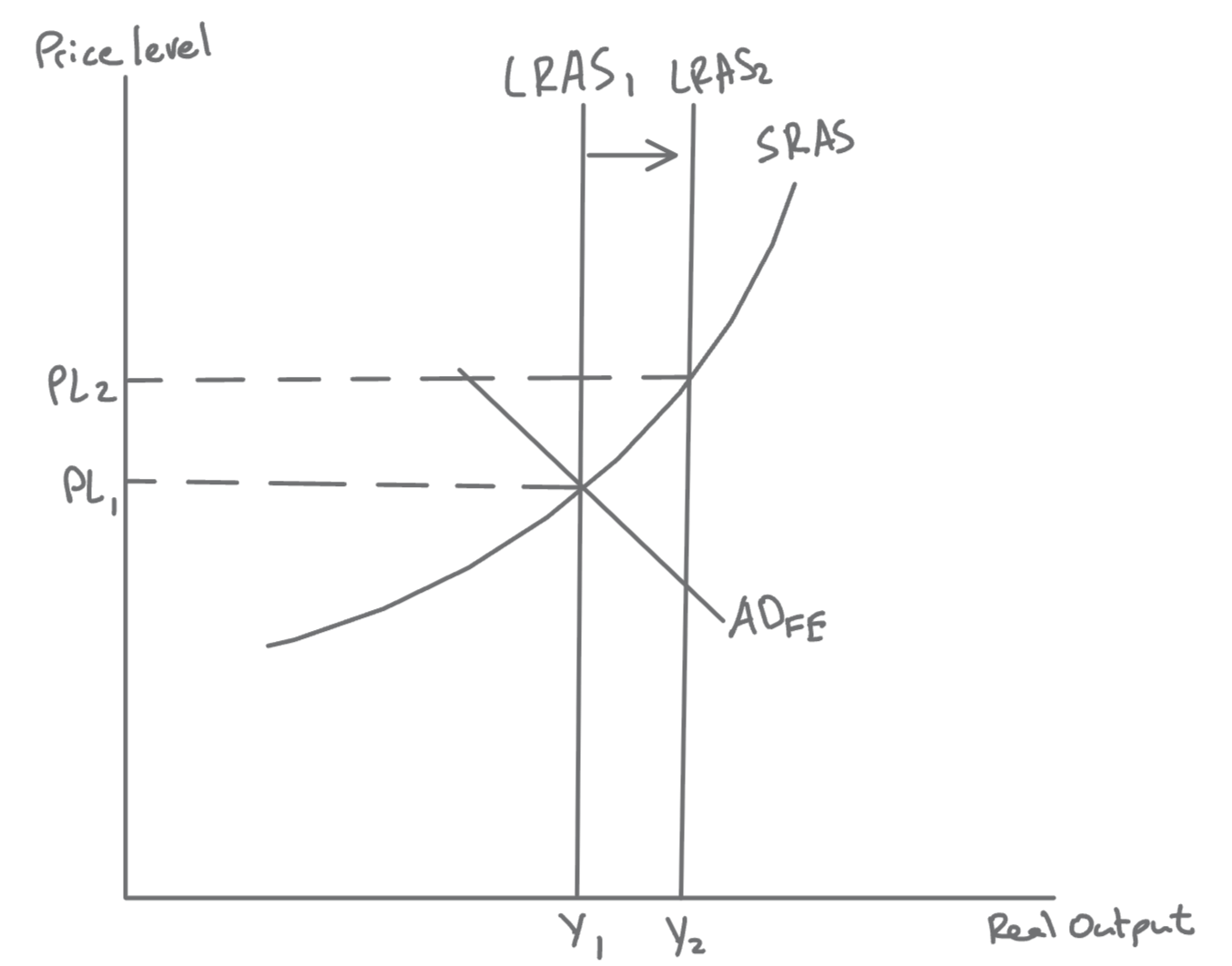
In the diagram, the economy starts at full employment: ADFE meets SRAS on LRAS1, at real output Y1 and price level PL1. Supply-side policy shifts LRAS1 right to LRAS2, so potential output rises from Y1 to Y2. Before the shift, pushing output out to Y2 would have taken the economy beyond its capacity, so prices would keep rising and the extra output could not last. After the shift, Y2 is within capacity. Actual output only gets there if aggregate demand grows to buy the extra output: on the existing SRAS, the economy would then produce Y2 at price level PL2, where SRAS meets LRAS2. If the policy also lowers firms' costs, SRAS shifts right as well and the price level rises by less. So supply-side policy raises what the economy can produce, but demand still decides how much it actually produces in the short run. That caveat matters. Supply-side policies can improve the economy's long-run position, but if the main problem is a recession caused by weak aggregate demand, firms may still be unwilling to hire or invest straight away because they do not have enough customers.
Market-Based and Interventionist Approaches
Economists usually group supply-side policies into two broad approaches. The distinction is important because it shapes evaluation: some policies try to make markets work more freely, while others rely on government correcting market failure directly.
Definition: Market-based supply-side policies
Policies that aim to increase productive potential by reducing government intervention and strengthening incentives in markets.
Market-based policies focus heavily on incentives. Lower marginal income tax rates may encourage extra work, promotion, or labour-force participation because workers keep more of each extra pound earned. The effect is not guaranteed: a tax cut also raises the income from hours already worked, so some people may choose to work fewer hours and keep the same take-home pay (the income effect). Lower corporation tax can raise the post-tax return on investment, and tax relief on research and development can make innovation more attractive.
Benefits can matter just as much as taxes. The unemployment trap happens when taking a job leaves a person only slightly better off because benefits are lost and taxes are paid. The poverty trap, sometimes called the earnings trap, affects low-paid workers whose extra earnings are heavily withdrawn through tax and reduced benefits. A gentler Universal Credit taper is meant to reduce that problem by letting workers keep more of any extra income they earn. In late 2021 the UK cut the taper from 63% to 55%: for each extra £1 of take-home pay above the work allowance, Universal Credit falls by 55p rather than 63p, so the worker keeps 45p instead of 37p.
Definition: Interventionist supply side policies
Policies that aim to increase productive potential through direct government action to correct market failure.
Interventionist policies start from the idea that markets may underprovide what growth needs most. Education, training, infrastructure, and research can all create spillover benefits, so firms and households may invest less than is socially optimal. That is why governments may directly fund schools, transport projects, universities, or research programmes rather than relying only on tax cuts and deregulation.
In practice, most governments mix the two approaches. UK policy has used both R&D tax relief, which is more market-based, and direct public funding for research and infrastructure, which is more interventionist.
Competition and Labour Market Reform
One way to raise productive potential is to make firms face stronger pressure to improve. More competition can reduce inefficiency, encourage innovation, and force firms to keep costs under control. That is why supply-side policy often includes privatisation, deregulation, and competition policy.
Privatisation is meant to expose firms to profit incentives and the threat of failure. The UK's privatisations of telecoms (BT, 1984), gas (British Gas, 1986) and airlines (British Airways, 1987) are classic examples. Deregulation tries to lower barriers to entry so new firms can challenge incumbents. Competition policy stops cartels, price-fixing, and anti-competitive mergers. In the UK, this role is carried out mainly by the Competition and Markets Authority. The big qualification is that not every market becomes genuinely competitive just because ownership changes. A natural monopoly such as water, privatised in England and Wales in 1989, can move from public monopoly to private monopoly with limited competitive gain, and deregulation can lead to cream-skimming if firms only serve the most profitable customers.
Labour market reform matters for the same reason: if workers can move into jobs more easily and firms can adjust more smoothly, the economy can produce more without bottlenecks. Labour market flexibility has several dimensions:
- Geographical flexibility: workers can move to the regions where jobs exist.
- External numerical flexibility: firms can change the number of workers they employ more easily.
- Internal numerical flexibility: firms can vary workers' hours when demand changes.
- Functional flexibility: workers can switch between tasks because they have broader skills.
- Wage flexibility: pay can respond to labour-market conditions.
Policies that affect housing supply, retraining, employment protection, trade union power, and retirement age can all influence those forms of flexibility. Weakening unions may increase wage flexibility, but the effect may be limited if unions are already relatively weak in much of the private sector. A lower minimum wage may reduce firms' costs in theory, yet moderate minimum wages do not automatically create large unemployment and may even encourage firms to invest in training or capital equipment to raise productivity. Raising the state pension age can also expand labour supply by keeping more people in work for longer.
Continue this lesson.
You’re previewing NovaLearn without an account. Create a free account to read the rest.
Create free account