3.4.2 - Perfect competition
Perfect competition is a theoretical market structure that shows what the most intense form of competition would look like. No real market fits it perfectly, but it matters because it gives economists a benchmark for judging pricing, profit, and efficiency in other market structures.
Conditions and Price Taking
Definition: Perfect competition
A market structure in which there are many buyers and sellers, firms sell homogeneous products, there is perfect knowledge, and there is freedom of entry and exit.
All four assumptions matter together. If there are many firms but products are differentiated, firms may still have some pricing power. In perfect competition, that does not happen because each firm's output is tiny relative to total market supply, the product is identical wherever it is bought, and buyers know the prices available. Firms also know when profit opportunities exist, which helps explain why entry is rapid in the model.
That is why the firm is a price taker. It cannot charge above the market price because consumers can switch to an identical product elsewhere. It has no reason to charge below the market price either, because it can already sell as much as it wants at the ruling market price.
Freedom of entry and exit also matters from the start. If firms can enter easily when profit looks attractive, and leave when losses persist, unusually high or low profits cannot last forever.
[DIAGRAM: asset_name: 3.4.2 - Perfect competition - diagram 1; asset_slug: 3.4.2 - 1; recommended_method: retained_png; description: Retained source diagram supporting 3.4.2 - Perfect competition; the packaged PNG preserves the original educational visual.]
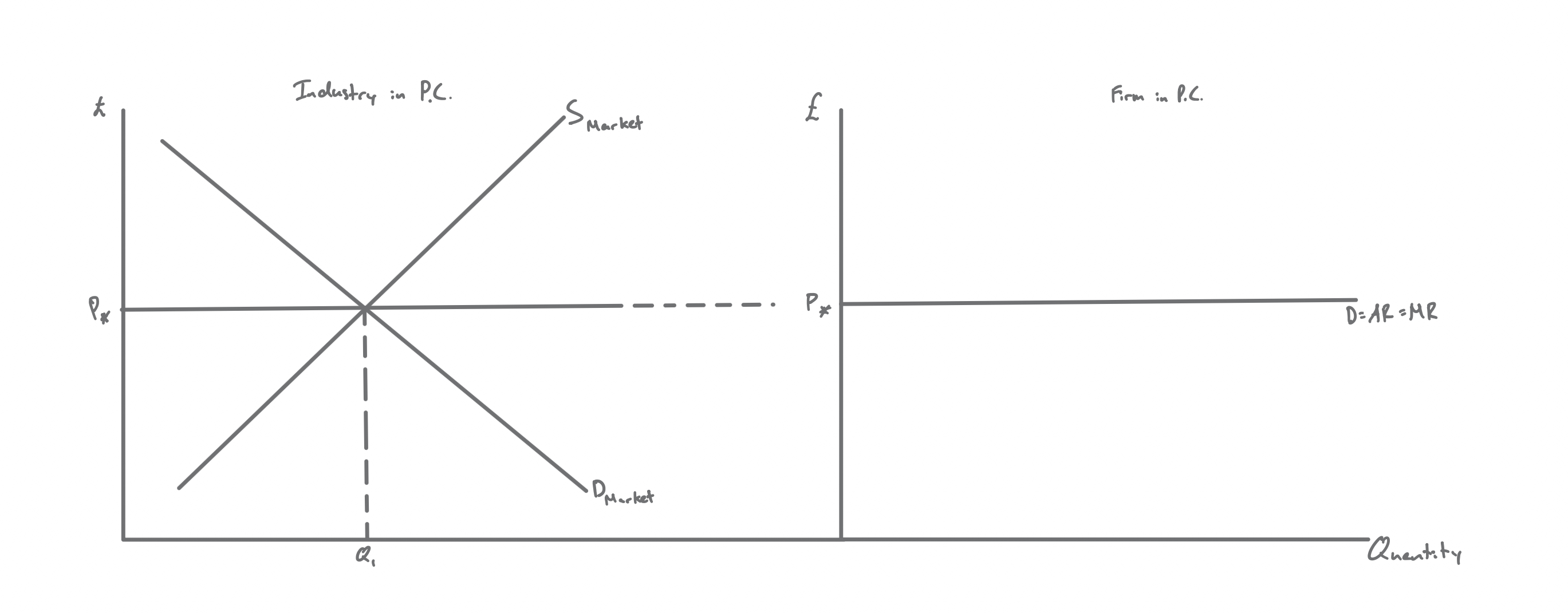
The diagram makes the logic clear. In the market panel, industry demand and supply determine the equilibrium price P* and quantity Q1, but the individual firm simply takes that same P* as the horizontal D = AR = MR curve in its own panel. So for the firm:
Every extra unit sold adds exactly the market price to revenue, so marginal revenue equals price. Average revenue is also the same price, because revenue per unit is just the price charged.
Application
The UK wheat market is often used as the closest classroom example. One British wheat farmer is too small to influence the national or world price, and wheat is much more standardised than branded manufactured goods. Even so, the market is still not perfectly competitive because quality differences, subsidies, and imperfect information remain.
Short-Run Outcomes
In the short run, at least one factor of production is fixed and the number of firms is taken as given. The individual firm still maximises profit in the usual way:
But because the firm is a price taker, this becomes:
The firm keeps expanding output while the revenue from the last unit is greater than the cost of producing it. Once marginal cost rises to the market price, producing another unit would no longer increase profit.
There are three possible short-run outcomes. If price is above average cost at the profit-maximising output, the firm earns supernormal profit. If price is exactly equal to average cost, the firm earns normal profit. If price is below average cost, the firm makes a loss. Any supernormal profit is the gap between price and average cost, multiplied by output.
Definition: Normal profit
The minimum profit needed to keep a firm or factor of production in its current use.
Normal profit does not mean the firm is doing badly. It means there is no incentive for resources to leave the industry, but also no extra reward strong enough to attract new entry.
If the firm is making a loss, it does not automatically shut down. The key short-run question is whether price covers average variable cost. If it does, the firm can keep producing because it is covering all variable costs and making some contribution toward fixed costs. If price falls below average variable cost, the firm shuts down in the short run because it cannot even cover its running costs.
This also gives the firm's short-run supply curve. At any price above minimum average variable cost, the firm supplies the output where , so its short-run supply curve is the part of its marginal cost curve above .
Common mistake
Making a loss is not the same as shutting down. A perfectly competitive firm stays open in the short run if price is above average variable cost, because producing reduces the size of the loss by helping to cover fixed costs.
Long-Run Adjustment
The long run is different because firms can enter or leave the market. That is why perfect competition is strongly associated with only one sustainable long-run profit position.
If firms are earning more than normal profit, perfect knowledge means other firms can spot that opportunity. Freedom of entry then allows new firms to enter the market. Industry supply increases, the market price falls, and each existing firm's profit is squeezed.
Continue this lesson.
You’re previewing NovaLearn without an account. Create a free account to read the rest.
Create free account