3.2.1 - Business objectives
Neo-classical economics often starts from a simple assumption: firms aim to maximise profit. That is useful in theory, but real businesses do not always behave that way. Different objectives emerge because different stakeholders influence the firm, and because large firms are often run by managers whose priorities are not identical to those of shareholders.
Why Objectives Differ
A firm's objective depends heavily on who has the most influence over decision-making. Shareholders usually want the highest possible return on their investment. Managers may care more about salary, status, job security, or the size of the business they run. Workers and trade unions may push for higher wages and better conditions. Consumers influence firms through what they buy, while governments and regulators can limit what firms are allowed to do.
This is why the same firm may appear to pursue different objectives at different times. In a small owner-managed business, profit maximisation is often more likely because the owners are making the decisions themselves. In a large public limited company, ownership and control are separated. Shareholders own the business, but managers control day-to-day decisions. This separation, often described as the divorce of ownership from control, creates more scope for alternative objectives.
The key exam idea is that firms do not choose objectives in a vacuum. The objective reflects the balance of power inside the business and the constraints coming from outside it.
Objectives Can Change Over Time
Firms do not necessarily keep the same objective throughout their life. A start-up or a firm in deep recession may focus first on survival, cash flow, and keeping creditors paid, because there is little point aiming for maximum profit if the business may not survive long enough to earn it. Once the firm becomes more secure, objectives such as growth, revenue, market share, or profit may become more important.
This is a useful exam judgement point: do not just name an objective, link it to the firm's context. A young firm, a takeover target, a state-owned business, and a mature plc may all pursue different objectives even within the same industry.
Profit Maximisation
Definition: Profit maximisation
The objective of producing at the level of output where profit is greatest.
Profit is the difference between total revenue and total cost, so profit maximisation means choosing the output where that gap is as large as possible. In standard theory, this occurs where marginal cost equals marginal revenue, on the rising part of the MC curve. If one more unit adds more to revenue than to cost, profit can still rise. If one more unit adds more to cost than to revenue, profit falls. The firm therefore stops where the two are equal.
[DIAGRAM: asset_name: 3.2.1 - Business objectives - diagram 1; asset_slug: 3.2.1 - 1; recommended_method: retained_png; description: Retained source diagram supporting 3.2.1 - Business objectives; the packaged PNG preserves the original educational visual.]
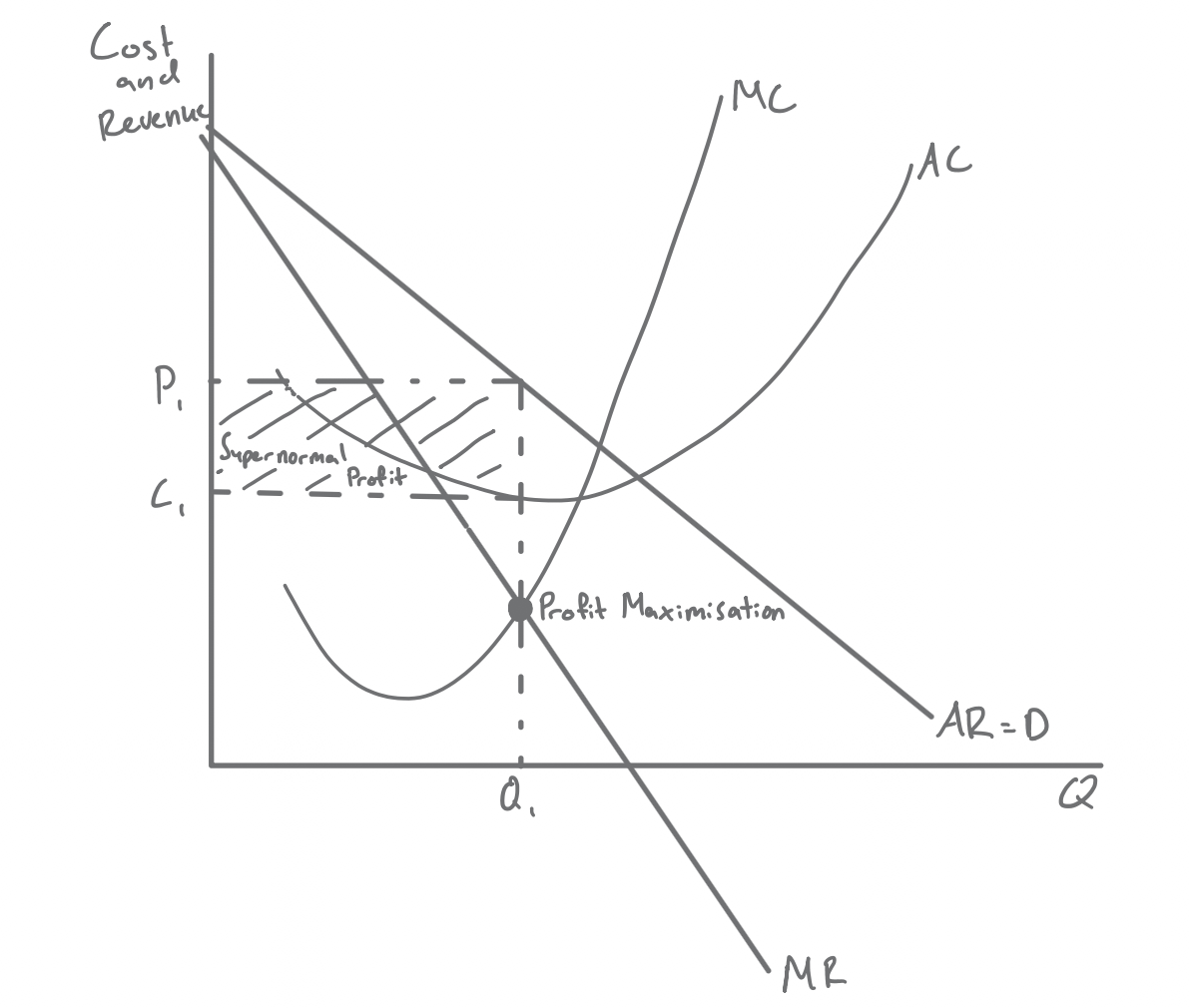
On the diagram, profit is maximised at Q1 where MC = MR. The firm then reads the price P1 from the AR curve at that output. If P1 is above AC at Q1, the gap between them is profit per unit; if P1 just equals AC, the firm is earning only normal profit. Here average cost at Q1 is C1, so the shaded rectangle, (P1 − C1) × Q1, is the firm's total supernormal profit.
This objective makes sense when shareholder interests dominate. Higher profits can be paid out as dividends or kept as retained profit for future investment. That matters in industries where firms need a financial buffer and large amounts of internal finance. For example, a firm such as AstraZeneca needs substantial profit to help fund expensive research and development, including projects that may never become successful drugs. In 2024 it spent over $12 billion on research and development.
Profit maximisation also improves survival. A business with strong profits is usually better placed to cope with recessions, unexpected cost increases, or competitive pressure than a firm operating on a very thin margin.
Revenue Maximisation
Definition: Revenue maximisation
The objective of producing at the level of output where total revenue is greatest.
Revenue maximisation is most closely associated with Baumol. The idea is that managers may prefer rapid growth in sales revenue even if that does not give the maximum possible profit. Managerial pay and prestige are often linked to the size of the business, and strong revenue growth is easy to show to investors, the media, and the board. Falling revenue can also worry lenders, shareholders, and directors, so protecting sales revenue may help managers protect their own position.
The usual condition is marginal revenue = 0. As long as marginal revenue is positive, selling one more unit still increases total revenue. Once marginal revenue becomes negative, extra sales reduce total revenue because the price cut needed to sell more output outweighs the gain from the extra unit. Total revenue is therefore at its highest when marginal revenue just falls to zero. For example, if cutting the price from £8 to £7 raises sales from 7 to 8 units, total revenue stays at £56, so MR = 0. Cutting the price again to £6 to sell 9 units lowers total revenue to £54.
[DIAGRAM: asset_name: 3.2.1 - Business objectives - diagram 2; asset_slug: 3.2.1 - 2; recommended_method: retained_png; description: Retained source diagram supporting 3.2.1 - Business objectives; the packaged PNG preserves the original educational visual.]
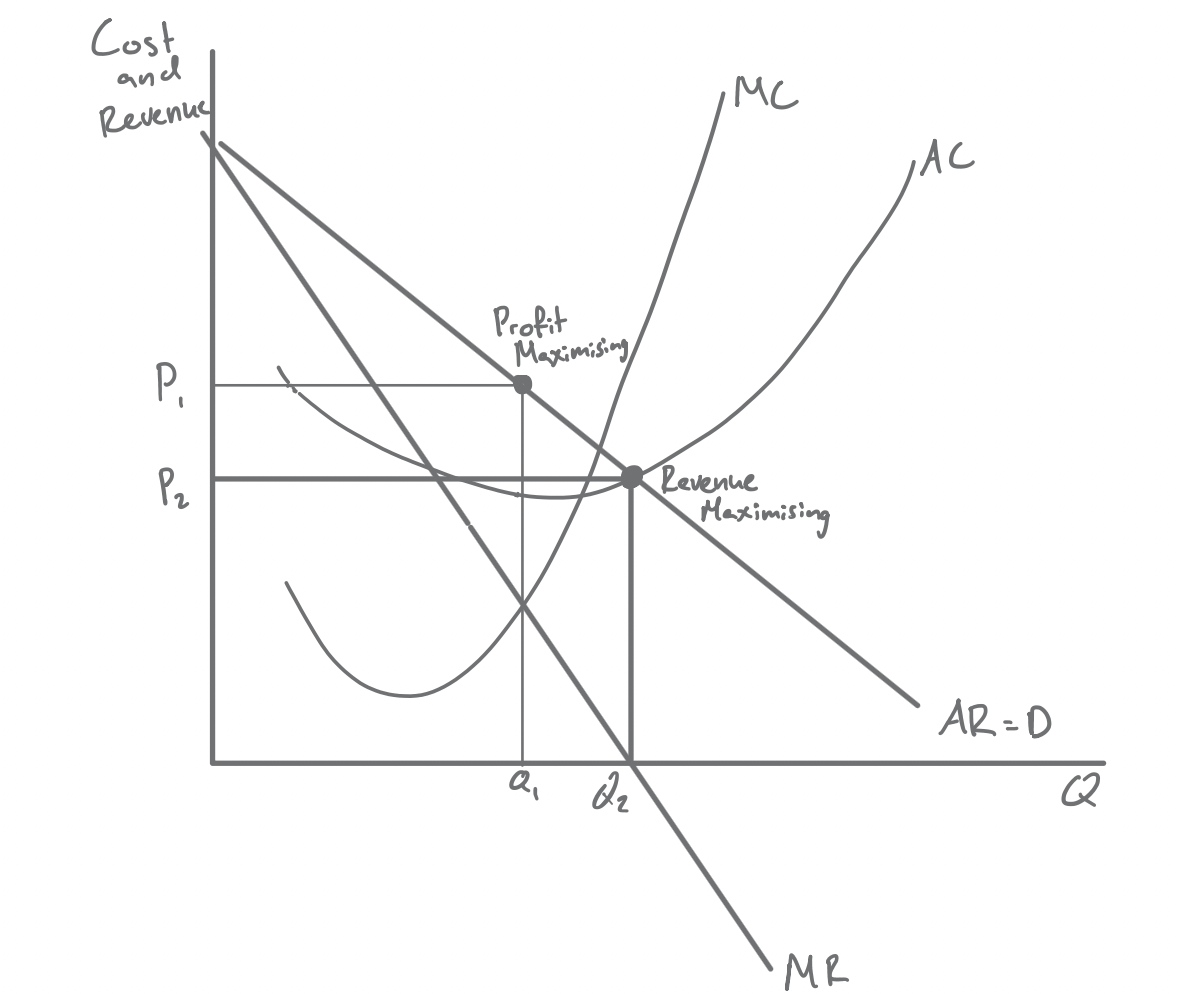
This helps explain the difference from profit maximisation. Profit is maximised at Q1 where MC = MR, but revenue is maximised further right at Q2 where MR = 0, and the price read from AR falls from P1 to P2 as output expands. Firms may still need to earn a minimum acceptable profit, but they are willing to sacrifice some profit if it allows them to achieve a higher sales revenue.
Amazon is a useful example. For long periods it prioritised rapid growth in sales revenue and market expansion, reinvesting heavily in logistics, technology, and Prime rather than aiming at maximum short-run profit. Founded in 1994, it did not report its first full-year profit until 2003: $35 million on revenue of $5.26 billion.
Continue this lesson.
You’re previewing NovaLearn without an account. Create a free account to read the rest.
Create free account