6.8 - Exact trigonometric values
Use two special right-angled triangles to obtain exact lengths and trigonometric values without a calculator. You will keep surds exact and combine these values with reference angles to work throughout a full turn.
The forty-five-degree triangle
Can you work out exactly without knowing either decimal? Two simple triangles will supply everything you need, and we will return to that product at the end.
Start with a right-angled triangle whose two shorter sides both have length . Its two acute angles are equal and add to , so each is . Pythagoras gives a hypotenuse of .
[DIAGRAM: asset_name: The forty-five-degree triangle; asset_slug: l2fm-exact-45-triangle; caption: Equal legs of length 1 give a hypotenuse of square root 2 and two forty-five-degree angles; description: A right-angled isosceles triangle has horizontal and vertical legs each labelled 1, hypotenuse labelled square root 2 and both acute angles labelled 45 degrees. A right-angle square marks the perpendicular legs. The equation 1 squared plus 1 squared equals square root 2 squared and ratio 1 to 1 to square root 2 are shown beside it.]
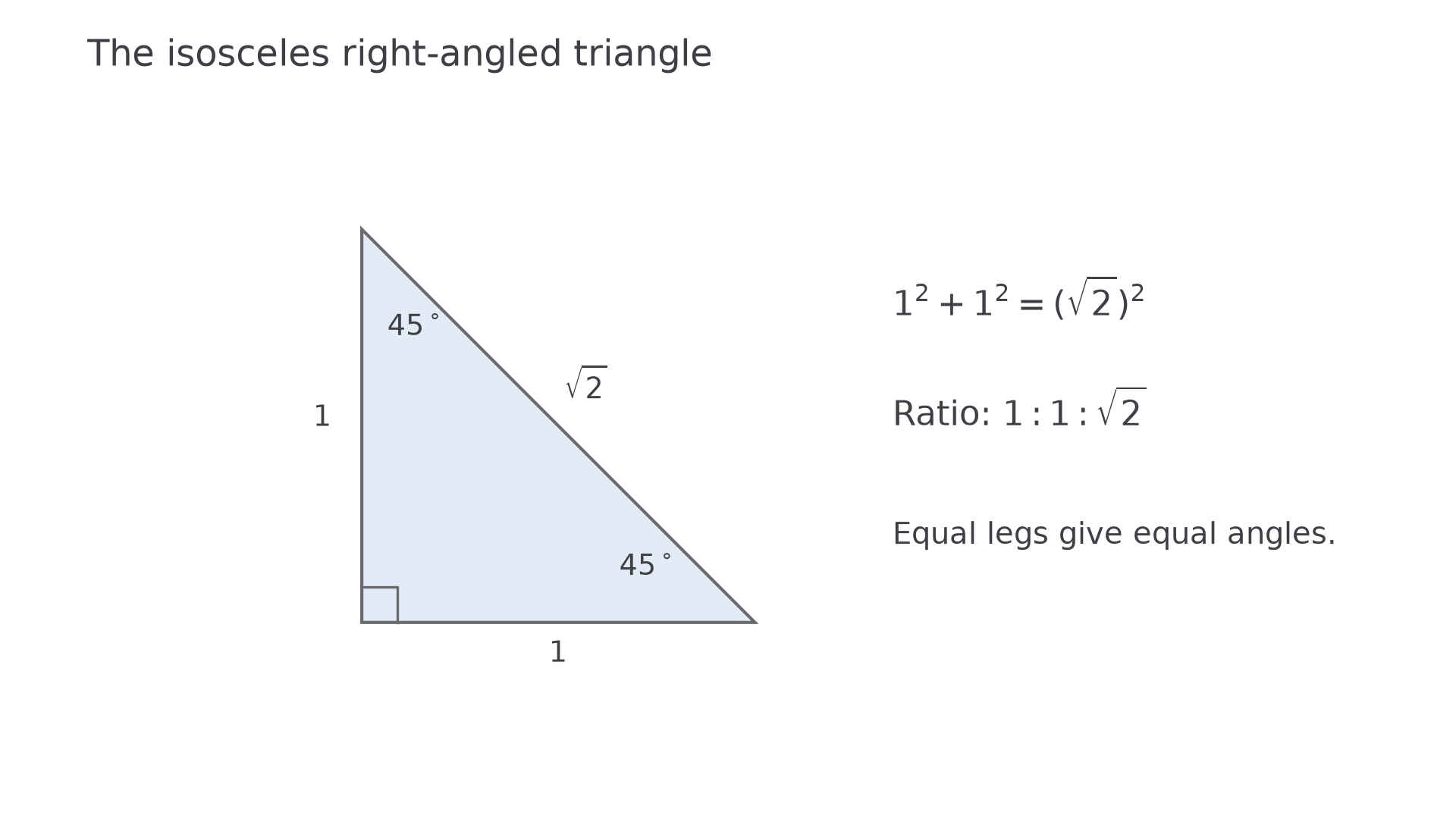
Any enlargement keeps the angles, so every triangle has the same side ratio. A ratio specifies relative lengths, not a requirement that one actual side must be .
Exact forty-five-degree values
For a triangle,
Hence
These are exact ratios, independent of the triangle's size.
Not on the formulae sheet: learn it.
The sheet gives the general right-triangle sine, cosine and tangent ratios. It does not give these exact values. Use the ratio to scale lengths directly.
Worked example 1: a rational hypotenuse
Question. A right-angled isosceles triangle has hypotenuse . Work out each shorter side exactly.
Plan. Match the hypotenuse to ratio parts, then work out the length of one part.
Why this step? The hypotenuse is longer than a leg by the factor , so divide by that factor.
Answer. Each shorter side is .
Check. .
Worked example 2 changes only the hypotenuse to . The same division now produces an integer.
Worked example 2: a surd hypotenuse
Question. A right-angled isosceles triangle has hypotenuse . Work out each shorter side exactly.
Plan. Divide the hypotenuse by its ratio part .
Why this step? A surd in the given length need not remain in the answer; the common factors cancel.
Answer. Each shorter side is .
Check. .
The ratio's order matters: its longest entry must represent the hypotenuse.
Watch out
Wrong: the legs in Worked example 1 are . That would make them longer than the hypotenuse. Right: .
Apply the same scaling to a new hypotenuse.
The thirty- and sixty-degree triangle
Bisect an equilateral triangle to obtain a second set of exact ratios.
Take an equilateral triangle of side . Its perpendicular bisector splits the base into two lengths of , and its top angle into two angles of . Each half is a right-angled triangle with hypotenuse , short leg and long leg .
[DIAGRAM: asset_name: The thirty- and sixty-degree triangle; asset_slug: l2fm-exact-30-60-triangle; caption: Bisecting an equilateral triangle gives the exact side ratio 1 to square root 3 to 2; description: An equilateral triangle of side 2 is split down its perpendicular height into two right-angled triangles. Each half-base is labelled 1, the height is square root 3, an outside sloping side is 2, and the right-hand half has acute angles 30 degrees at the top and 60 degrees at the base. A right-angle square marks the height meeting the base.]
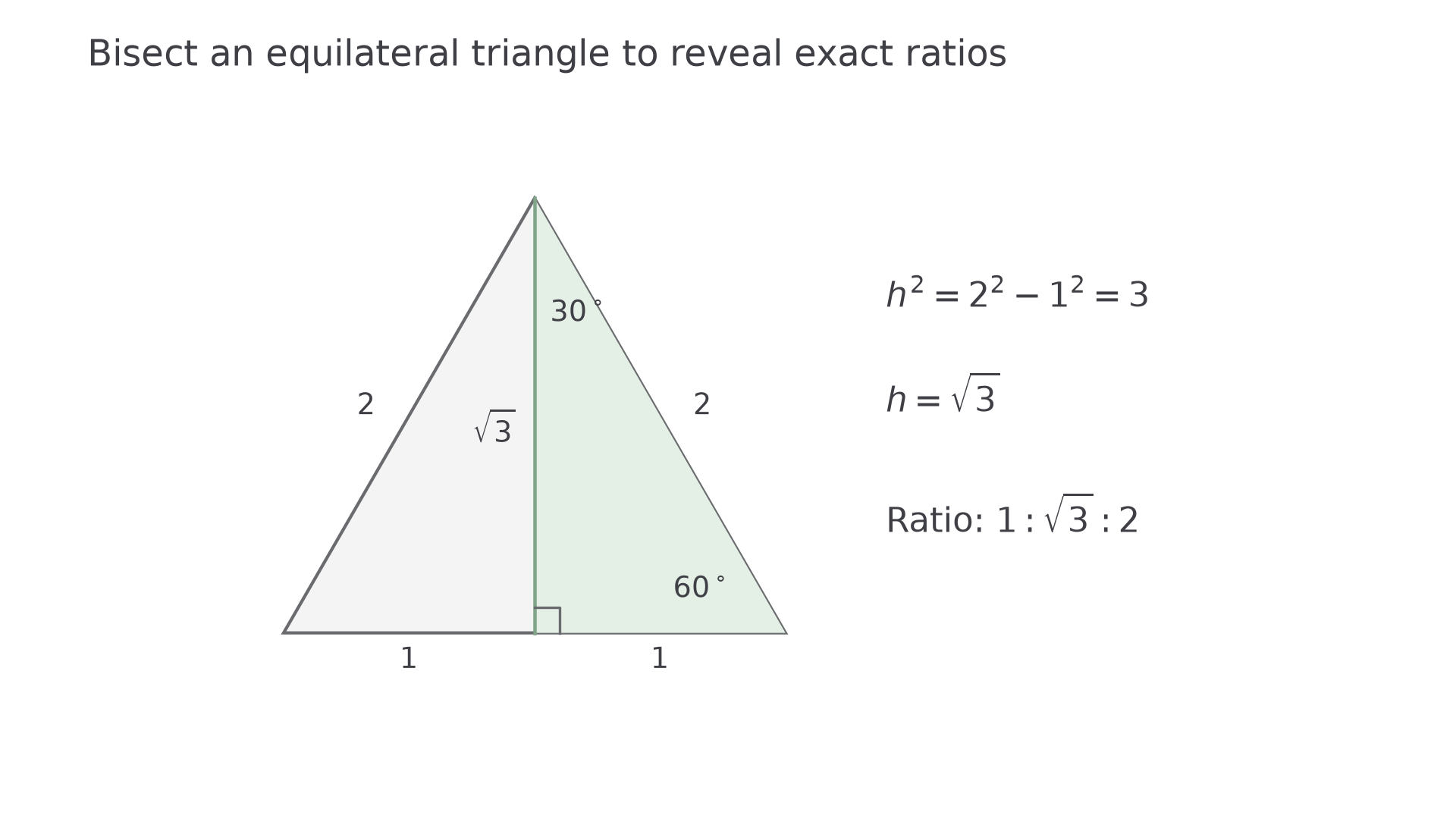
The side opposite is the short leg. The side opposite is the long leg. Saying which angle a side is opposite avoids swapping them.
Exact thirty- and sixty-degree values
For a triangle,
Therefore
Not on the formulae sheet: learn it.
Changing which side is given changes which ratio entry you match first.
Continue this lesson.
You’re previewing NovaLearn without an account. Create a free account to read the rest.
Create free account