1.1 - Fractions, percentages, ratio and proportion
Use fractions, decimals, percentage multipliers and ratios confidently, so the arithmetic supports your reasoning. You will choose an exact form, keep track of what a percentage refers to and distinguish direct from inverse proportion. These familiar number skills will carry much more interesting mathematics later in the course.
Fractions, decimals and exact calculation
A price falls by , then rises by : does it return to its starting value? Keep that question in mind. The arithmetic is short; choosing the right amount to take each percentage of is the real problem.
First, make the arithmetic dependable. A fraction and a decimal can name the same number: . Converting between them changes the notation, not the value. Use the form that makes the calculation clearest.
You already know
Integers include negative whole numbers, zero and positive whole numbers. Follow the order of operations: brackets, powers, multiplication and division, then addition and subtraction. Operations at the same level go from left to right.
A fraction bar groups its whole numerator and denominator: , whereas . Likewise, , but : in the second expression the power is evaluated before the leading minus.
Rational number
A rational number can be written as , where and are integers and . For example, , and are rational. Division by zero is undefined, so is not a number you may use in a calculation.
A terminating decimal is an exact fraction with a power of ten as denominator. For example, . A recurring decimal is exact when its repeating pattern is specified; cutting it off usually loses information. In particular, . Keep during a calculation, then round only if the question requests it.
Adding fractions requires equal-sized pieces, so use a common denominator. Multiplication combines the numerators and denominators. Dividing by a fraction multiplies by its reciprocal: there are halves in , so .
Fraction operations
For integers , with and ,
Simplify by cancelling common factors, not separate terms in a sum.
Not on the formulae sheet: learn it.
The following calculation has both brackets and multiplication. Deal with the brackets first, keeping the decimal exact.
Worked example 1: a decimal inside brackets
Question. Work out . Give your answer as a fraction in its simplest form.
Plan. Convert the decimal to a fraction, subtract using a common denominator, then multiply and simplify.
Why this step? Converting to lets you subtract exact quantities with a shared denominator.
Answer. .
Check. .
Worked example 2 changes just multiplication to division. The bracket is unchanged, but division by a positive number smaller than makes its value larger.
Worked example 2: dividing by a fraction
Question. Work out . Give your answer as a fraction in its simplest form.
Plan. Evaluate the bracket exactly, then multiply by the reciprocal of .
Why this step? Multiplying by reverses multiplication by ; it is the divisor that must be inverted.
Answer. .
Check. , recovering the original bracket.
An estimate catches errors that a neat-looking fraction can hide: the bracket is about , and dividing by should give a little more than .
Watch out
Wrong: . The denominators describe different-sized pieces; subtracting them does not make a common unit. Right: .
Now the bracket contains different fractions, but the order of operations and the reciprocal step stay the same.
Percentage multipliers and original amounts
A percentage compares an amount with a stated reference amount, so identify that reference before doing any arithmetic.
“ of ” means . There is a useful surprise here: of equals of ; both are . In general, , because multiplication can be done in either order. Occasionally an awkward percentage has a much friendlier twin.
Percentage change
The percentage change compares the change in an amount with its original value. For example, a rise from to is a increase, because the rise of is compared with , not . A percentage decrease uses the size of the fall compared with the original value.
To increase an amount by , retain the original and add : the new amount is times the original. For a reduction, remains, so use . These multipliers act on the entire current amount.
Percentage multipliers
For an original amount and percentage ,
To reverse a change, the multiplier must be non-zero. For an ordinary reduction, ; a reduction leaves zero whatever the original amount was, so it cannot be reversed from the new amount alone.
Not on the formulae sheet: learn it.
Writing the multiplier first makes the direction of the change visible. A multiplier greater than increases a positive amount.
Worked example 3: increasing an amount
Question. A price of £ is increased by . Work out the new price.
Plan. Multiply the original price by .
Why this step? The multiplier includes the original amount as well as the increase; multiplying by would give only the increase.
Answer. £.
Check. , and of £ is £. Adding it gives £.
Worked example 4 keeps the percentage change but reverses the direction of the task: the new price is known and the original price is wanted.
Worked example 4: reversing an increase
Question. After a increase, a price is £. Work out the original price.
Plan. Divide the new price by the increase multiplier .
Why this step? The increase was of the original price, so taking off the larger new price would remove too much.
Answer. £.
Check. , recovering the stated new price.
Successive changes use successive current amounts. For instance, two reductions give multiplier , so the total reduction is , rather than . Percentage multipliers and their reversals are not on the formulae sheet: learn them.
Watch out
Wrong: reverses a increase. That subtracts of the wrong starting amount. Right: .
The next question changes only the final price. Decide which amount represents before you calculate.
Ratios, totals and differences
A ratio describes the relative sizes of quantities using equal-sized parts, and the information given tells you how large one part is.
Ratio
For positive quantities and , means that contains equal-sized parts and contains of the same parts. For example, and are equivalent ratios. The ratio does not mean the first quantity is of the total: it is of the total.
Convert quantities to the same unit before simplifying a ratio: . Dividing both entries by the same non-zero number keeps the ratio unchanged.
For the ratio , the total contains parts but the difference contains only part. The bars show why those two pieces of information lead to different calculations.
[DIAGRAM: asset_name: Ratio total and difference; asset_slug: l2fm-number-ratio-bars; caption: A ratio of 4 to 5 gives 9 parts in total and 1 part in the difference; description: Two horizontal bars share the same left edge. The upper blue bar has 4 equal boxes labelled A and the lower sage bar has 5 equal boxes labelled B. Every box is the same size. The fifth box of B is labelled difference 1 part. Text states total 4 plus 5 equals 9 parts, A is 4 ninths of the total, and B is 5 ninths of the total.]
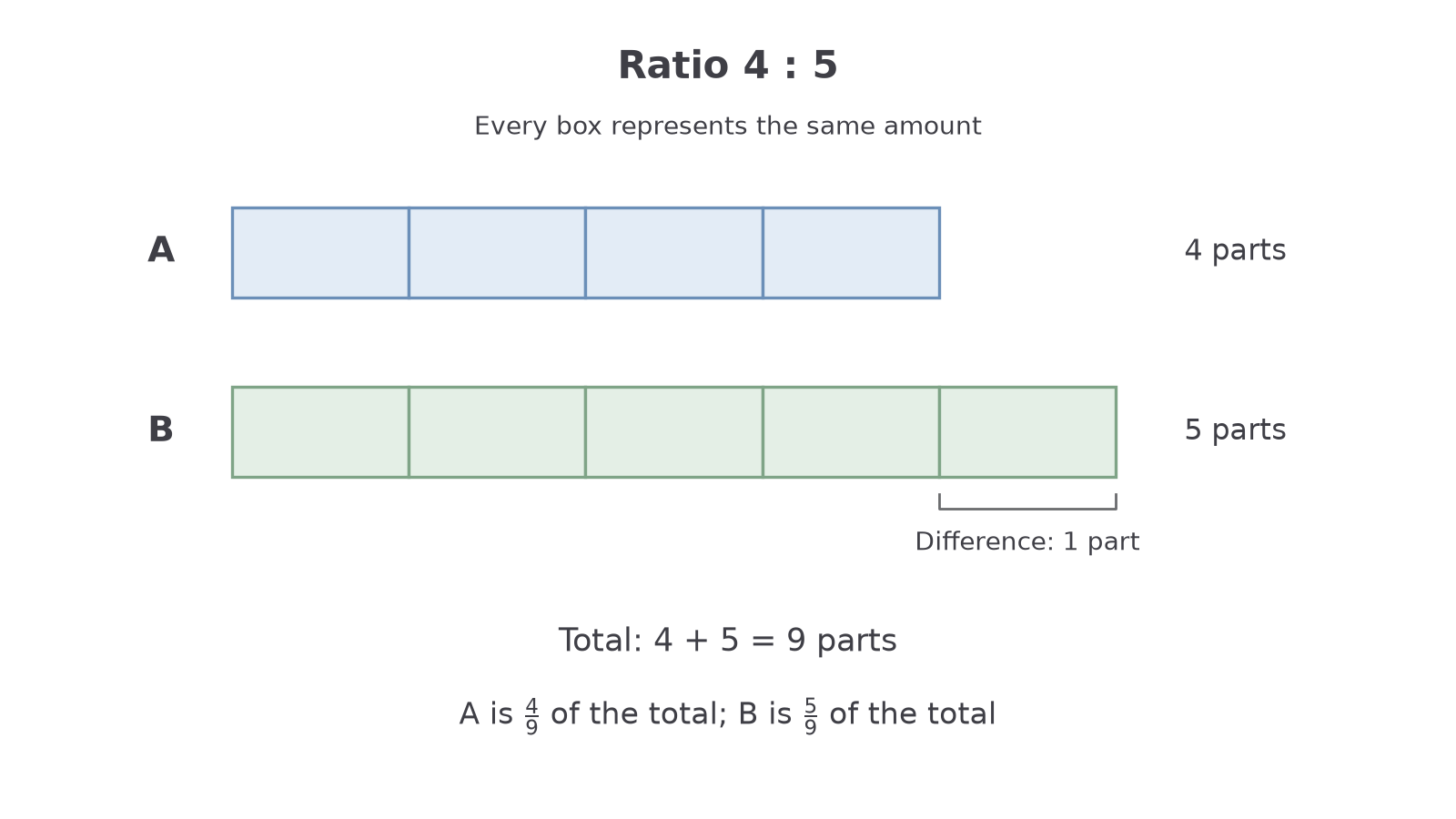
The size of one part is the bridge from a ratio to actual amounts.
Sharing in a ratio
For a total shared in the positive ratio ,
If instead the difference is given and , one part is .
Not on the formulae sheet: learn it.
Start by matching the given amount to its number of parts. Do not divide automatically by the sum of the ratio entries.
Worked example 5: the total is given
Question. £ is shared between Aisha and Ben in the ratio . Work out how much each receives.
Plan. The total represents parts; work out one part, then multiply by and .
Why this step? The ratio compares the two shares; adding its entries tells you how many equal parts make the whole £.
Answer. Aisha receives £ and Ben receives £.
Check. , and .
Worked example 6 keeps the ratio but gives a difference instead of a total. The equal parts are the same idea; the number of parts represented by the given amount changes.
Worked example 6: the difference is given
Question. Aisha and Ben receive money in the ratio . Ben receives £ more than Aisha. Work out how much each receives.
Plan. The difference represents part; use it to work out each share.
Why this step? The extra fifth part of Ben's share is exactly the £ difference, not the whole amount shared.
Answer. Aisha receives £ and Ben receives £.
Check. , and .
In more involved problems, labelling the one-part calculation “total” or “difference” makes the reason for your division clear.
Watch out
Wrong: gives one part in Worked example 6. The £ is a difference, so it represents parts. Right: . Use the sum for a total and the difference for a difference.
The next ratio has a gap of more than one part, so the given difference must be shared between those extra parts.
Direct and inverse proportion
Proportion tells you how one quantity changes when another changes, provided the relationship's assumptions stay true.
At a fixed price per item, doubling the number bought doubles the cost: the cost is directly proportional to the number. For a fixed job done by identical machines working together, doubling the number of machines halves the time: the time is inversely proportional to the number. More machines do not halve every quantity; they halve time here because the job is fixed.
Direct and inverse proportion
Two quantities are in direct proportion when their ratio is constant: multiplying one by a factor multiplies the other by that same factor. They are in inverse proportion when their product is constant: multiplying one by a factor divides the other by that factor. For example, doubling both quantities fits direct proportion; doubling one and halving the other fits inverse proportion. Adding the same amount to both does not in general preserve either relationship.
The constant summarises what the problem holds fixed: a rate for direct proportion, or the total work for the machine-time example.
Proportion relationships
For variables and , and a constant ,
The relationship must be stated or justified by the situation; a few convenient values alone do not establish it. Machine counts and times below are positive.
Not on the formulae sheet: learn it.
You can use a unit rate, a scale factor or the constant . Choose whichever leaves the calculation clearest.
Worked example 7: output in a fixed time
Question. Six identical machines produce parts in one hour. Each machine works at the same constant rate. Work out how many parts ten machines produce in one hour.
Plan. With time fixed, output is directly proportional to machine count; work out the output of one machine, then scale up.
Why this step? Each additional identical machine contributes the same parts in the fixed hour, so output scales with the number of machines.
Answer. parts.
Check. : output and machine count have the same scale factor.
Worked example 8 keeps the machine counts but changes what is fixed: a whole job replaces the one-hour time interval. Now the unknown is the time needed, so the relationship is inverse.
Worked example 8: time for a fixed job
Question. Six identical machines take minutes to complete a job. Each works at the same constant rate, and the job can be shared equally between any number of machines. Work out how long ten machines take to complete the same job.
Plan. Keep machine count multiplied by time constant, then divide by the new machine count.
Why this step? The job needs the same total machine-time; ten machines supply that work in less elapsed time than six.
Answer. minutes.
Check. . More machines take less time, as expected.
An additive rule can look proportional without being so. For a taxi fare with a fixed starting charge, twice the distance does not generally cost twice as much. Identify what stays constant before choosing a calculation.
Watch out
Wrong: gives the time for ten machines. That makes a larger workforce take longer. Right: . In inverse proportion, use the reciprocal scale factor.
Return to the opening price puzzle. Starting with £, a fall leaves the fraction , then a rise multiplies the new amount by :
It ends below the original. The fall was £; the later rise was only £, because it was of £. The percentages look equal, but their reference amounts differ. This is the same habit used in proportion: say what is fixed and what is changing.
Apply the fixed-job relationship once more with a different number of printers.
Quick Recap
- Keep fractions and specified decimals exact; obey brackets and the order of operations.
- Percentage changes multiply the current amount. Reverse a change by dividing by its multiplier.
- In a ratio, use the sum of the entries for a total and their difference for a difference.
- Direct proportion keeps a ratio constant; inverse proportion keeps a product constant. Check which assumptions make the relationship hold.
The opening price ends at of its starting value: equal percentage falls and rises act on different amounts.