6.6, 6.7 - Trigonometry for any angle
Extend sine, cosine and tangent beyond acute triangles using coordinates on a circle. You will use signs and reference angles, then sketch and read their graphs for angles of any size. All angles in this lesson are measured in degrees.
Trigonometric ratios from coordinates
Why does tangent repeat after half a turn, while sine and cosine take a full turn to repeat? A point moving round a circle makes the difference visible. Start at the positive horizontal axis and turn anticlockwise; after half a turn, both its coordinates change sign.
You already know
In a right-angled triangle, , and . On the formulae sheet.
For an acute angle, a point on a circle of radius , centred at the origin, makes a right triangle with horizontal side , vertical side and hypotenuse . The ratios are therefore , and . Keep these coordinate definitions as the point travels into the other quadrants: the coordinates now supply the signs that side lengths alone could not.
[DIAGRAM: asset_name: Coordinates define the ratios; asset_slug: l2fm-geometry-unit-circle; caption: Anticlockwise angle theta determines the signed coordinates of a point on the unit circle; description: A unit circle on x and y axes has point P at coordinates negative 3 fifths and 4 fifths in quadrant two. Radius OP is blue; a sage vertical drop and horizontal segment show the coordinate triangle. The anticlockwise angle theta is measured from the positive x axis, and acute reference angle alpha lies between OP and the negative x axis. A right-angle mark appears at the foot of the vertical drop.]
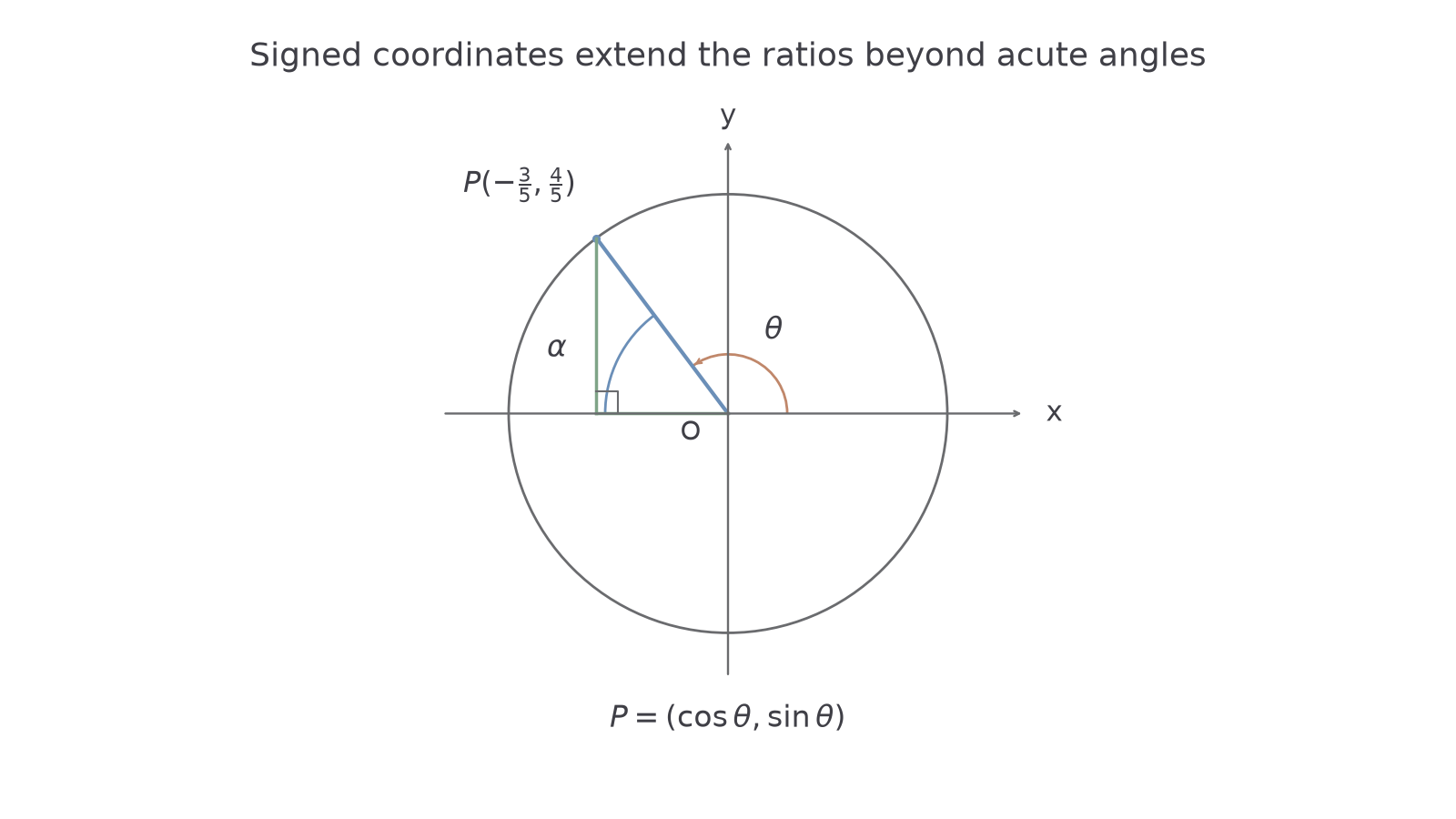
Using makes the coordinates themselves equal to cosine and sine. The radius remains positive even when a coordinate is negative.
Coordinate definitions
For a point on a circle with centre and radius , reached by an anticlockwise angle ,
On the unit circle, . Tangent is undefined when , including and .
Not on the formulae sheet: learn it.
The definitions work on the axes too. At , : sine is , cosine is , and tangent has no value because division by zero is undefined.
Worked example 1: a point in the second quadrant
Question. A radius of length ends at . Its anticlockwise angle from the positive horizontal axis is . Work out , and .
Plan. Use signed coordinates in the three definitions.
Why this step? Replacing signed coordinates by positive side lengths would lose the quadrant information.
Answer. , , , respectively.
Check. , so the point and radius agree. Its positive height gives positive sine.
Worked example 2 reflects only the point in the horizontal axis. The radius stays , while the vertical coordinate changes sign.
Worked example 2: a point in the third quadrant
Question. A radius of length ends at , at anticlockwise angle . Work out , and .
Plan. Use the same definitions with the new signed coordinates.
Why this step? The two ratios to the positive radius are negative, but the ratio of the two negative coordinates is positive.
Answer. , , , respectively.
Check. Reflection in the horizontal axis reverses sine and tangent but leaves cosine unchanged, as these answers show.
On a calculator, use degree mode. Negative sine and cosine values are normal outside the first quadrant.
Watch out
Wrong: , because its horizontal coordinate is zero. Right: tangent divides by that coordinate, so it is undefined. Cosine divides the zero coordinate by the positive radius, giving zero.
Use a new point and radius without first calculating the angle.
Reference angles and signs
A reference angle supplies the magnitude of a ratio, while the quadrant supplies its sign.
Reference angle
For an angle not on an axis, its reference angle is the acute angle between its radius and the horizontal axis. For example, the reference angle of is . It is not the angle measured to the vertical axis.
Reflecting a point in an axis changes one coordinate sign and preserves its distance from each axis. Rotating by changes both signs. The absolute coordinate ratios therefore match those of the acute reference triangle.
| Quadrant | Angle interval | Sine | Cosine | Tangent |
|---|---|---|---|---|
| First | positive | positive | positive | |
| Second | positive | negative | negative | |
| Third | negative | negative | positive | |
| Fourth | negative | positive | negative |
The axes are boundaries, so use coordinates directly there. At , the unit-circle points are , respectively. The sign table and reference-angle method are not on the formulae sheet: learn them.
Worked example 3: an angle in the second quadrant
Question. You are given , and . Write down , and .
Plan. Use reference angle and second-quadrant signs.
Why this step? The magnitude comes from the reference triangle; the signs come from the actual point's position.
Answer. , respectively.
Check. Reflection of the radius in the vertical axis preserves height and reverses horizontal position.
Worked example 4 changes only the quadrant, putting the radius below the negative horizontal axis.
Worked example 4: the same reference angle in the third quadrant
Question. You are given , and . Write down , and .
Plan. Keep reference angle and use third-quadrant signs.
Why this step? Both coordinates are negative here, so their quotient is positive even though sine and cosine are negative.
Answer. , respectively.
Check. The radius is a half-turn from the radius, reversing both coordinates.
Choose a positive acute reference angle, then apply the signs of the actual quadrant.
Watch out
Wrong: the reference angle of is , obtained from . That measures to the vertical axis. Right: use the horizontal axis, giving .
Take the same reference triangle into the fourth quadrant.
Continue this lesson.
You’re previewing NovaLearn without an account. Create a free account to read the rest.
Create free account