4.4 - Tangents and normals to curves
Turn a curve's local gradient into the equation of a straight line. You will differentiate to obtain tangent gradients, use perpendicular gradients for normals and handle the special case of a horizontal tangent with a vertical normal.
Writing the tangent equation
Can a curve have a perfectly ordinary tangent but a normal whose gradient cannot be written as a number? We will reach that case after building the usual tangent and normal methods.
You already know
The derivative gives the tangent gradient at a point. A line through with finite gradient has equation . This straight-line equation is on the formulae sheet.
Use the curve equation to work out the point's height, and the derivative to work out its tangent gradient. A point and a gradient then determine the line. The differentiation step is not on the formulae sheet: learn it.
Worked example 1: point and tangent gradient
Question. A curve has equation . Work out the equation of the tangent at , in the form .
Plan. Work out the height and derivative at , then use the point-gradient line equation.
Why this step? The height and gradient come from different functions; both are needed to locate the tangent.
Answer. .
Check. At , the line gives , and its gradient equals the curve's gradient there.
Change only the sign of the input, from to . Both the point's height and its tangent gradient must be recalculated.
Worked example 2: a different point on the same curve
Question. For , work out the tangent at , in the form .
Plan. Substitute into the curve and its derivative, then build the line.
Why this step? In , the coordinate gives , not .
Answer. .
Check. At , the line gives , with the required gradient .
Here is a useful exact fact about a parabola. The tangent to at is , so the vertical gap between the curve and that line is
At horizontal distance from contact, the curve is exactly above its tangent, wherever the contact point is. This fact is specific to this parabola; tangents to other curves can cross their curves.
Exam tip
Check which line the question asks for before writing its gradient. Using the negative reciprocal gives the normal, even if all your later straight-line work is correct.
The matched question uses a new quadratic and input; give the equation, not just the gradient.
Writing the normal equation
A normal is the line through the point of contact perpendicular to the tangent. It passes through the same point as the tangent, but usually has a different gradient.
[DIAGRAM: asset_name: A tangent and its perpendicular normal; asset_slug: l2fm-tangent-normal; caption: The tangent and normal both pass through P and their gradients multiply to minus 1; description: Equal-scale axes show the parabola y equals x squared and P at 1 comma 1. A sage tangent y equals 2x minus 1 and a clay normal y equals minus one half x plus three halves meet at P at a right angle. Separate labels show tangent gradient 2 and normal gradient minus one half. The curve and both line equations are identified]
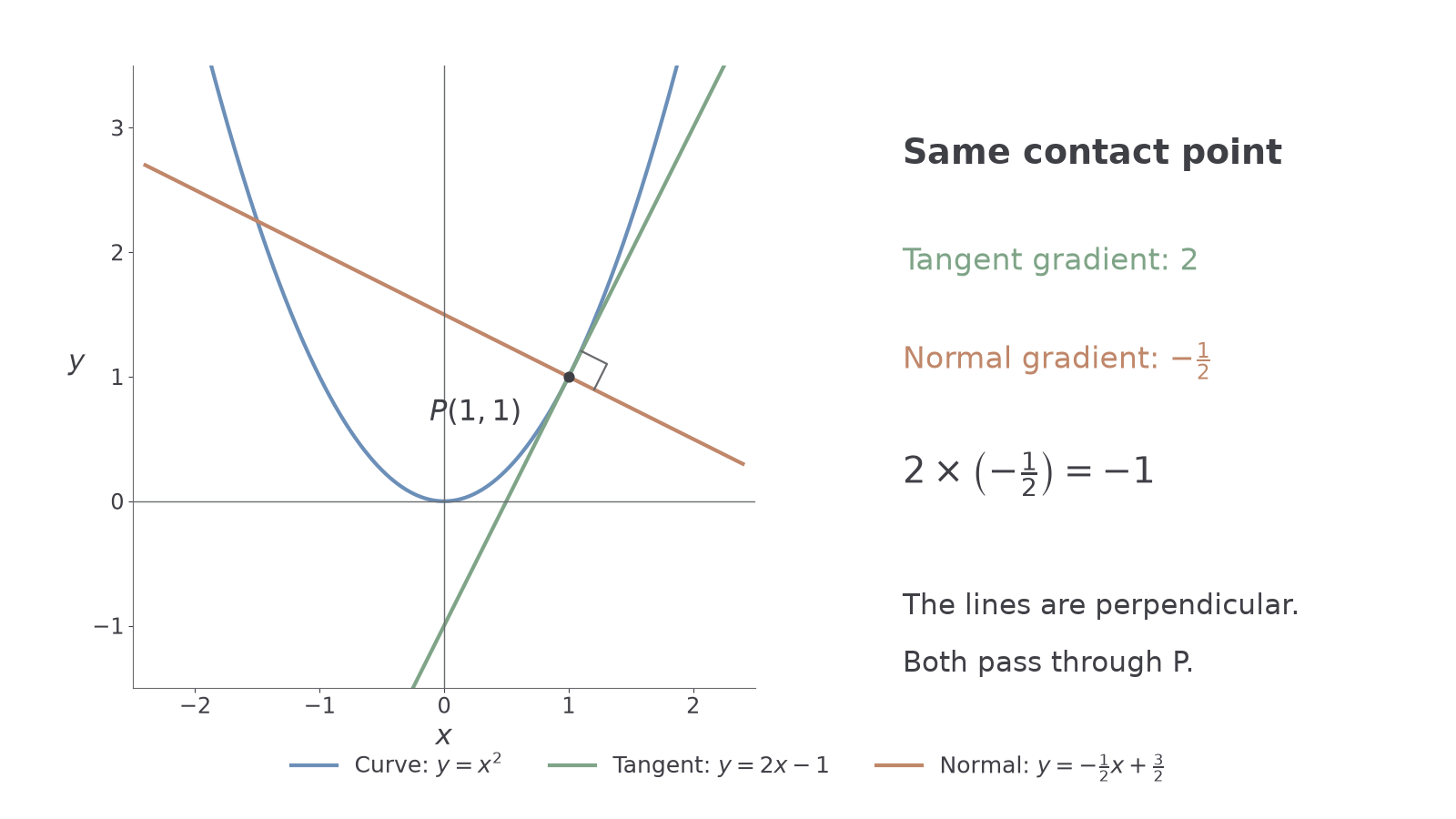
The perpendicular-gradient relationship applies when both gradients are finite and non-zero. Remember the negative sign as well as the reciprocal.
Normal gradient
If the tangent gradient at a point is a finite non-zero number , the normal gradient is
The normal passes through the same point on the curve.
Not on the formulae sheet: learn it.
Use this gradient in the same straight-line equation as before. The point's coordinates stay unchanged.
Worked example 3: a fractional normal gradient
Question. Work out the normal to at , in the form .
Plan. Work out the tangent gradient, take its negative reciprocal and use the point .
Why this step? The derivative supplies the tangent gradient, so an extra perpendicular-gradient step is required for the normal.
Answer. .
Check. The gradients multiply to ; the line gives at .
Continue this lesson.
You’re previewing NovaLearn without an account. Create a free account to read the rest.
Create free account