6.5 - Lengths and angles in 2D and 3D
Turn a flat or spatial diagram into the triangle that contains the required length or angle. You will interpret bearings, distinguish line-to-plane from plane-to-plane angles and use the cosine rule when a triangle inside a solid is not right-angled.
Building the triangle in a two-dimensional problem
On one square pyramid, can a sloping edge and a sloping face make different angles with the same horizontal base? Yes: the triangles used to measure those angles are different. We will calculate both, after practising how to extract the angle inside a flat triangle.
A bearing is measured clockwise from north and written with three digits. Bearings locate directions, but a trigonometric rule needs the angle inside the triangle. For two directions from the same point, work out the smaller angle between their rays. For bearings crossing north, such as and , that angle is , not .
[DIAGRAM: asset_name: Bearings and the included angle; asset_slug: l2fm-bearings-included-angle; caption: Bearings of thirty and one hundred fifty degrees give an included angle of one hundred twenty degrees; description: From O, the north direction is dashed upwards. A is 6 units away on bearing 030 degrees, and B is 10 units away on bearing 150 degrees. Triangle OAB is shaded, with the included angle at O marked 120 degrees.]
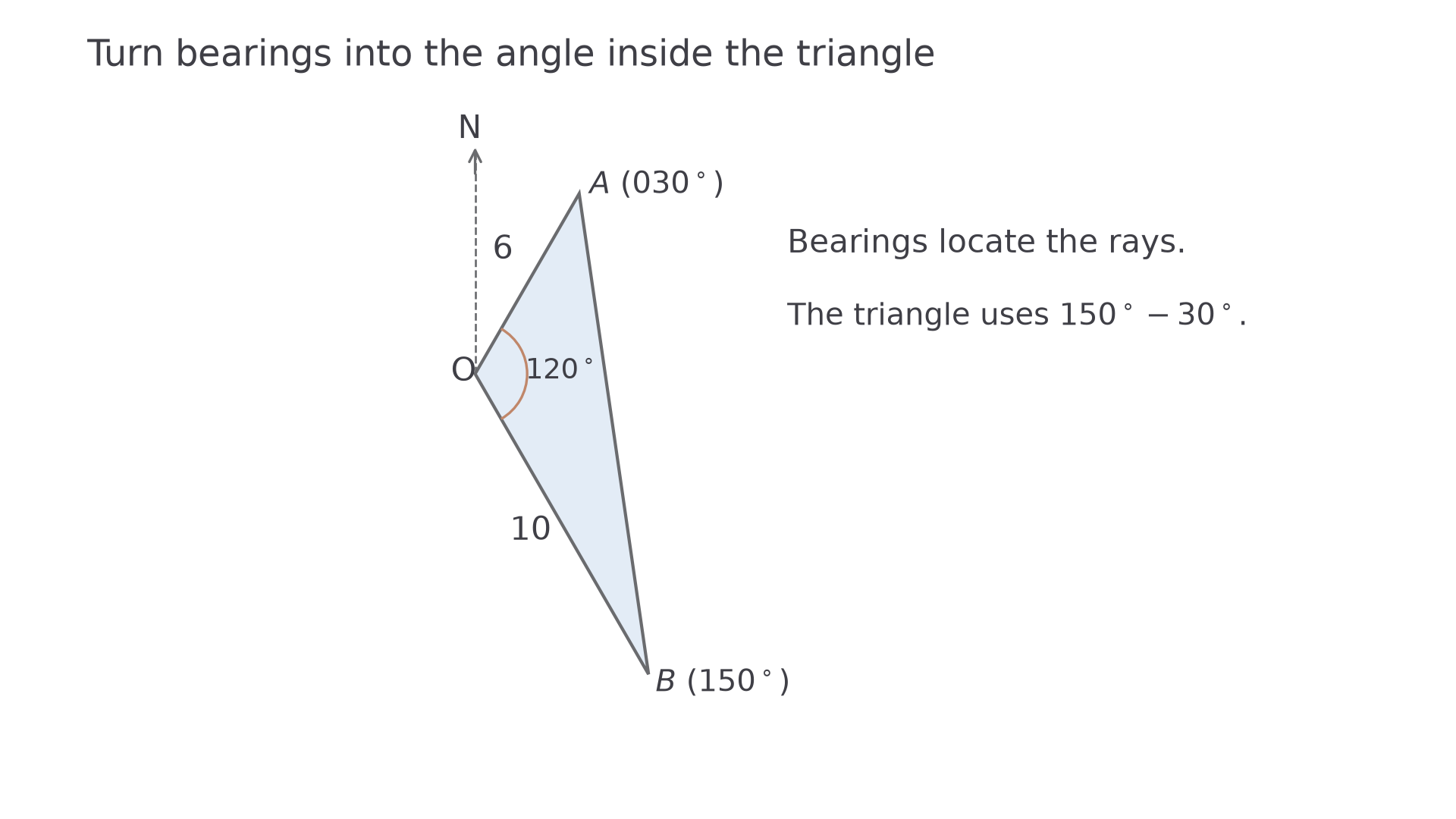
The geometry chooses the angle; the calculation then uses a rule you already know. Pythagoras, the right-triangle ratios and the sine/cosine rules are on the formulae sheet. The choice of triangle and interpretation of bearings are not supplied as a procedure: learn them.
Worked example 1: directions give an obtuse angle
Question. on bearing , and on bearing . Work out .
Plan. Subtract the bearings to obtain the included angle, then use the cosine rule.
Why this step? The bearings are measured from the same north line, so their difference gives this included angle.
Answer. .
Check. , as required for a triangle.
Worked example 2 changes only 's bearing to . Its distance remains , but the included angle is smaller.
Worked example 2: the new direction changes the separation
Question. on bearing , and on bearing . Work out exactly.
Plan. Recalculate the included angle before using the same side lengths.
Why this step? The side lengths alone do not determine the separation; the included angle is part of the triangle's information.
Answer. .
Check. This is shorter than , as expected when the two rays move closer together.
In a more crowded diagram, sketch just the required triangle beside it and label every known length and angle.
Watch out
Wrong: use a bearing itself as the triangle's included angle. Right: first work out the angle between the appropriate rays, using parallel north lines if they start at different points.
Try new distances and bearings, again starting from a common point.
The angle between a line and a plane
Compare a sloping line with its perpendicular projection onto the plane, rather than with whichever edge looks nearest in the drawing.
Angle between a line and a plane
For a line meeting a plane obliquely, its angle with the plane is the acute angle between the line and its perpendicular projection onto the plane. A line perpendicular to the plane makes an angle of ; a parallel line makes an angle of .
For a pyramid with apex vertically above base centre , the projection of sloping edge onto the base is . The required angle is therefore , in the right-angled triangle . It is at the base vertex, not at the apex.
[DIAGRAM: asset_name: A line and its projection onto the base; asset_slug: l2fm-line-plane-projection; caption: The angle of VA with the base is the angle between VA and its projection OA; description: A square-base pyramid ABCD has V vertically above centre O and AB equals 8. Sloping line VA is blue, horizontal projection OA sage and perpendicular height VO clay. The extracted right triangle VOA has VO equals 3, OA equals 4 square root 2 and the required angle alpha at A.]
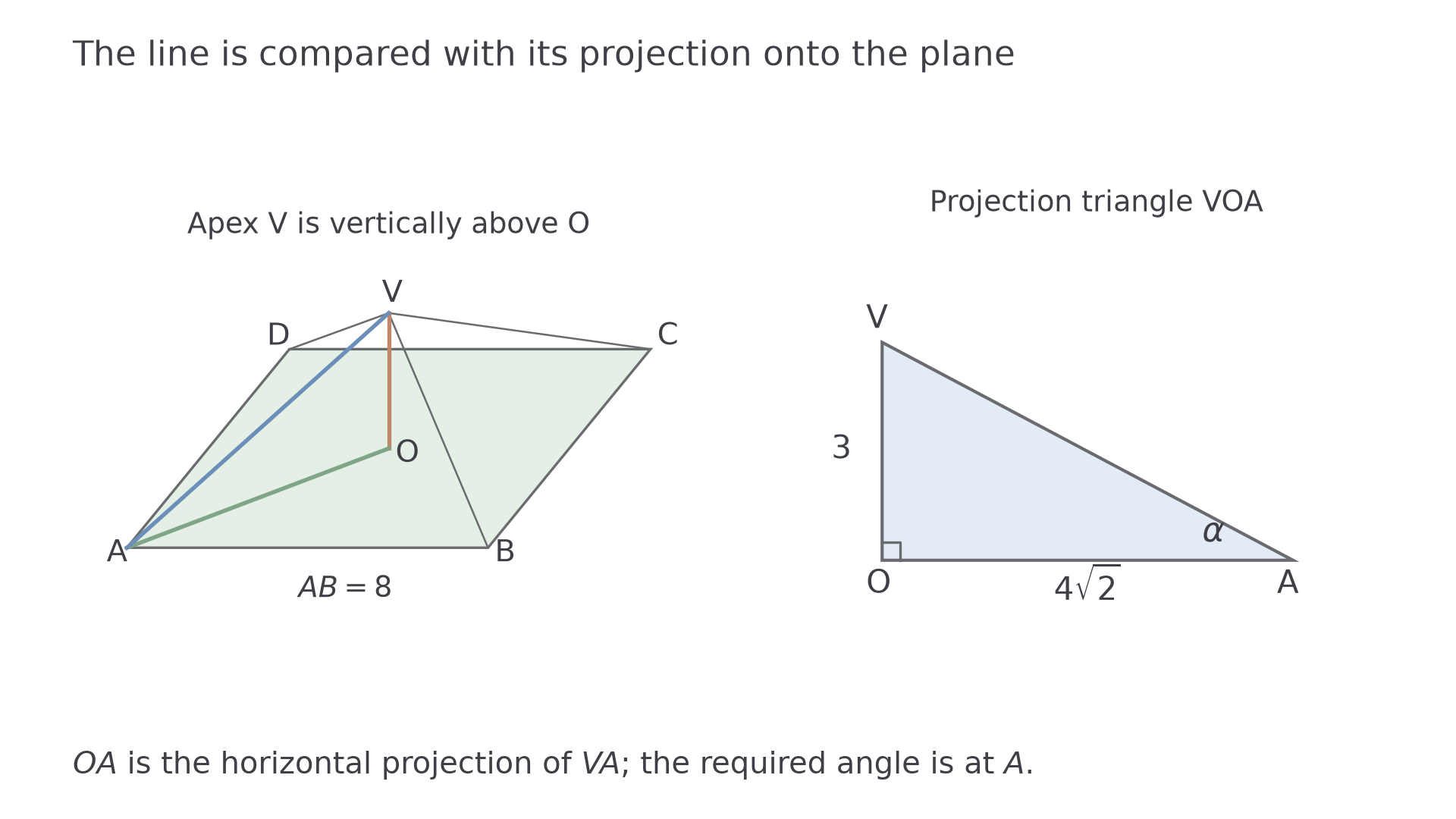
The projection tells you the horizontal distance to use. This angle definition and triangle choice are not on the formulae sheet: learn them; the right-triangle ratios themselves are supplied.
Worked example 3: an edge above a square base
Question. A pyramid has square base of side . Its apex is vertically above the centre . Work out the angle between a sloping edge and the base, to decimal place.
Plan. Calculate half the base diagonal, then use tangent in .
Why this step? The edge projects onto half a diagonal, not half a side of the square.
Answer. .
Check. , so this angle must be below .
Worked example 4 changes only the vertical height, from to . The base projection is unchanged.
Worked example 4: a steeper sloping edge
Question. The same square-base pyramid has base side , but its apex is vertically above the centre. Work out the angle between a sloping edge and the base, to decimal place.
Plan. Keep the exact projection and use the new height.
Why this step? Doubling the height doubles the tangent, rather than doubling the angle.
Answer. .
Check. Now , so the angle is above , consistent with the answer.
Keep exact diagonals until the last calculator step.
Watch out
Wrong: use in Worked example 3. The distance reaches a side midpoint, whereas the edge ends at a corner. Right: use .
Change the base and height, keeping the apex vertically above its centre.
The angle between two planes
Measure the angle between intersecting planes in a cross-section perpendicular to their common line.
Angle between two planes
Take a point on the planes' common line and draw one line in each plane perpendicular to that common line. The smaller angle between these two perpendicular lines is the angle between the planes, between and . Parallel planes have angle ; perpendicular planes have angle .
Continue this lesson.
You’re previewing NovaLearn without an account. Create a free account to read the rest.
Create free account