2.21 - nth terms of linear sequences
An nth-term rule lets you go straight to any position in a sequence. You will build rules for numerical and algebraic linear sequences, then use them to decide whether a value occurs and which term first passes a boundary.
From a constant difference to a rule
The sequence keeps falling by . Will it ever land exactly on , or will it step straight past? A rule will answer that without listing nearly two hundred terms.
Start with . To reach position from position , you make three jumps of , giving . Position is reached after jumps.
Linear sequence
A linear sequence has a constant difference between consecutive terms. Its common difference is the next term minus the current term. For example, has common difference ; has common difference . The sequence is not linear because its differences change.
Write for the term in position . Unless told otherwise, positions are the positive integers : a negative term is allowed, but a negative position is not.
[DIAGRAM: asset_name: Counting jumps in a linear sequence; asset_slug: l2fm-linear-sequence-jumps; caption: Position n is reached by n minus 1 equal jumps from the first term; description: Two rows show the terms in positions 1 to 5. The increasing row is 7, 11, 15, 19, 23 with arrows labelled plus 4. The decreasing row is 7, 3, minus 1, minus 5, minus 9 with arrows labelled minus 4. A bracket under the first four positions shows three jumps from position 1 to position 4.]
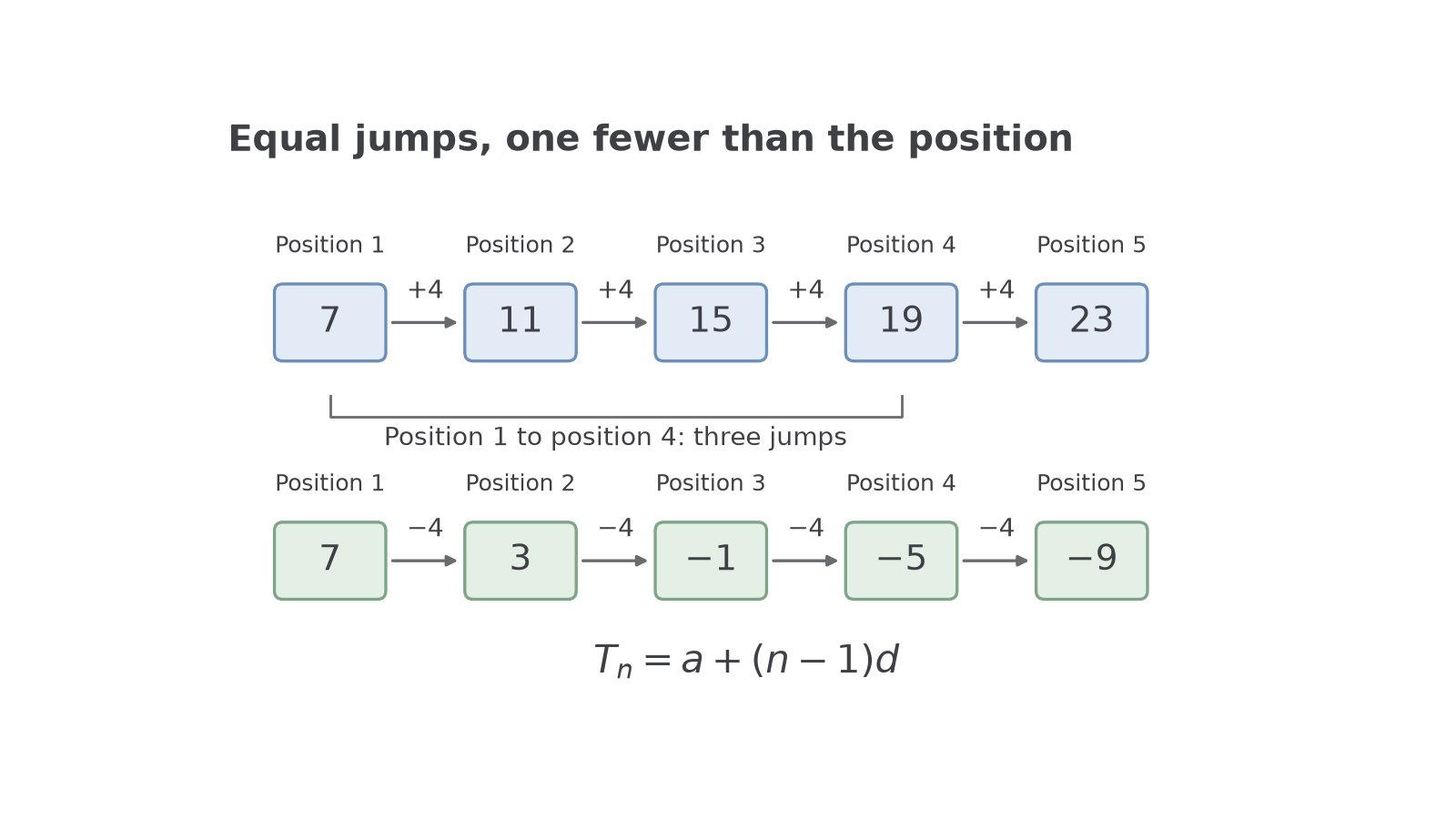
The first term supplies the starting value; the common difference supplies the size and direction of every jump.
Nth term of a linear sequence
If the first term is and the common difference is , then
The difference may be positive, negative or zero. When , all the terms are equal.
Not on the formulae sheet: learn it.
Use the jump form to build the rule, then simplify if you want the form .
Worked example 1: an increasing sequence
Question. Work out an expression for the nth term of .
Plan. Start at and add jumps of .
Why this step? There are jumps, because position already contains the first term.
Answer. .
Check. At , the rule gives ; at , it gives . Increasing by adds .
Change only the common difference from to . The first term stays , so the starting value is unchanged.
Worked example 2: a decreasing sequence
Question. Work out an expression for the nth term of .
Plan. Start at and make jumps of .
Why this step? The common difference is negative, so the coefficient of must be negative too.
Answer. .
Check. and , matching the given terms.
Decimals and fractions work in the same way. For , the difference is , so . The positions remain integers even when the terms are not.
Watch out
Wrong: for the decreasing example. It gives at , missing the first term. Right: . Always test position .
Try a different negative difference. Keep the starting value and the jump count separate.
Linear sequences with algebraic terms
Letters in the terms do not change the method: subtract consecutive terms to identify the common difference, then count the jumps.
In a sequence with terms involving and , these letters stand for fixed values throughout the sequence. Only the position changes. Keep brackets when subtracting a complete term; the repeated often cancels.
Worked example 3: an algebraic common difference
Question. Work out the nth term of the linear sequence .
Plan. Subtract the first term from the second, then use the first-term rule.
Why this step? The common difference is , not : the coefficients of go .
Answer. .
Check. Positions and give and . If , every term becomes , as the rule predicts.
Change only the common difference from to , keeping the first term . This changes the coefficient of , as well as the constant adjustment.
Worked example 4: changing the algebraic step
Question. Work out the nth term of the linear sequence .
Plan. Use first term and common difference .
Why this step? Expanding contributes , which combines with the starting to give .
Answer. .
Check. At , the coefficient of is , respectively.
There is a neat balance in every linear sequence: terms equally far either side of a middle term add to twice that middle term. Here, . In general, the equal backwards and forwards jumps cancel. This holds even if the difference is negative or zero.
Watch out
Wrong: for Worked example 4. At , it gives . Right: . The first term fixes the adjustment after you choose the coefficient of .
Continue this lesson.
You’re previewing NovaLearn without an account. Create a free account to read the rest.
Create free account