4.1, 4.2 - The gradient function of a curve
A curve can be steep at one point and almost flat at another, so one gradient cannot describe the whole curve. You will interpret its gradient function, use supplied gradient functions to work out local gradients and explain what those gradients mean as rates of change.
The gradient at one point
At on , should the curve's gradient be or ? Both numbers come from sensible-looking lines through that point. The choice depends on whether you want the gradient at one point or an average between two points.
You already know
A straight line has gradient . Its gradient is constant. A positive gradient slopes upwards as you move right; a negative gradient slopes downwards; a horizontal line has gradient zero.
The blue curve below has a tangent of gradient at . The other line passes through two points on the curve, so it gives the average gradient between them. It does not give the gradient at .
[DIAGRAM: asset_name: Tangent and chord at the same point; asset_slug: l2fm-tangent-and-chord; caption: The tangent gives gradient 2 at P while the chord gives average gradient 4 from P to Q; description: Coordinate axes show y equals x squared, P at 1 comma 1 and Q at 3 comma 9. A sage tangent through P has equation y equals 2x minus 1 and gradient 2. A clay chord through P and Q has equation y equals 4x minus 3 and gradient 4. Clear separate labels distinguish local tangent gradient at P from average gradient between P and Q]
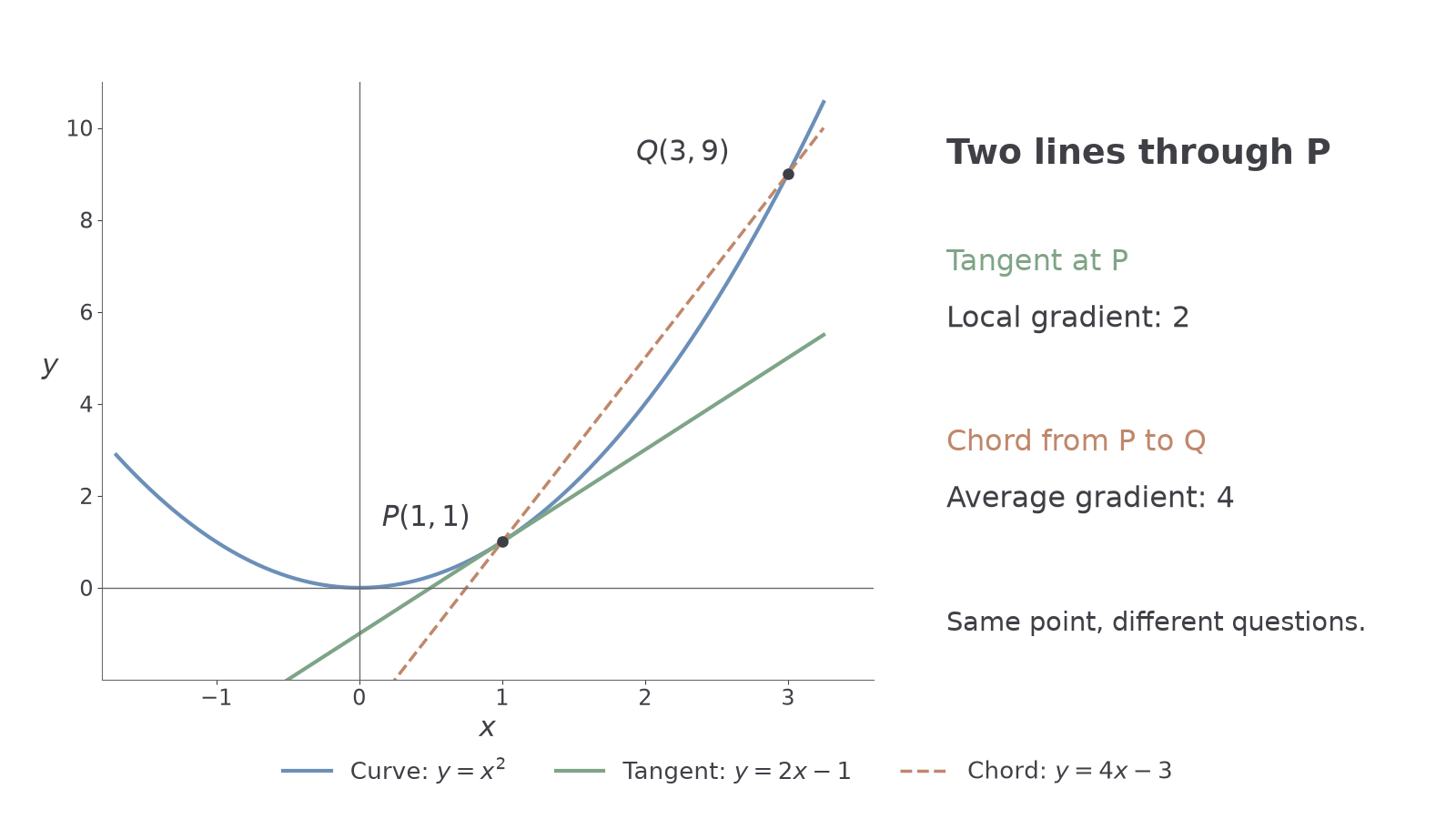
A tangent follows the curve's direction at its point of contact. If you inspect a smooth curve very close to that point, its direction approaches the direction of the tangent. A chord uses a second, distinct point, so it measures an average over an interval instead.
Gradient of a curve
The gradient of a curve at a point is the gradient of the tangent to the curve at that point. The gradient function, written , gives that gradient for each allowed value of .
Read as “dee y by dee x”. Here it names a new function; it is not . A tangent is defined by its local direction, so it need not meet the curve only once overall, and it may cross the curve.
Key idea
The gradient at one point comes from the tangent there. A line joining two distinct points gives an average gradient between them.
Use that distinction to settle the opening choice.
Using a supplied gradient function
A curve equation gives heights; its gradient function gives slopes. Substitute into the expression that answers the question you have actually been asked.
For , suppose you are given . The first expression gives a point's -coordinate. The second gives the tangent gradient there. You will learn to obtain gradient functions in the next lesson; for now they are supplied.
Gradient at a specified value
If the gradient function is , then the tangent gradient at is
The point must lie in the curve's domain and the gradient function must be defined there.
Not on the formulae sheet: learn it.
First compare the height and the gradient at the same input.
Worked example 1: gradient versus coordinate
Question. A curve has equation and gradient function . Work out its gradient at .
Plan. Substitute into the gradient function, rather than the curve equation.
Why this step? The question asks for a slope. Substituting into would instead give the height .
Answer. The gradient is .
Check. The tangent rises unit for each -unit movement right. This is a positive slope, even though the point is below the horizontal axis.
Change only the sign of the input, from to . Keep the negative value in brackets during substitution.
Continue this lesson.
You’re previewing NovaLearn without an account. Create a free account to read the rest.
Create free account