2.20 - Using nth terms and limiting values
A given nth term tells you both individual values and how a sequence behaves far along its list. You will substitute and compare terms exactly, match values in two sequences and work out limiting values using ordinary algebra.
Substituting and comparing terms
The sequence with nth term gets closer and closer to . Will any term actually equal ? We will answer that after learning to use a rule without having to generate all the earlier terms.
You already know
means the term in position . Positions are positive integers unless the question says otherwise. Substitute the same value for every in the rule, and use common denominators when subtracting fractions.
For a fraction, the position replaces in both numerator and denominator. For instance, the denominator becomes at position . It is not left as , and the is not multiplied by .
Keep fractions exact when comparing terms. Rounding both terms first can spoil a small difference. Also check that the rule is defined at the positions used: a zero denominator is never allowed.
Worked example 1: the difference between two terms
Question. A sequence has nth term . Work out .
Plan. Substitute each position separately, then subtract the exact fractions.
Why this step? A difference of terms means subtracting their values. Subtracting the positions would give , which is a different quantity.
Answer. .
Check. , recovering the later term.
Change only the earlier position, from to . The later position and the rule stay fixed.
Worked example 2: a different earlier term
Question. The same sequence has nth term . Work out .
Plan. Reuse , evaluate and subtract.
Why this step? Only the earlier position changed, so you need just one new term value before forming the difference.
Answer. .
Check. . The difference is smaller than in Worked example 1 because the earlier term is now closer to .
Substitution needs no special sequence formula from the formulae sheet: it uses the given rule. For a difference, preserve any subtraction order stated in the question; would be negative here.
Watch out
Wrong: . For a general nth-term rule, subtracting inputs does not subtract outputs. Here , whereas .
Use a fresh rule and new positions. Give the exact difference rather than rounded term values.
Matching values in two sequences
Two sequences may contain the same value at different positions. Evaluate the specified term in the first sequence, then use that value as the target in the second.
Use different letters for the two positions while solving. The fifth term of one sequence need not be the fifth term of another. A target equation still needs a positive-integer solution to identify a position.
Worked example 3: one value, two positions
Question. Sequence A has nth term . Sequence B has nth term . The fifth term of A is also a term of B. Work out its position in B.
Plan. Evaluate A at , then call the unknown position in B .
Why this step? The value transfers between sequences; the position does not.
Answer. Position in B.
Check. .
Change only the numerator of B's rule, from to . The fifth term of A stays the same, but a shared value is no longer guaranteed.
Worked example 4: the target is absent
Question. Sequence A has nth term . Sequence B has nth term . Is the fifth term of A a term of B? Show your working.
Plan. Use the same target , then test the resulting position.
Why this step? The algebra can produce a fractional input, but sequence positions must be positive integers.
Answer. No. is not an integer position.
Check. and : the sequence steps past the target.
Multiplying by a denominator is safe here because it is non-zero at every positive-integer position. Always retain any restrictions if a different rule has an excluded position.
Watch out
Wrong: substitute into both rules and compare only those results. Right: work out the target in A, then solve for B's own position. Matching a value does not match its position.
The next pair again shares a value at different positions. Keep the target value exact while solving.
Approaching a limiting value
A limiting value describes where the terms settle as the position keeps increasing, rather than the value at a final position.
Consider the opening rule. Split its numerator into :
As positive grows, the fraction becomes as small as you want. The sequence therefore approaches from below.
| Position | |||||
|---|---|---|---|---|---|
| Term | |||||
| Gap below |
The dots below represent integer positions only. The dashed line shows the limiting height, rather than an extra term.
[DIAGRAM: asset_name: Sequence approaching three; asset_slug: l2fm-sequence-limit-three; caption: The terms rise towards 3 while their positive gap below 3 shrinks; description: Discrete points for T_n equals 3n divided by n plus 4 at positions 1 to 40, with a dashed horizontal line at height 3 labelled limiting value. The points at positions 6 and 16 are labelled 1.8 and 2.4. A vertical gap at position 16 is labelled 0.6. Only integer-position points are plotted, with no continuous curve joining them.]
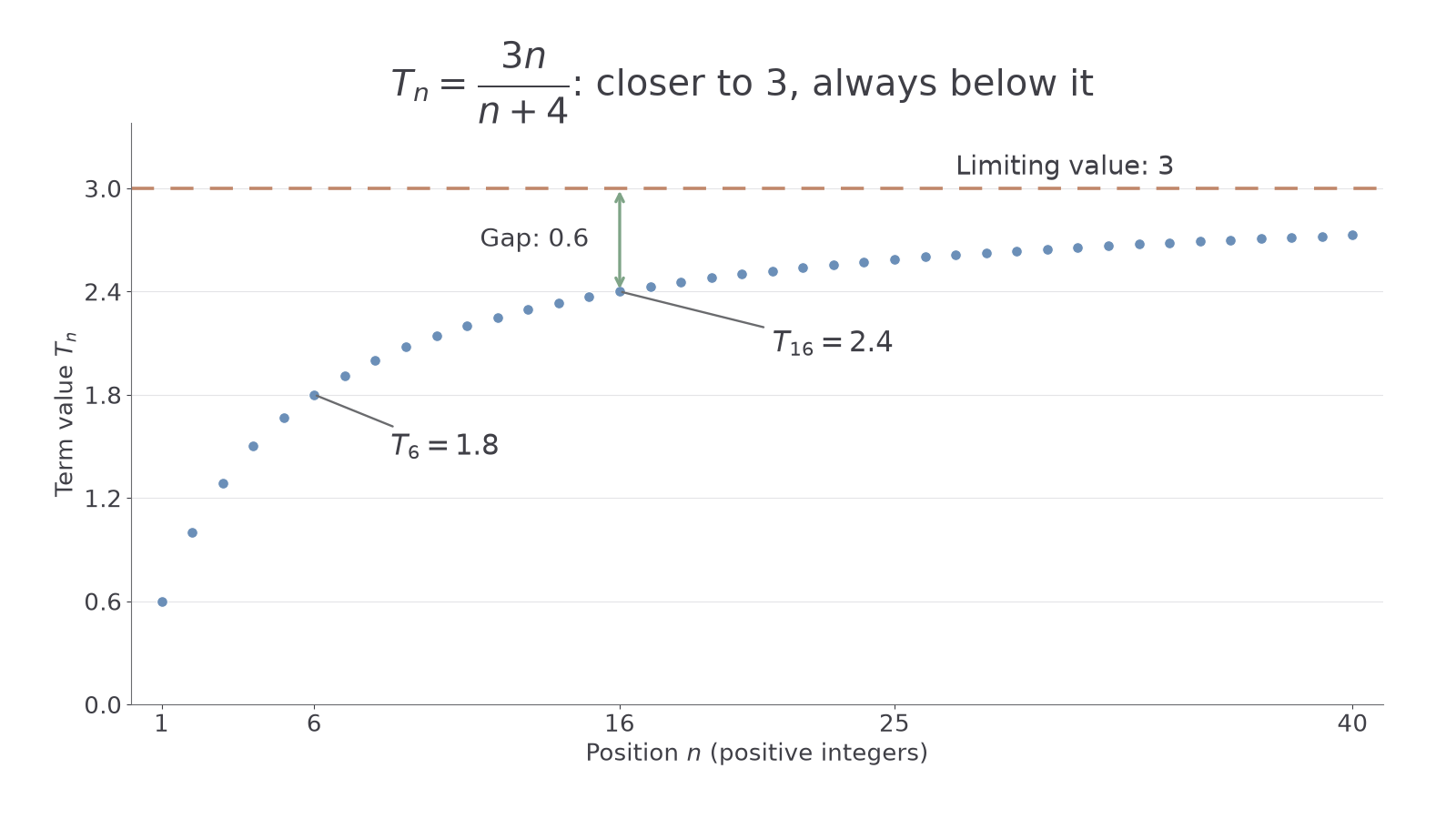
No finite positive makes the gap zero. The sequence can keep getting closer to forever without ever containing . That is the surprising answer to the opening question.
Continue this lesson.
You’re previewing NovaLearn without an account. Create a free account to read the rest.
Create free account