6.10 - Solving trigonometric equations
Solve equations involving a single angle by combining algebra, reference angles and the graphs you already know. Every solution must satisfy both the original equation and its stated interval. All angles here are in degrees.
All the solutions for sine and cosine
A calculator gives for . Why can have four solutions in one full turn? We will build the answer by first solving equations without a square.
You already know
On the unit circle, sine is the vertical coordinate and cosine is the horizontal coordinate. Reference angles supply magnitudes; quadrants supply signs. Sine and cosine lie between and , and each repeats after .
An inverse-trigonometric button returns one angle, not a complete solution set. For example, means a unit-circle height of . Both the first and second quadrants reach that height. The graph meets the horizontal line twice.
[DIAGRAM: asset_name: Sine and cosine equation intersections; asset_slug: l2fm-sine-cosine-equation-roots; caption: A horizontal line at one half cuts sine and cosine twice in a full turn; description: Two degree-labelled graphs run from 0 to 360 degrees. The sine graph meets y equals one half at 30 and 150 degrees. The cosine graph meets y equals one half at 60 and 300 degrees. Filled points and vertical dashed guides identify all four intersections in their respective graphs.]
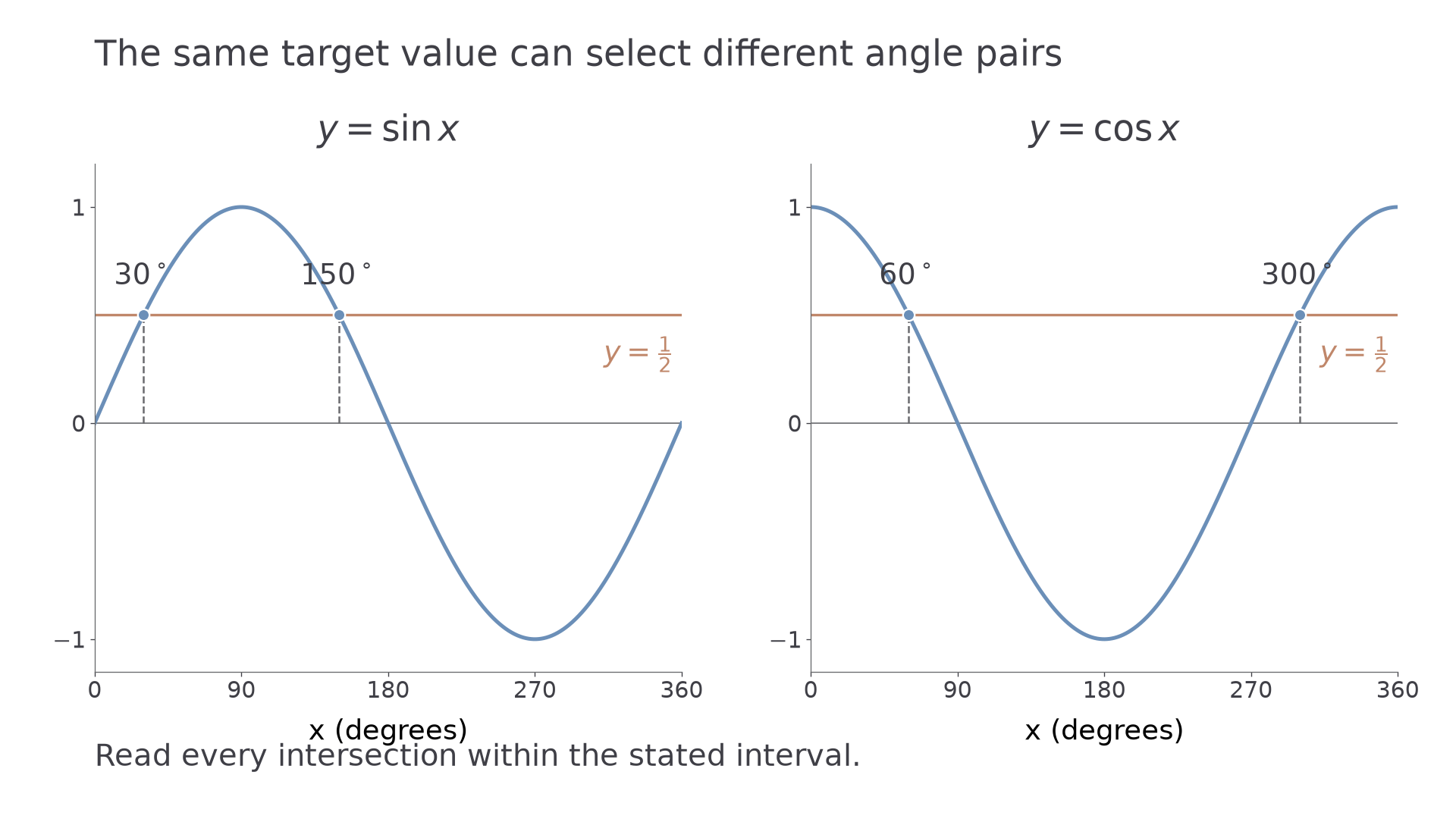
For a reference angle strictly between and , the following arrangements collect the quadrant information in one place. Axis values need a separate check because two arrangements can coincide there.
Reference-angle arrangements in one full turn
For and ,
These arrangements follow from unit-circle symmetry. Exact trigonometric values are also needed when an exact answer is required.
Not on the formulae sheet: learn it.
First isolate the ratio. Then use its sign to select quadrants, work out candidate angles and apply the stated interval. With a calculator, select degree mode and retain extra digits until the final answer.
Worked example 1: two equal sine heights
Question. Solve for .
Plan. Use the exact reference angle and choose the two quadrants where sine is positive.
Why this step? The same positive height occurs on both sides of the unit circle, so the inverse-sine answer alone is incomplete.
Answer. .
Check. Both angles have sine . Neither endpoint has that sine value.
Worked example 2 changes only the function from sine to cosine. The target value and interval stay the same, but now the horizontal coordinate must be positive.
Worked example 2: two equal cosine coordinates
Question. Solve for .
Plan. Use the cosine reference angle and the first and fourth quadrants.
Why this step? Sine and cosine have different reference angles for the same value, and their positive quadrants differ.
Answer. .
Check. Reflection in the horizontal axis keeps the horizontal coordinate unchanged.
For negative targets, change the allowed quadrants: gives , whereas gives , in the same closed full-turn interval.
Boundary values deserve their own check. In , has only , while has . The equation has both and : they are different allowed angle values. A target outside , such as , gives no solution.
Watch out
Wrong: always add to get the second sine solution. For , has the wrong sign. Right: use the graph or quadrant signs, giving .
Isolate cosine in this new equation, then use the negative sign and an exact reference angle.
Tangent solutions and the interval filter
Tangent repeats after a half-turn. A line through the origin meets opposite points of the unit circle with the same coordinate quotient: both numerator and denominator change sign together. That is why its solution spacing differs from sine's usual reflection pattern.
The half-turn repetition of tangent
This holds wherever tangent is defined. It is undefined when cosine is zero, including and in a full turn.
Not on the formulae sheet: learn it.
For a negative tangent target, use a positive acute reference angle, then choose the second and fourth quadrants. If the question gives a shorter interval, discard candidates outside it after generating them.
Worked example 3: a non-exact tangent value
Question. Solve for . Give answers to decimal place.
Plan. Work out the acute reference angle using , then place it in the negative-tangent quadrants.
Why this step? A negative calculator output such as does not lie in the stated interval; the quadrant construction gives the required representatives.
Answer. .
Check. The unrounded angles differ by exactly , and both give tangent . Rounded answers give values close to .
Worked example 4 changes only the interval. The equation and its candidate angles stay unchanged; one candidate now fails the interval test.
Worked example 4: a shorter interval
Question. Solve for . Give answers to decimal place.
Plan. Generate the same full-turn candidates, then compare them with the new endpoints before rounding.
Why this step? Satisfying the equation is necessary, but a solution must also be an angle the question allows.
Answer. only.
Check. The retained unrounded angle gives tangent and lies strictly above , below .
The same idea works for intervals that cross a full-turn boundary: use the graph's period to move candidates into the required window. Read strict and inclusive endpoints literally. For instance, is allowed by , but excluded by .
Watch out
Wrong: accept because it lies in the requested interval. Right: check the original function too. Tangent is undefined there, so it cannot solve a tangent equation.
Change the target and interval, keeping all calculator digits until the final line.
A square creates two possible signs
If , then or . Replacing by a trigonometric ratio does not remove either sign. Solve both resulting equations before collecting the angles.
Worked example 5: four solutions from one square
Question. Solve for .
Plan. Take both square roots, then solve the positive-sine and negative-sine branches.
Why this step? Squaring hides the sign, so an equation with a squared ratio can have more solutions than either unsquared branch.
Answer. .
Check. The four sine values are . Squaring any of them gives .
Here is the opening puzzle's answer: the calculator returned one angle from just one sign branch. Both signs together give four. There is another neat consequence: sine takes a full turn to repeat, but sine squared repeats after a half-turn, because changing the sign leaves the square unchanged.
Continue this lesson.
You’re previewing NovaLearn without an account. Create a free account to read the rest.
Create free account