2.1 - Basic algebra skills
Make algebra easier to read by choosing a useful order, collecting like terms and multiplying a whole bracket correctly. This short lesson refreshes the GCSE skills that support the longer expressions you will meet next, and explains why each change preserves the value.
Changing order and grouping
How can you work out without long multiplication? Keep that question in mind: the same laws that make algebra tidy will turn it into a very short calculation.
Start with . Adding and first gives . You changed the order and the grouping, but you still added the same three numbers. Similarly, . A sensible rearrangement saves work.
Commutative and associative laws
A commutative law allows you to change the order of two quantities being added or multiplied. An associative law allows you to change the grouping of three quantities being added or multiplied. For example, changes order, whereas changes grouping.
Letters stand for numbers, so these same laws let you write a coefficient before the letters and gather repeated factors. For example, : the order changes, but no factor is lost or added.
Order and grouping laws
For any real numbers , and ,
Not on the formulae sheet: learn it.
The operation matters. Subtraction is not commutative: , whereas . Nor can you regroup subtraction freely: , whereas . Division has the same restrictions. To reorder a subtraction, first read it as addition of a signed term: . The minus sign travels with .
Key idea
Addition and multiplication allow changes of order and grouping. A subtraction sign belongs to the term after it; moving the term without its sign changes the expression.
The next check asks you to distinguish regrouping from changing an operation.
Collecting like terms
Like terms count the same algebraic quantity, so you combine their coefficients while keeping that quantity unchanged.
Like terms
Like terms have exactly the same letters raised to exactly the same powers. For example, and are like terms, as are and , because . The terms and are not like terms; neither are and .
Think of as seven lots of plus two lots of . That makes nine lots. By contrast, cannot be combined into one term: and may have different values.
Collecting coefficients
For real coefficients , and a common algebraic term ,
The complete term , including its powers, must be the same in both terms.
Not on the formulae sheet: learn it.
Use the commutative law to place like terms together, then add their signed coefficients.
Worked example 1: two groups of like terms
Question. Simplify .
Plan. Group the terms and the terms separately.
Why this step? Both terms count lots of ; the terms count something different and stay in their own group.
Answer. .
Check. At , , the original is , and the answer is .
Change just one sign for Worked example 2: the term is now negative. Keep that sign attached when you move the term.
Worked example 2: a negative coefficient
Question. Simplify .
Plan. Collect the signed coefficients, then the coefficients.
Why this step? The coefficient of the moved term is , not . Reordering does not turn subtraction into addition.
Answer. .
Check. At , , both expressions give : .
After collecting, stop when the remaining terms are unlike. There is no further simplification of without more information.
Watch out
Wrong: . Adding terms adds coefficients, so the correct result is . Multiplying gives a different result: .
Keep the two letter groups separate in this short check, with new coefficients.
Multiplying a whole bracket
The distributive law connects multiplication and addition: multiplying a total is the same as multiplying each part and then adding.
A rectangle of height and width has area . Split its width into and , and the two areas are and . Nothing has been added or removed: .
[DIAGRAM: asset_name: Splitting a rectangle to distribute; asset_slug: l2fm-basic-distributive-area; caption: Multiplying the whole width gives the same area as adding the two smaller rectangles; description: A rectangle of height 3 and total width 7 is split into a blue rectangle of width 5 and area 15 and a sage rectangle of width 2 and area 6. Dimension labels show 3, 5 and 2. Below it the equality 3 times open bracket 5 plus 2 close bracket equals 15 plus 6 equals 21 connects the whole area to its parts]
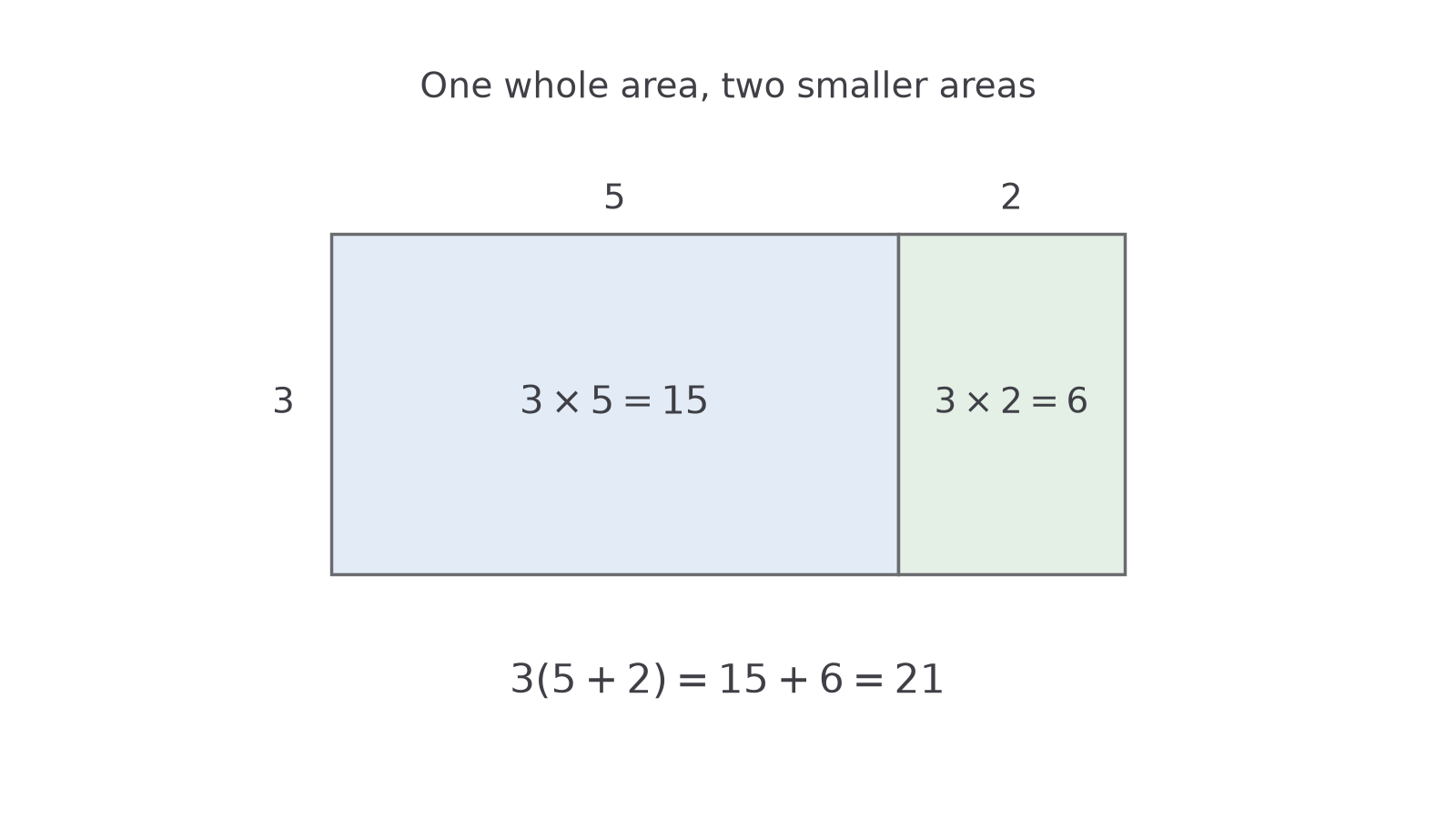
The area picture uses positive lengths. The algebraic law also works with zero and negative numbers, so you can use it with signed coefficients.
Distributive law
For any real numbers , and ,
Multiply every term inside the bracket by the outside factor.
Not on the formulae sheet: learn it.
When the outside factor is negative, use the usual sign rules for each product separately.
Worked example 3: a negative outside factor
Question. Expand .
Plan. Multiply both terms by .
Why this step? The bracket is one complete quantity multiplied by ; both of its terms must receive that factor.
Answer. .
Check. At , the bracket gives , and the expansion gives .
Worked example 4 changes only the sign inside the bracket. The second product is now negative times negative.
Worked example 4: two negative signs
Question. Expand .
Plan. Treat the second term as and multiply it by .
Why this step? Writing as the complete second term makes the positive product visible.
Answer. .
Check. At , both forms give : .
You can now solve the opening puzzle. In fact, multiplying any three-digit positive integer by writes the digits twice. For example,
For a three-digit integer , shifts its digits three places left, leaving exactly three places for the final . A small algebra law explains a rather neat number trick.
Watch out
Wrong: . The outside negative multiplies the negative second term too, so the correct answer is .
Apply the same sign decision to a different outside factor and different terms.
Quick Recap
- The commutative laws change order; the associative laws change grouping. They apply to addition and multiplication.
- Keep a term's sign when you move it. Collect like terms by adding their signed coefficients.
- Multiply every term in a bracket by the outside factor, including its sign.
The opening calculation is , using the distributive law.