1.3 - Surds and rationalising denominators
Keep square roots exact while simplifying sums, multiplying brackets and removing surds from denominators. You will see why these methods work, then use them to turn an awkward fraction into a surprisingly simple exact answer.
Keeping square roots exact
Can you remove the fraction from without using a decimal? The denominator is positive but small, so its reciprocal is much larger. By the end of the lesson you will write it exactly with no fraction at all.
A square of area has side length . This is a perfectly precise length even though its decimal expansion never ends or repeats. Since , its side lies between and . Writing is an approximation: , which falls just short of .
You already know
A rational number can be written as , with integers and and . Fractions and specified terminating or recurring decimals can be exact. Rounding changes the value; keep an exact form until a question requests an approximation.
Some roots are rational and others are irrational. The root sign alone does not tell you which: , but cannot be written as a ratio of integers.
Surd
A surd is an irrational root of a rational number. For example, , and are surds. Not examples: and , because their values are rational. The square root of a positive integer is a surd precisely when that integer is not a perfect square.
The symbol means the non-negative, or principal, square root. Thus , while the equation has two solutions, and . We use real square roots here, so the number under a square root must be non-negative. These square-root conventions are not on the formulae sheet: learn them.
Key idea
A surd keeps the exact number. A decimal approximation may help you check its size, but it does not replace an exact answer.
Decide whether each root actually has an irrational value, rather than judging by its appearance.
Simplifying and combining surds
Take square factors out of each root before adding or subtracting; expressions that look different may then become like terms.
The picture shows . Nine small squares, each of area , form one square of area . There are three small sides across the large square, so its side is both and .
[DIAGRAM: asset_name: Extracting a square factor; asset_slug: l2fm-surds-square-factor; caption: Nine squares of area 2 make a square whose side is both square root 18 and 3 square root 2; description: A three by three grid of equal squares, each labelled with area 2. One small square is sage and its side is labelled square root 2. The large square has area 18, its left side is labelled square root 18 and its top side is labelled 3 square root 2. The accompanying equation is square root of 9 times 2 equals square root 9 times square root 2 equals 3 square root 2.]
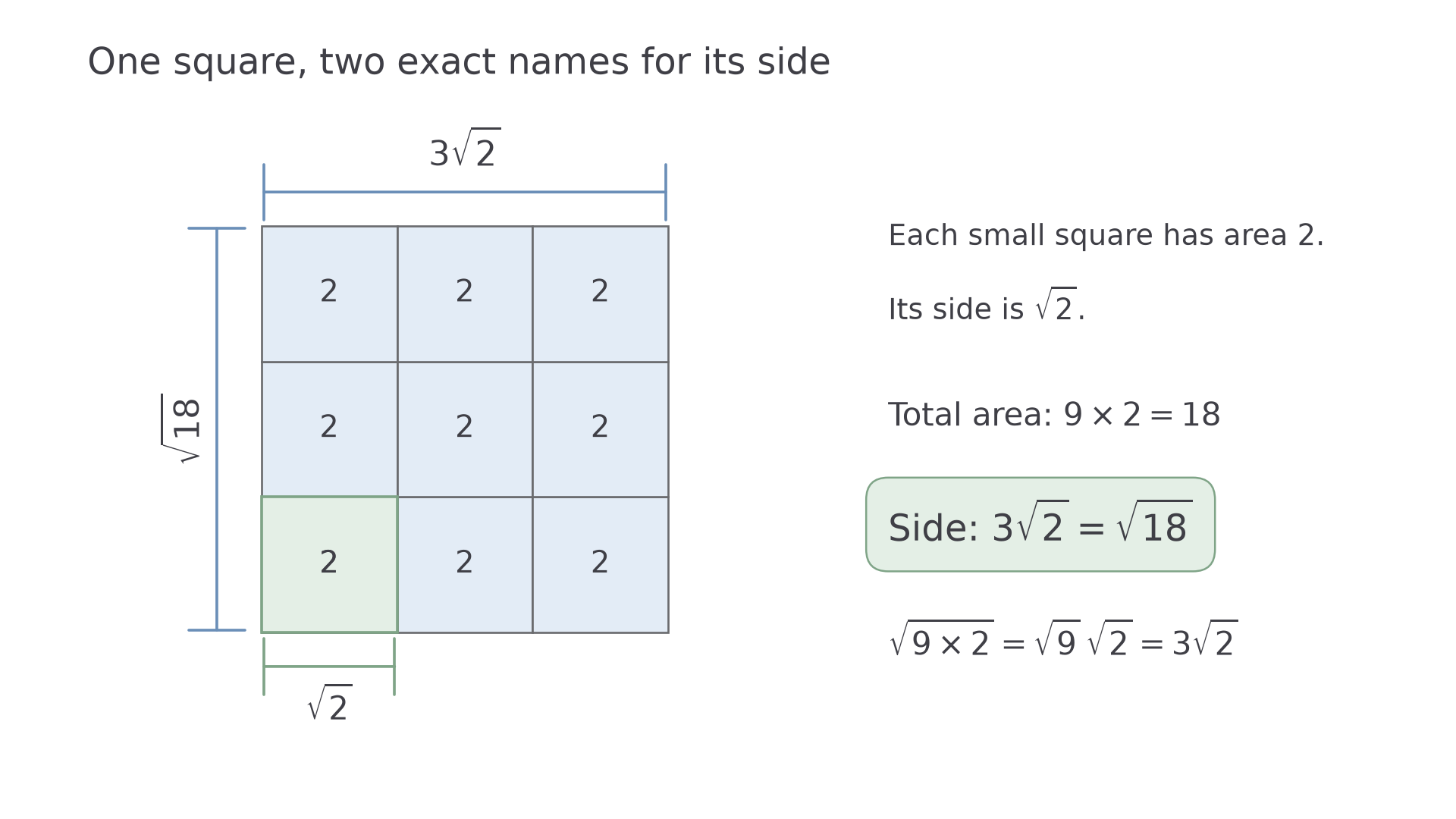
More generally, the product is non-negative and its square is , so it is the principal square root of . This explains why roots can be split across multiplication. The same reasoning applies to division by a positive root.
Square-root rules
For and ,
If also ,
In particular, for and ,
Not on the formulae sheet: learn it.
Choose the largest square factor you can see: . A smaller square factor works too, but leaves another step. For positive integer roots, a fully simplified surd has no square factor greater than left under the root. For division, .
Like terms have the same simplified root. Just as , we have . The expression has unlike roots and does not combine into a single term this way.
Worked example 1: uncovering like surds
Question. Simplify fully .
Plan. Extract the largest square factor from each root, then add the coefficients of .
Why this step? All three terms become multiples of the same root; the coefficients tell you how many copies to add.
Answer. .
Check. Square the extracted roots: , and . Each is non-negative and squares to the original number, confirming all three simplifications.
Worked example 2 changes only the first plus sign to a minus sign. The roots simplify as before; keep the subtraction attached to its term.
Worked example 2: subtracting a like surd
Question. Simplify fully .
Plan. Simplify each root and combine the signed coefficients.
Why this step? Subtraction changes the coefficient, not the number under the root.
Answer. .
Check. Changing to reduces the previous answer by . Indeed, .
Splitting a root over a product works; splitting it over a sum does not.
Watch out
Wrong: . The left side is , while the right side is . Right: add inside the root first, or use the product rule only when the expression under the root is a product.
The next expression has the same subtraction pattern, but its like terms involve .
Multiplying surds and brackets
Multiply surds using the square-root rule, and expand brackets by multiplying every term in one bracket by every term in the other.
For example, . The product can need simplifying even when the original roots were already in their simplest forms. Coefficients multiply too: .
You already know
Expanding gives . A minus sign belongs to the term that follows it. Surds obey the same distributive law as other numbers.
Write all four products before collecting terms. In particular, , so multiplying two irrational numbers can give a rational result.
Worked example 3: all four products
Question. Work out . Give your answer in the form , where and are integers.
Plan. Expand into four products, simplify the product of the roots, then collect rational and surd terms separately.
Why this step? The last product is , so it joins the rational terms rather than the terms.
Answer. .
Check. Expand by grouping instead: , giving the same answer.
Worked example 4 changes only the sign in the second bracket. Both products involving that negative term must change sign.
Worked example 4: a negative surd term
Question. Work out . Give your answer in the form , where and are integers.
Plan. Expand into four signed products, then collect like terms.
Why this step? The product is ; losing its minus sign changes the rational part of the answer.
Answer. .
Check. Add the answers to Worked examples 3 and 4. Before expansion their sum is . Our answers add to , as required.
A bracket squared also means four products; the two middle products still exist.
Watch out
Wrong: . Right: . Squaring a sum is different from squaring its terms separately.
Now keep the same sign pattern and work with a different root. The requested form tells you when to stop simplifying.
Rationalising a single surd denominator
Rationalising rewrites a fraction with a rational denominator while keeping exactly the same value.
The fraction is already exact. Multiplying top and bottom by gives , another exact name for it. The purpose is to obtain the requested form, not to make an approximation.
Rationalising the denominator
To rationalise the denominator is to rewrite an equivalent fraction so that its denominator is rational. For example, . Multiplying only the denominator by would change the value, so it would not be rationalising the original fraction.
The multiplier is when . Its denominator becomes , which removes the root.
One surd in the denominator
For real and , with and ,
When and are rational, the new denominator is rational. Simplify any common factors afterwards.
Not on the formulae sheet: learn it.
You do not need to multiply by the entire denominator: only the root is needed to pair with the root already there.
Worked example 5: rationalise, then cancel
Question. Rationalise the denominator and simplify fully .
Plan. Multiply top and bottom by , then cancel the common factor in the resulting fraction.
Why this step? The extra makes a rational denominator; the same multiplier on the numerator preserves the value.
Answer. .
Check. Multiplying the answer by the original denominator gives , the original numerator.
Worked example 6 adds only a factor of to the denominator. That factor remains when the two roots multiply.
Worked example 6: a coefficient beside the root
Question. Rationalise the denominator and simplify fully .
Plan. Multiply top and bottom by , keep the factor of , then simplify.
Why this step? Only the root is squared. The original coefficient multiplies the resulting ; it does not disappear.
Answer. .
Check. Doubling a non-zero denominator halves the fraction. This answer is half of , as it should be.
If a numerator has more than one term, the multiplier acts on all of it. Brackets keep this visible.
Watch out
Wrong: . The first numerator term was not multiplied. Right: .
The next fraction has a different coefficient and root, but the multiplier still only needs to pair the two roots.
Rationalising a two-term denominator
For a denominator with two terms, choose a multiplier that makes the middle products cancel.
Multiplying by gives . Both terms in the middle disappear because they are opposites. This is the difference of two squares, which makes the result rational.
Conjugate pair
For the surd expressions used here, a conjugate pair has the same two terms with the sign between them reversed. For example, and form a conjugate pair; and do too. The pair and is not a conjugate pair, because a term has changed as well as the sign.
Write the two terms as and . The products and cancel, leaving . This works whether the surd is the first term, the second term or both terms.
Conjugates and the difference of two squares
For real and ,
If and are rational, this product is rational. To rationalise , multiply top and bottom by ; for , use . Both the original denominator and the chosen conjugate must be non-zero.
Not on the formulae sheet: learn it.
For instance, , so this method also handles denominators containing two different surds. Check the squares before expanding the numerator; a sign error there affects the whole fraction.
Worked example 7: choosing the opposite sign
Question. Rationalise the denominator and simplify fully
Give your answer in the form , where and are integers.
Plan. Multiply top and bottom by , use the difference of two squares below and expand all four products above.
Why this step? The conjugate makes the denominator's two middle products cancel. Multiplying by alone would leave another surd term in the denominator.
Answer. , so and .
Check. Multiply back: , the original numerator.
Worked example 8 changes only the sign in the denominator. Its conjugate must change too; the numerator stays exactly as it was.
Worked example 8: a minus sign in the denominator
Question. Rationalise the denominator and simplify fully
Give your answer in the form , where and are integers.
Plan. Use the conjugate , then expand and divide every numerator term by the rational denominator.
Why this step? Although the denominator's sign changed, its product with its conjugate is still . The change appears in the numerator products.
Answer. , so and .
Check. , recovering the numerator.
The final division is part of simplifying fully. Divide every term in the numerator and give the simplified answer in the requested form.
Watch out
Wrong: . The last product is . Right: the denominator is , and .
Back to the opening fraction
The conjugate of is . Their product is , so
The fraction has vanished without rounding. There is a more extreme version of the same surprise: and are reciprocals, because
One is about , and the other is about . Two large terms can leave a tiny difference; keeping the roots exact preserves it. You will meet the same need for exact surds when solving quadratics and working with lengths later in the course.
Use the conjugate once more with a different root. Show the numerator and denominator products separately so each part of the method is clear.
Quick Recap
- A surd is an irrational root; the root symbol denotes the non-negative square root. Keep roots exact until rounding is requested.
- Extract square factors, then combine only like surds. Square roots split over products and quotients, not sums.
- Multiply every pair of terms when expanding brackets, keeping their signs.
- Rationalise a single-root denominator by multiplying top and bottom by its root. For a two-term denominator, use its conjugate, then simplify fully.
The opening fraction is exactly , because .