2.4, 2.5 - Composite and inverse functions
Combine functions by feeding one output into the next, then reverse a function to recover its original input. In 2.4 you will work with composite rules and equations; in 2.5 you will use algebra and domains to work out inverse functions and check that they undo the original rule.
Composite functions and their order
Can a function be its own undo button? The rule sends to , then sends back to . Is that a lucky pair, or will applying the rule twice return every allowed input? By the last part you will be able to prove the answer.
First combine simpler rules. With and , input can follow two routes. Squaring first gives , then . Using first gives , then squaring gives . The operations are the same, but their order changes the answer.
You already know
A function's brackets contain its input. To work out , substitute the whole expression wherever appears in the rule for . The domain contains allowed inputs; the range contains their outputs.
A composite uses an intermediate output as the next input. You can calculate one stage at a time or substitute one complete rule inside the other.
[DIAGRAM: asset_name: Two orders for the same functions; asset_slug: l2fm-composite-order; caption: In fg, g acts first; reversing the order usually changes the result; description: Two left-to-right chains compare f(x) equals 3x plus 2 and g(x) equals x squared. The fg chain has input x, sage g square, intermediate x squared, blue f multiply by 3 then add 2, and output 3x squared plus 2. The gf chain has input x, blue f multiply by 3 then add 2, intermediate 3x plus 2, sage g square, and output (3x plus 2) squared. A numerical line beneath each gives input 2 mapping to 4 then 14, or to 8 then 64.]
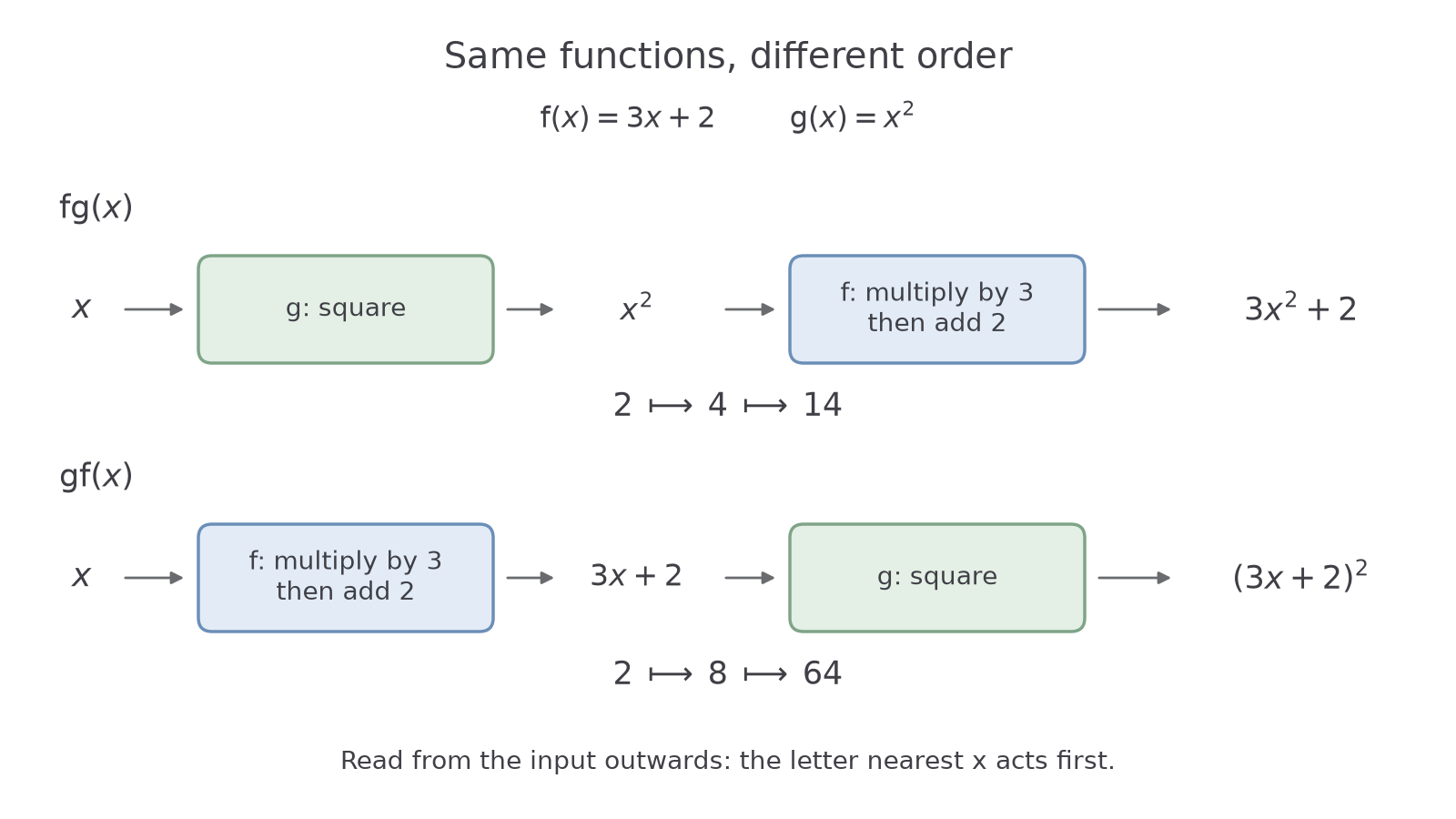
Composite function
A composite function is the result of functions acting in succession. In , acts first and acts on its output. The intermediate output must be an allowed input for the next function. For example, “square, then add ” is a composite; multiplying two outputs is a different operation.
Read the notation from the input outwards: the letter nearest acts first. This convention also handles three functions: means , then , then .
Composition notation
This is defined when is in the domain of and is in the domain of . In general, .
Not on the formulae sheet: learn it.
Use the same two rules to work out both possible orders. Keep brackets around each whole substituted expression.
Worked example 1: g followed by f
Question. and . Work out .
Plan. Put the output of into the input of .
Why this step? The in is an input slot. Here the entire slot is filled by .
Answer. .
Check. At , the composite gives , matching the route .
Worked example 2 changes only the order of the functions. Now the whole linear expression must be squared.
Worked example 2: f followed by g
Question. and . Work out , expanding your answer.
Plan. Put into the square rule, then expand both brackets.
Why this step? Squaring a sum creates cross-products. The expression is not .
Answer. .
Check. At , this gives , matching .
Composition is not multiplication: is neither of these composites. When domains are restricted, check the middle of the chain too. If and , then requires , even though itself accepts every real input.
Watch out
Wrong: for these rules. That is , the opposite order. Right: . Write the nested form before expanding if the order is easy to mix up.
Keep the same “linear rule, then square” route with new coefficients.
Equations involving function inputs
An equation such as compares two routes from the same starting value, so write each route as an expression before solving.
The distinction between changing the input and changing the output matters. For , replacing the input by gives . Doubling the output gives . These are different operations.
Worked example 3: equal outputs from two routes
Question. and . Work out the value of for which .
Plan. Form the two expressions separately, equate them, then solve the cubic equation.
Why this step? In , the cube applies to the whole input , so the multiplier becomes .
Answer. .
Check. , while and . Both routes give the same output.
Worked example 4 changes only the constant in . The method is unchanged, but the solution is now negative.
Worked example 4: a negative solution
Question. and . Work out the value of for which .
Plan. Substitute carefully into both routes, then solve their equality without dropping the constant terms.
Why this step? The final constant belongs to , so it is applied after the multiplication by . It must not disappear when the inner function is substituted.
Answer. .
Check. , while and .
Both rules in these examples accept all real inputs. With restricted functions, also check that a solution permits every stage of its route; an algebraic solution outside an allowed domain is not a solution of the function equation.
Watch out
Wrong: . For , the correct expressions are and . Put brackets around the whole substituted input and retain the function's constant term.
Change the constant once more and solve the same two-route comparison.
Inverse functions reverse the mapping
An inverse takes an output of the original function and returns the input that produced it.
Inverse function
The inverse function of , written , reverses the input-output mapping. It exists on the range of when each output comes from exactly one allowed input. For example, if , then . The notation does not mean .
The domain and range swap roles: the original outputs become the inverse's inputs, and the original inputs become its outputs. To obtain a rule, write , rearrange to make the original input the subject, then rename the inverse's input as . Alternatively, swap and first, then rearrange. Both routes reverse the same mapping.
You already know
Rearrange an equation by applying the same operation to both sides. To undo a chain of operations, reverse their order: if the original rule doubles, adds , then divides by , the reverse multiplies by , subtracts , then divides by .
You can check the complete rule by putting the two functions together. A successful inverse returns the starting input throughout the relevant domain, not just at one convenient number.
Inverse checks and domains
The domain of is the range of ; its range is the domain of .
Not on the formulae sheet: learn it.
Begin with a linear rule. Its non-zero coefficient means each output comes from just one input, so no domain restriction is needed here.
Worked example 5: reversing a linear rule
Question. . Work out .
Plan. Write the output as , make the original input the subject, then express the inverse using input .
Why this step? The rearranged equation gives the original input in terms of its output, which is exactly what the inverse must do.
Answer. .
Check. Also, and .
Continue this lesson.
You’re previewing NovaLearn without an account. Create a free account to read the rest.
Create free account