3.7, 3.8 - Equations of circles
Use a circle's centre and radius to describe its points, recover its equation and solve intersections with a line. In 3.7 you will connect circles centred at the origin with right angles, chords and tangents; in 3.8 you will extend the equation to any centre and use the same geometry in shifted coordinates.
A circle is a fixed distance from its centre
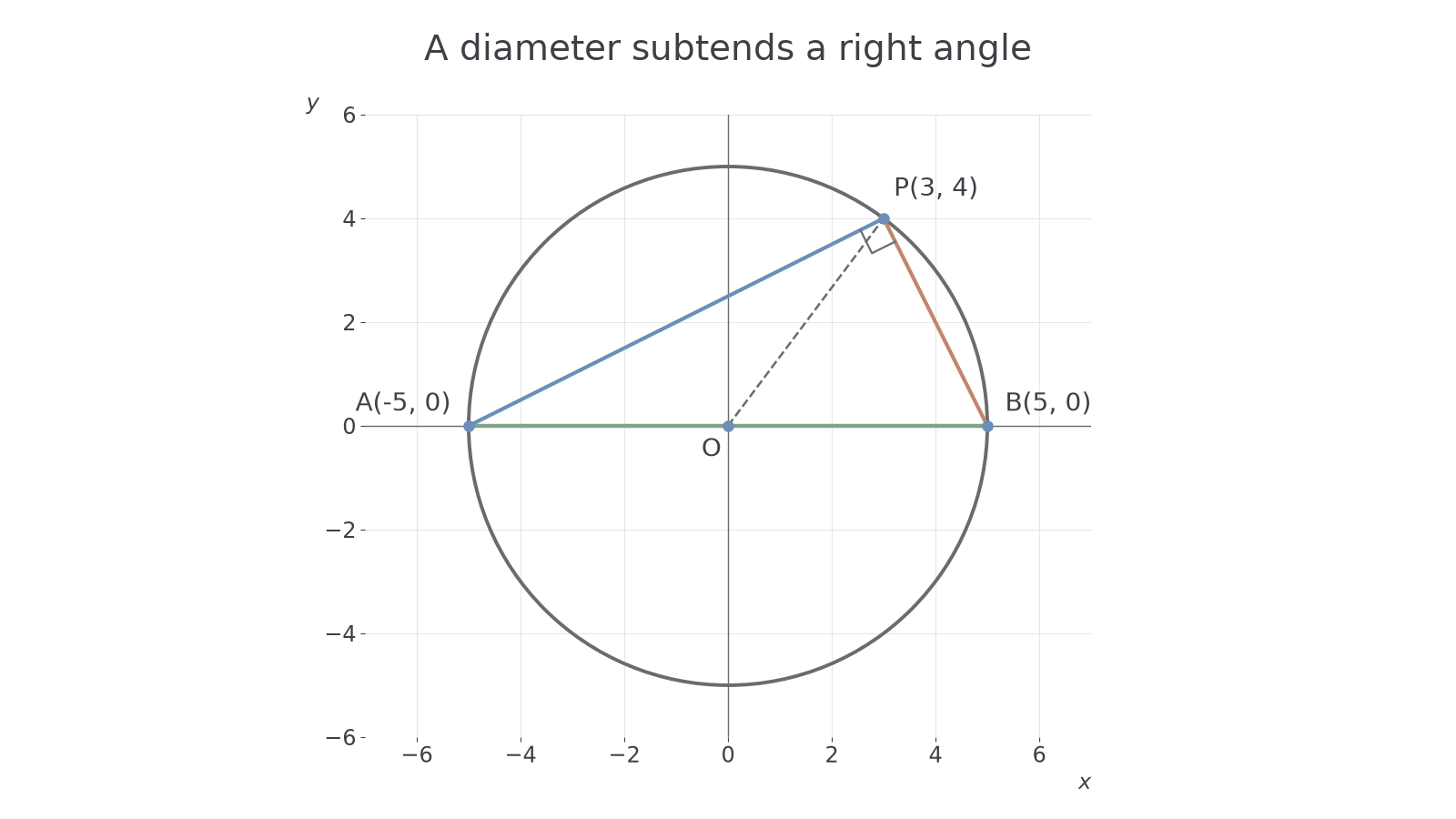
Take , and . Why must the angle be a right angle? A circle equation will show that lies on the circle with diameter , and a circle fact will then settle the angle without measuring it.
Circle
A circle is the set of points in a plane at a fixed positive distance, its radius, from a fixed point, its centre. For example, a circle of radius centred at the origin contains , because . Its centre is not on the circle: its distance from itself is zero.
For a point on a circle centred at , the horizontal and vertical changes from the centre are and . Pythagoras' theorem therefore gives its squared distance as .
Circle with centre and radius
For radius , the circle with centre has equation
At the origin, this becomes . A point lies on the circle exactly when its coordinates satisfy the equation.
On the formulae sheet.
Read the bracket signs as subtractions of the centre coordinates. The number on the right is the square of the radius. If a diameter's endpoints are given instead, its midpoint is the centre and half its length is the radius; use those two values in the same equation.
Worked example 1: centre at the origin
Question. The points and are the endpoints of a diameter. Work out the equation of the circle.
Plan. Calculate the diameter's midpoint and length, then substitute the centre and radius into the circle equation.
Why this step? The equation describes squared distance from the centre, so its right-hand side is , not .
Answer. .
Check. Both diameter endpoints give . The point is also one radius from the centre and gives .
Worked example 2 translates both endpoints units right and units down. The centre moves with them, while the diameter length and radius stay fixed.
Worked example 2: a shifted centre
Question. The points and are the endpoints of a diameter. Work out the equation of the circle.
Plan. Use the midpoint for the shifted centre, calculate half the diameter length, then subtract the centre coordinates inside the brackets.
Why this step? Subtracting the centre's negative height produces . The centre is , not .
Answer. .
Check. The point is units right of the centre; it gives . Substituting the centre itself gives zero, so it is inside, not on, the circle.
The equation also tests position. If a point's squared distance from the centre is less than , it lies inside; if greater, it lies outside. This comparison avoids taking an unnecessary square root.
Watch out
Wrong: for centre , radius . Both signs and the radius square are wrong. Right: .
Use a different centre and radius, keeping those two decisions separate.
Recovering the centre by completing squares
An expanded circle equation hides the centre, so complete one square in and another in to recover the centre-radius form.
You already know
Completing the square preserves an expression's value by correcting the constant added inside the square. For example, . Perform the same process independently for the -terms.
Keep both constant corrections. The general circle equation is on the formulae sheet; the completing-square method used to reach it is not supplied.
Worked example 3: two completed squares
Question. Work out the centre and radius of the circle .
Plan. Group by variable, complete both squares, then read the centre and radius from the resulting equation.
Why this step? Each completed square creates its own extra constant. Omitting either correction changes the radius.
Answer. Centre , radius .
Check. Expanding the final form gives , equivalent to the original equation. The point is units from the centre and satisfies it.
Worked example 4 changes only the original constant term, from to . The centre stays fixed, but the radius changes.
Worked example 4: the same centre, a smaller radius
Question. Work out the centre and radius of .
Plan. Use the same completed squares and recalculate the remaining constant.
Why this step? The linear coefficients determine the centre. Changing the constant affects only the squared radius after completing the squares.
Answer. Centre , radius .
Check. The point , one unit from the centre, gives in the original equation.
A right-hand side of zero in centre-radius form describes just the centre point, not a circle of positive radius. A negative right-hand side gives no real points, because a sum of two real squares cannot be negative. If the equation has a common non-zero coefficient on both squared terms, divide through by it before completing the squares.
Watch out
Wrong: read centre from . Right: the centre makes both brackets zero, so it is . The radius is , not .
The next centre has different signs. Complete both squares before interpreting it.
A line and a circle together
At an intersection, the same coordinate pair satisfies both the line equation and the circle equation, so substitute the line into the circle and solve.
You already know
Substitution reduces simultaneous linear and quadratic equations to one quadratic. Retain every real root and work out the matching second coordinate. A repeated root gives one distinct point; no real roots give no intersection.
A circle is not the graph of one output for every : it can contain both an upper and a lower point at the same horizontal position. Its two-coordinate equation retains both automatically.
Worked example 5: two exact intersections
Question. Work out the coordinates where meets .
Plan. Replace by , solve for , then use the line for each .
Why this step? Substituting into the line gives one matching height for each root. Giving only the two -values would leave the coordinates incomplete.
Answer. and .
Check. and ; both pairs also satisfy .
Worked example 6 changes only the line's constant term from to . The new line passes through the centre, but the intersection coordinates are now irrational.
Worked example 6: surd coordinates
Question. Work out the coordinates where meets . Give exact answers.
Plan. Substitute, take both square roots and match each root to twice its value.
Why this step? The positive -root belongs with the positive -value; mixing opposite signs would fail the line equation.
Answer. and .
Check. Each pair has , and its height is twice its horizontal coordinate.
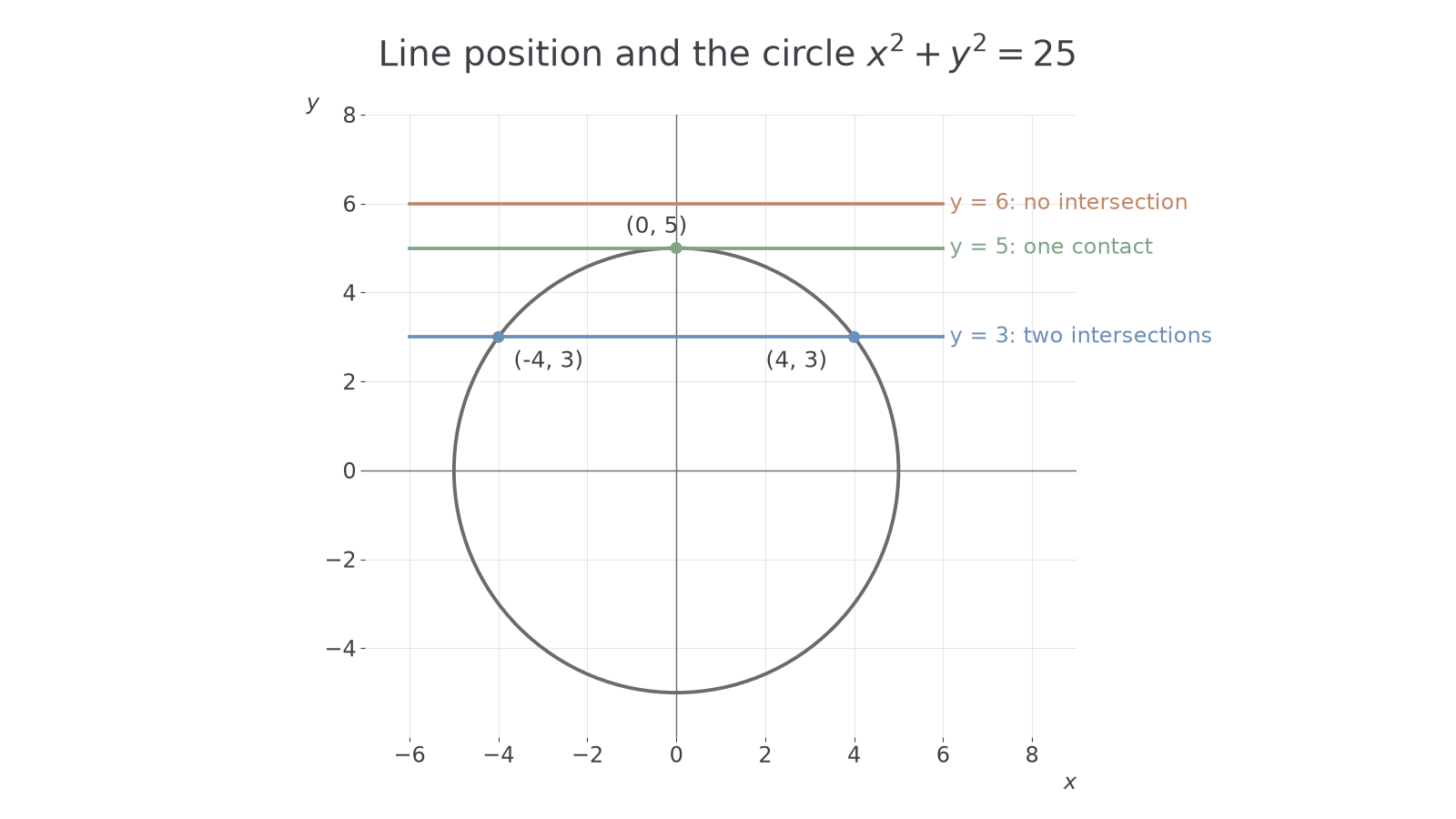
For a horizontal or vertical line, substitute its fixed coordinate directly. On this circle, gives , so it touches once at ; gives , so it never meets the circle. Likewise, touches at , while gives , two intersections. A line meeting the circle just once is a tangent.
[DIAGRAM: asset_name: Two, one or no intersections; asset_slug: l2fm-circle-line-positions; caption: Substitution distinguishes a crossing line, a tangent and a line outside the circle; description: Equal-scale coordinate axes show the circle x squared plus y squared equals 25. Three labelled horizontal lines are y equals 3, crossing at (minus 4, 3) and (4, 3); y equals 5, touching at (0, 5); and y equals 6, with no intersection. The two crossing points and the touching point are marked, and the circle centre is the origin.]
If a question asks you to show that intersection coordinates satisfy a given quadratic, show the substitution and expansion. Solving the supplied quadratic alone does not establish where it came from.
Watch out
Wrong: replace by when . Right: use , including the cross-products. After solving, return to the line for each matching second coordinate.
Keep exact roots in the shifted-circle question below.
A diameter creates a right angle
The angle subtended by a diameter at any other point on its circle is a right angle, so a diameter can supply a hypotenuse without a gradient calculation.
Angle in a semicircle
If is a diameter and is any other point on the circle,
The points and themselves are excluded: they do not form a triangle with a third vertex at an endpoint.
Not on the formulae sheet: learn it.
Here is why. Join the centre to . Equal radii make and isosceles. If the angles at and are and , the two angles at are also and . The whole triangle therefore has angle sum , giving .
[DIAGRAM: asset_name: A right angle subtended by a diameter; asset_slug: l2fm-diameter-right-angle; caption: A and B are the endpoints of a diameter, so the angle at P is a right angle; description: Equal-scale coordinate axes show the circle x squared plus y squared equals 25, centre O at (0, 0). The horizontal diameter joins A at (minus 5, 0) and B at (5, 0). P is (3, 4) on the upper circumference. Segments AP and BP form a non-symmetric triangle, and an accurate rotated right-angle marker is drawn at P. A dashed radius OP supports the isosceles-triangle explanation.]
Continue this lesson.
You’re previewing NovaLearn without an account. Create a free account to read the rest.
Create free account