2.12 - Completing the square
Rewrite a quadratic as a squared bracket plus a constant, without changing its value. You will complete the square with positive, negative and fractional bracket values, handle a coefficient in front of the square and work out unknown constants in identities.
Building a squared bracket
Can ever be less than ? Trying lots of values might suggest an answer. A squared bracket will explain it for every real value of .
Start with . For positive , picture a square of side and two strips, each of width and area . The missing corner has area ; adding it creates a square of side .
[DIAGRAM: asset_name: Completing a square with two strips; asset_slug: l2fm-completing-square-area; caption: Adding a corner of area 9 makes a square of side x plus 3; description: An exact square area construction has a blue x by x square, two sage strips of width 3 and area 3x, and a clay corner square of area 9. Dimensions mark x and 3 on each side. The equations show x squared plus 6x plus 9 equals the square of x plus 3, so x squared plus 6x equals the square of x plus 3 minus 9. The diagram states that its area interpretation uses positive x but the identity holds for every real x]
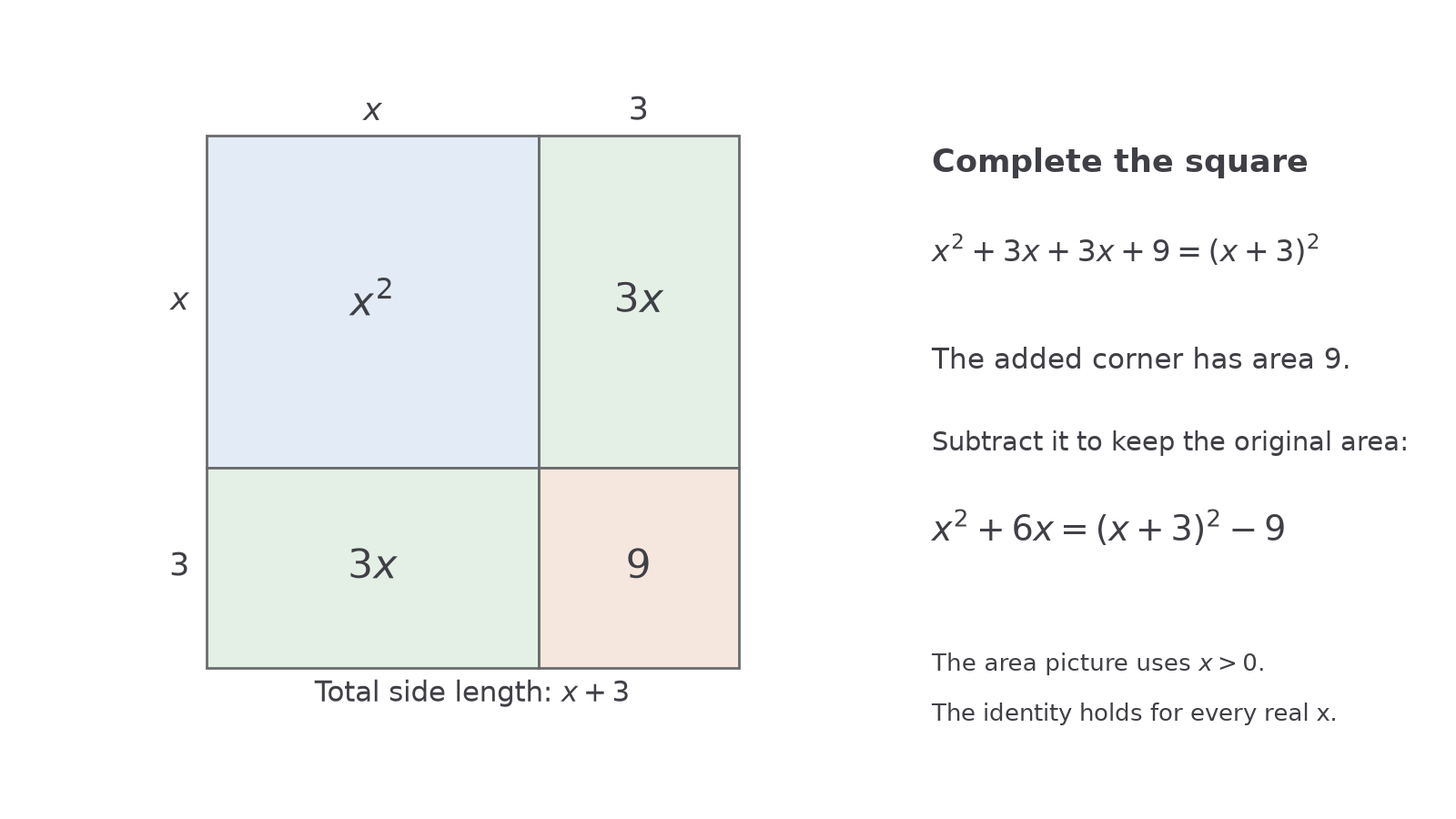
Adding changes the original expression, so subtract as well: . Expansion proves this identity even when is zero or negative and the area picture no longer applies.
You already know
. The middle coefficient is twice the bracket value. Squaring a bracket includes its two mixed products; .
Completing the square reverses this expansion. Choose the bracket value to match the linear term, then correct the constant.
Completing the square
Completing the square rewrites a quadratic as , where , in an identity true for every real . For example, . The expression alone is not identical to , because it includes an extra .
For a quadratic whose squared-term coefficient is , halve the linear coefficient to get the bracket value.
Completing the square when the leading coefficient is one
For real , and ,
Half of may be negative or fractional. Subtract its square to compensate for the constant added by the bracket.
Not on the formulae sheet: learn it.
First use the positive linear coefficient from the area picture, with a constant already present.
Worked example 1: a positive bracket value
Question. Write in the form .
Plan. Halve , form the squared bracket and subtract its extra constant.
Why this step? Expanding creates , so subtracting preserves the original value.
Answer. , so and .
Check. Expansion gives . At , both forms give .
Change only the sign of the linear term. The bracket value becomes negative, but its square is still positive.
Worked example 2: a negative bracket value
Question. Write in the form .
Plan. Halve , then compensate for the constant in the squared bracket.
Why this step? The bracket creates , so the correction is , just as before.
Answer. , so and .
Check. Expanding gives . At , both expressions equal .
The sign of the linear coefficient controls the sign inside the bracket, not the sign of the squared correction.
Watch out
Wrong: . The square already contains , so this adds it twice. Right: .
Try a new negative linear coefficient, keeping the constant correction separate until the final line.
Keeping the outside coefficient
If the coefficient of is not , take it outside the quadratic terms first. Complete the square inside, then let the outside coefficient multiply every correction inside its bracket.
For , start with . You must halve , the linear coefficient inside, rather than the original .
Completing the square with a leading coefficient
For real , , and ,
The factorisation-and-correction method works for negative too. The outside factor multiplies the entire correction.
Not on the formulae sheet: learn it.
You can derive the result each time; memorising the longer formula is less useful than understanding where the correction comes from.
Worked example 3: a fractional bracket value
Question. Write in the form .
Plan. Take out from the quadratic terms, complete the square inside and distribute the correction.
Why this step? The extra lies inside a bracket multiplied by , so it contributes to the whole expression.
Answer. , so , , .
Check. Expansion gives . At , the result is .
Change only the leading coefficient from to , leaving the linear and constant terms unchanged. The linear coefficient inside the first bracket changes, so halve it afresh.
Worked example 4: the leading coefficient changes
Question. Write in the form .
Plan. Take out , complete the square inside and simplify the constant outside.
Why this step? Changing the outside coefficient changes the inside coefficient too; copying the previous bracket value would give the wrong linear term.
Answer. , so , , .
Check. . At , the original and completed forms both give .
A completed square can reveal a fact hidden in the expanded form. For every real ,
So this quadratic is always positive, even though the middle term is negative whenever . The square makes the guarantee visible.
Watch out
Wrong: . The outside must multiply as well. The correction outside is .
In this check the bracket value is fractional again. Give the expression in the exact form requested as your final answer.
Matching constants in a square identity
An identity holds for every value of , so coefficients of corresponding powers must match. This gives another route to a completed square and lets you work out a missing constant in the original quadratic.
Expand the general form once:
The three coefficients are , and . This is an expansion of the earlier identity, not a formula supplied on the formulae sheet.
Worked example 5: a missing constant in the quadratic
Question. , where , and are constants. Work out their values.
Plan. Expand the right-hand side, then compare the squared, linear and constant coefficients in that order.
Why this step? The outside coefficient contributes to both the linear term and the constant; neither is determined by alone.
Answer. , , .
Check. .
Change only the sign of the linear term. Predict which constant changes sign and which stays the same before following the working.
Worked example 6: the bracket sign changes
Question. , where , and are constants. Work out their values.
Plan. Compare coefficients again, retaining the sign in the linear equation.
Why this step? Negating changes , but it does not change .
Answer. , , .
Check. Expanding gives , with the required negative linear coefficient.
Finally, the opening expression is
A real square is non-negative, so the expression cannot be less than . It equals exactly when . This is why the completed form is useful later when you study quadratic functions.
Exam tip
Read whether the question wants an expression or values of named constants. For “write in the form”, give the completed expression. For “work out the values”, finish with each named value clearly identified.
The last check changes the coefficients and the supplied final constant. Compare all three terms, including the constant created by squaring the bracket.
Quick Recap
- A squared bracket creates a linear term and a constant; compensate for the constant it adds.
- When the squared-term coefficient is , halve the linear coefficient for the bracket value.
- Otherwise factor out the leading coefficient first, and let it multiply the correction too.
- Expand to check the identity, or match coefficients to work out unknown constants.
The opening quadratic is , so its smallest real value is , attained at .