6.3 - Sine rule, cosine rule and triangle area
Choose a trigonometric rule from the information a triangle gives you. You will work out sides, angles and areas in triangles without a right angle, keeping exact values where possible and checking whether a sine calculation permits more than one triangle.
Matching opposite pairs in the sine rule
Can two triangles have the same two side lengths and the same area, but different third sides? Keep sides of and in mind. We will compare included angles of and by the end.
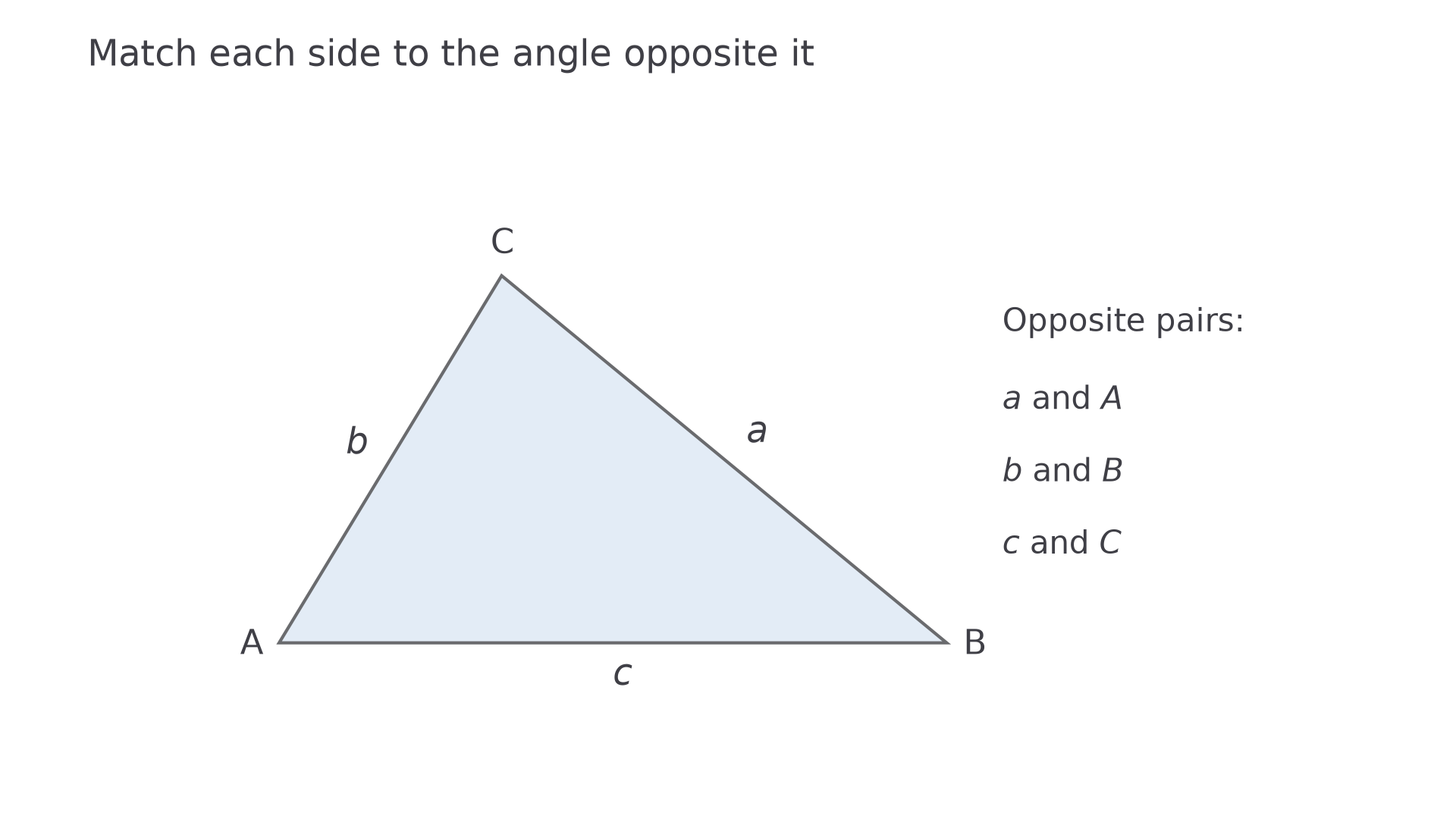
In a triangle, use lower-case for the side opposite angle , and similarly for and . Opposite pairs are what make the sine rule work.
[DIAGRAM: asset_name: Opposite side and angle pairs; asset_slug: l2fm-triangle-opposite-pairs; caption: Each lower-case side is opposite its matching capital-letter angle; description: A scalene triangle has vertices A, B and C. Side BC is labelled a, side AC is b and side AB is c. The three opposite side-angle pairs are listed beside it.]
You already know
In a right-angled triangle, sine is opposite over hypotenuse, cosine is adjacent over hypotenuse and tangent is opposite over adjacent. Those ratios are on the formulae sheet. For a non-right-angled triangle, do not invent a hypotenuse: use the sine or cosine rule instead.
Drop a perpendicular height from onto the line through and . Its height can be written as or , so . Rearranging gives the sine rule; the same result also holds when a height meets an extended side.
Sine rule
For a non-degenerate triangle, with each side opposite its matching angle,
Use it when a complete opposite pair and another required side or angle are available. All triangle angles are strictly between and .
On the formulae sheet.
For a missing side, put that side on top. This makes the rearrangement short.
Worked example 1: a missing side
Question. In triangle , , and . Work out exactly.
Plan. Pair with , then rearrange the sine rule for .
Why this step? The given side is opposite , not opposite the angle whose sine looks easiest.
Answer. .
Check. , so ; indeed .
Worked example 2 changes only , from to . The sine rule also works with an obtuse angle.
Worked example 2: an obtuse opposite angle
Question. In triangle , , and . Work out exactly.
Plan. Keep the known opposite pair and use the exact value of .
Why this step? Sine is positive for every triangle angle, including obtuse ones.
Answer. .
Check. The remaining angle is , so the triangle is possible. Since is the largest angle, its opposite side is the largest; .
Write the paired equation before inserting decimals or surds.
Watch out
Wrong: pair with . Right: is opposite , so it belongs with . Relabel a triangle if necessary before choosing a rule.
Use a new known side and an angle of .
Angles and the two possible sine values
When the sine rule gives an angle, a calculator's inverse sine may give only one of two possible triangle angles.
For , the angles and have equal sines. Test both against the other given angle: the triangle's angles must add to , leaving a strictly positive third angle. If a computed sine is greater than , no triangle is possible.
[DIAGRAM: asset_name: Two possible sine-rule triangles; asset_slug: l2fm-sine-rule-two-triangles; caption: The same side of length 8 and opposite-pair data can allow two positions for the third vertex; description: A common segment AC has length 8 and makes 30 degrees with the horizontal ray from A. C is joined to two possible points B1 and B2 on that ray, each at distance 5 from C. The two exact triangles have obtuse and acute angles respectively at B1 and B2.]
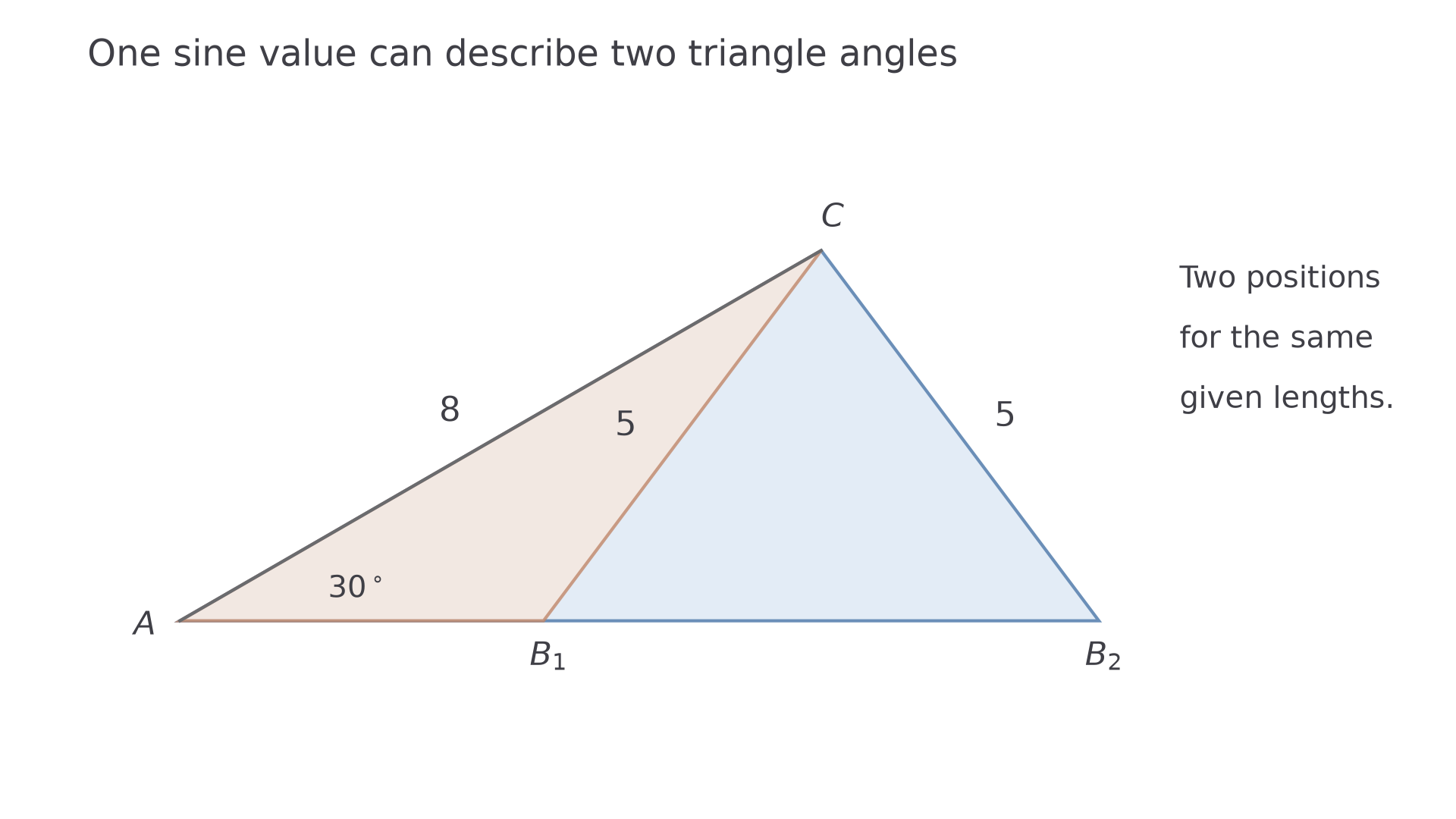
This is a question about the available information, not a calculator fault. Two sides and a non-included angle need not fix one triangle.
Worked example 3: two valid angles
Question. In triangle , , and . Work out the possible values of , to decimal place.
Plan. Work out , obtain the acute angle and its supplement, then check the angle sum.
Why this step? The supplement has the same sine, and here it still leaves a positive third angle.
Answer. or .
Check. Both candidate sines are ; their corresponding third angles are about and .
Worked example 4 changes only the given angle , from to . The new data cannot form a triangle.
Worked example 4: impossible triangle data
Question. In triangle , , and . Work out whether a triangle is possible.
Plan. Apply the sine rule and check whether its proposed sine is within the possible range.
Why this step? A real angle cannot have sine greater than . Taking inverse sine is not a way around inconsistent data.
Answer. No triangle satisfies these conditions.
Check. The exact comparison confirms the contradiction without rounding.
If the supplement makes the known angles add to or more, reject it. If the inverse-sine angle is exactly , its supplement is the same angle, so there is only one candidate.
Watch out
Wrong: report the calculator's acute angle automatically as the only answer. Right: also test its supplement, then keep only candidates that leave a positive third angle.
The next lengths give another pair of possible triangles.
The cosine rule for a missing side
Use the cosine rule when two sides and their included angle are known; no complete opposite pair is needed.
The included angle lies between the two known sides. In the formula below, and meet at , and the unknown side is opposite .
Cosine rule
For a non-degenerate triangle,
The angle is between sides and , and opposite side .
On the formulae sheet.
At , cosine is zero and the rule becomes Pythagoras. For an obtuse included angle, cosine is negative, so the last term adds to the square sum rather than subtracting from it.
Worked example 5: an acute included angle
Question. Two sides of a triangle are and , with included angle . Work out the third side.
Plan. Use the cosine rule for its square, then take the positive square root.
Why this step? The rule gives , so the length is its square root, not .
Answer. .
Check. The triangle inequality requires ; .
Continue this lesson.
You’re previewing NovaLearn without an account. Create a free account to read the rest.
Create free account