6.1 - Perimeter, area and volume
Choose the right lengths and surfaces when calculating with flat shapes and solids. You will connect familiar area formulae to prisms, cylinders, cones, pyramids and spheres, keeping exact answers in terms of where appropriate. A careful sketch often matters more than a long calculation.
Perimeters and areas of flat shapes
Can two solids have exactly the same volume but different surface areas? We will compare a sphere and a cylinder at the end. First, separate three jobs: perimeter measures a boundary, area measures a surface and volume measures space inside a solid.
You already know
Use one length unit throughout a calculation. Area has squared units and volume has cubed units: , so and .
For a rectangle, rows of unit squares explain area , and its four edges give perimeter . A diagonal halves a rectangle into equal-area triangles, giving triangle area . A parallelogram can be cut at one end and rearranged into a rectangle of base and perpendicular height , so its area is . A sloping side is not generally that height.
Rectangle, triangle and parallelogram
For positive lengths and perpendicular height ,
For any polygon, its perimeter is the sum of its outside edge lengths.
Not on the formulae sheet: learn it.
Two matching trapezia fit together to form a parallelogram with base equal to the sum of the parallel sides. Each trapezium therefore has half that area.
Area of a trapezium
If the parallel sides have lengths and , and their perpendicular separation is ,
On the formulae sheet.
Composite shapes use the same ideas: split into non-overlapping pieces, or subtract a missing piece. Only the outside boundary counts towards perimeter.
Worked example 1: adding two areas
Question. A shape is made from a rectangle long and wide, with a triangle attached along an edge. The triangle has perpendicular height . Work out the total area.
Plan. Add the rectangle and triangle areas; they share an edge but no area.
Why this step? An internal joining edge has no area, so adding these two areas counts every point once.
Answer. .
Check. The triangle has the same area as an by rectangle, giving .
Worked example 2 changes only an attached triangle into a triangular cut-out of the same dimensions. Addition becomes subtraction.
Worked example 2: subtracting a cut-out
Question. A rectangle measures by . A triangle of base and perpendicular height is removed from inside it, with its base along a rectangle edge. Work out the remaining area.
Plan. Subtract the triangle's area from the rectangle's area.
Why this step? The cut-out is absent, so its area must be removed rather than added.
Answer. .
Check. The removed triangle is one third of the rectangle's area, leaving two thirds: .
The same two component areas can give different totals because the cut-out is removed rather than attached.
Watch out
Wrong: using a triangle's sloping side as in . The height must meet the chosen base at a right angle. Draw that perpendicular before substituting.
Apply the average-of-parallel-sides idea to a trapezium now.
Circles and curved boundaries
A circular part has a curved boundary and may have straight edges too, so calculate its area and perimeter separately.
The radius joins the centre to the circumference; the diameter is twice the radius. A semicircle uses half a disk but its boundary includes a full diameter. A sector is a slice bounded by two radii and an arc; its angle determines the fraction of the full circle.
Circumference and area of a circle
For radius and diameter ,
On the formulae sheet.
An angle of occupies the fraction of a full turn. Its sector area and arc length are the same fraction of the full area and circumference. This fraction-of-a-circle method is not on the formulae sheet: learn it.
Worked example 3: a semicircle
Question. A semicircle has radius . Work out its area and perimeter in terms of .
Plan. Halve the circle's area and circumference, then include the straight diameter in the perimeter.
Why this step? Perimeter follows every outside edge, including the straight edge that the full circle did not have.
Answer. Area ; perimeter .
Check. Two such areas make , the area of the full circle. The curved part alone has length .
Worked example 4 changes only the sector angle from to . Two radii now form the straight part of the boundary.
Worked example 4: a quarter-circle
Question. A quarter-circle has radius . Work out its area and perimeter in terms of .
Plan. Take one quarter of the disk and circumference, then add two radii to the arc length.
Why this step? Halving the sector angle halves its arc, but the two straight radii still total .
Answer. Area ; perimeter .
Check. Four areas total ; four arcs total , the full circumference.
For a composite shape, trace the outline with your finger before adding boundary lengths.
Watch out
Wrong: a semicircle's perimeter is . That is only its arc. Right: . The area still uses , while boundary lengths use .
Keep the quarter-circle angle and change its radius for the next calculation.
Prisms and cylinders
A prism has a constant cross-section along its length, so its volume counts identical layers and its surface area counts the exposed faces.
For a right prism, a cross-section of area and perimeter , extended through length , gives two end faces of area and side faces totalling . For example, a triangular prism with cross-section sides , perpendicular legs , and length has
Here lengths are in centimetres, so volume is and surface area is .
Volume of a prism
The length is measured perpendicular to the end cross-section.
On the formulae sheet.
A cylinder follows the same layer argument, with circular cross-section . Unroll its curved surface and you get a rectangle of width and height .
[DIAGRAM: asset_name: Unrolling a cylinder; asset_slug: l2fm-geometry-cylinder-net; caption: A cylinder's curved surface unrolls to a rectangle of width 2 pi r and height h, with two circular ends; description: A pale blue rectangular curved-surface net labelled width 2 pi r and height h, beside two sage disks each labelled area pi r squared. Text states total surface area equals 2 pi r h plus 2 pi r squared.]
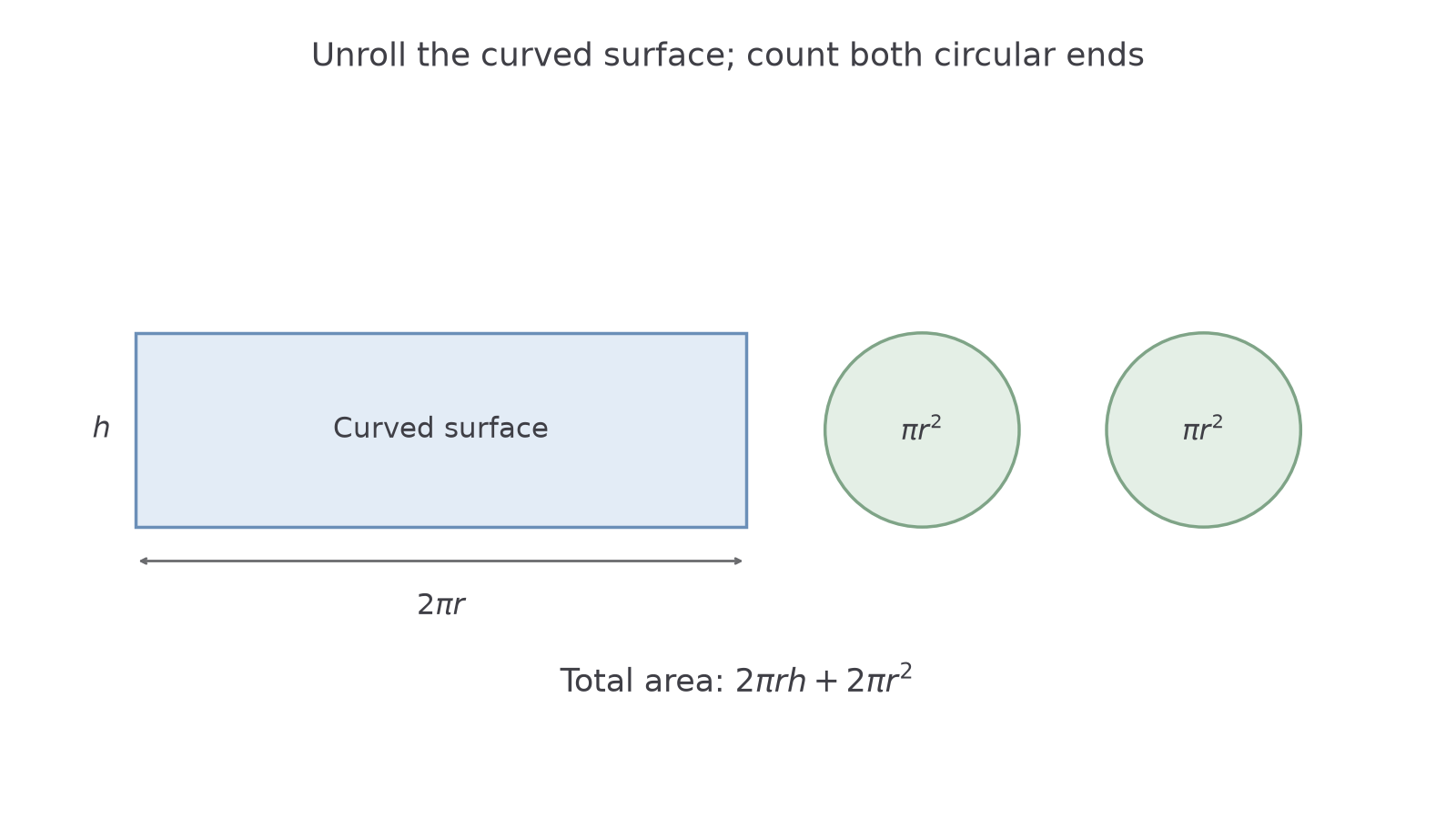
For a closed cylinder, include both circular ends. For an open container, count only the surfaces that exist.
Surface areas and cylinder volume
For a closed right prism, . For a cylinder,
These follow from the prism formula, circle measures and a net.
Not on the formulae sheet: learn it.
The word “total” asks for every exposed face, rather than just the curved surface.
Continue this lesson.
You’re previewing NovaLearn without an account. Create a free account to read the rest.
Create free account