6.1 - Angle facts and circle theorems
Use line, polygon and circle facts to work out angles with reasons. You will recognise the exact conditions behind each theorem, including which chord or arc an angle subtends. That turns a busy diagram into a short chain of deductions.
Lines and triangles
Can an angle at a circle's circumference be greater than ? It can, and the smaller angle between the corresponding radii is not always the angle to halve. By the end you will know which angle at the centre belongs to which angle at the circumference.
Begin with the facts that do most of the work. Angles on a straight line total ; angles around a point total . Vertically opposite angles are equal because each is the supplement of the same neighbouring angle. These statements apply to intersecting lines without any parallel-line condition.
Parallel-line angle facts
When a transversal crosses two parallel lines, corresponding angles are equal, alternate angles are equal and co-interior angles total . Corresponding angles occupy matching corners; alternate angles lie on opposite sides of the transversal; co-interior angles lie inside the parallels on the same side. Without parallel lines, those equalities and sums need not hold.
Draw a line through one vertex of a triangle parallel to its opposite side. Alternate angles move the other two interior angles next to the vertex angle, forming a straight line. This explains the triangle angle sum, rather than merely naming it.
Triangle angles
For the interior angles of a triangle,
An exterior angle equals the sum of the two opposite interior angles. An isosceles triangle has equal angles opposite its equal sides; an equilateral triangle has three angles. A right-angled triangle's other two angles total .
Not on the formulae sheet: learn it.
The exterior-angle result follows by comparing the straight-line sum with the triangle sum. Keep the exterior angle outside the triangle in your sketch.
Worked example 1: three interior angles
Question. A triangle has angles and . Work out its third angle.
Plan. Subtract the two known interior angles from .
Why this step? The three given positions are interior angles of one triangle, so exactly those three belong in the sum.
Answer. .
Check. .
Worked example 2 replaces the third interior angle by its adjacent exterior angle. The triangle itself has the same angles.
Worked example 2: an exterior angle
Question. In triangle , . Side is extended beyond to , and . Work out .
Plan. Use the exterior angle as the sum of the two opposite interior angles.
Why this step? The angle at outside the triangle equals the angles at and inside it; it is not a third interior angle.
Answer. .
Check. The interior angle at is , and .
Use full geometric reasons when they are requested: “alternate angles in parallel lines” states the condition as well as the fact.
Watch out
Wrong: corresponding angles are equal whenever two lines are crossed. They are equal here because the two lines are parallel. A diagram's appearance does not establish parallelism.
Now change the exterior angle and one opposite interior angle.
Quadrilaterals and polygons
Special quadrilaterals combine side information with angle information, so identify the shape before borrowing one of its properties.
A diagonal splits any convex quadrilateral into two triangles, giving an interior sum of . Parallel sides then give additional equalities and supplementary pairs. The table organises those facts; the reasons are the triangle and parallel-line facts you have just used.
| Shape | Angle properties and useful structure |
|---|---|
| Parallelogram | Opposite sides parallel and equal; opposite angles equal; adjacent angles total ; diagonals bisect each other |
| Rectangle | A parallelogram with four right angles; its diagonals are equal and bisect each other |
| Rhombus | A parallelogram with four equal sides; opposite angles equal; diagonals are perpendicular, bisect each other and bisect the vertex angles |
| Square | Both a rectangle and a rhombus: four right angles, four equal sides and both sets of diagonal properties |
| Kite | Two pairs of adjacent equal sides; the opposite angles between unequal sides are equal; its symmetry diagonal bisects the other diagonal at right angles and bisects the angles at its own ends |
| Trapezium with parallel bases | The angles at either end of a non-parallel side total |
| Isosceles trapezium | Equal non-parallel sides; equal angles at each base; diagonals equal |
For example, a rhombus with one angle has the other angles . An isosceles trapezium with one base angle has its other base angle and the two angles at the other base . In a kite whose unequal opposite angles are and , the remaining equal pair each measure . Mark the equal sides first so you select the correct pair of angles.
Regular polygon
A regular polygon has all sides equal and all interior angles equal. Equal sides alone do not make a polygon regular: a non-square rhombus is a counterexample.
Drawing diagonals from one vertex divides a convex -gon into triangles. Walking once around its boundary turns you through a full , so the exterior angles total one full turn.
Polygon angle sums
For a convex polygon with sides,
For a regular polygon,
An exterior angle here is formed by extending a side, not a reflex angle around a vertex.
Not on the formulae sheet: learn it.
A surprisingly small amount of information can fix the entire shape's side count: just one exterior angle of a regular polygon.
Worked example 3: exterior angle to side count
Question. A regular polygon has exterior angle . Work out its number of sides and its interior angle.
Plan. Divide a full turn by the exterior angle, then use a straight line at a vertex.
Why this step? Regularity makes every exterior turn equal, so each is the same fraction of .
Answer. sides and interior angle .
Check. .
Worked example 4 changes only the exterior angle. A smaller turn means more sides are needed to complete the circuit.
Worked example 4: a smaller exterior turn
Question. A regular polygon has exterior angle . Work out its number of sides and its interior angle.
Plan. Repeat the full-turn and straight-line calculations.
Why this step? The total turn stays ; only the share made at each vertex changes.
Answer. sides and interior angle .
Check. .
The full-turn argument also explains why a proposed regular polygon can fail: divided by its exterior angle must give a whole number of sides.
Watch out
Wrong: using an interior angle . Right: first work out , the exterior angle, then divide by that.
Use the same two steps for one more regular polygon.
Angles subtended by a chord
A chord's endpoints determine an arc, and that same arc links angles at the centre and circumference.
Chord, arc and segment
A chord joins two points on a circle. An arc is part of its circumference. A chord divides the disk into two segments. An angle subtended by chord at is , with on the circumference and distinct from and . The relevant arc is the one that does not contain .
Draw radii from the centre to the chord endpoints and to . The resulting isosceles triangles explain the doubling relationship. The important choice is the arc: if lies on the minor arc, the corresponding central angle is reflex.
[DIAGRAM: asset_name: The corresponding central angle; asset_slug: l2fm-geometry-central-angles; caption: The same chord gives an acute or obtuse circumference angle depending on the arc containing the vertex; description: Two general-position circle diagrams share endpoints A and B with minor central angle 134 degrees. Left C lies on the major arc, angle ACB is 67 degrees and minor AOB is 134 degrees. Right C lies on the minor arc, angle ACB is 113 degrees and the corresponding reflex AOB is 226 degrees. The endpoints are not a diameter.]
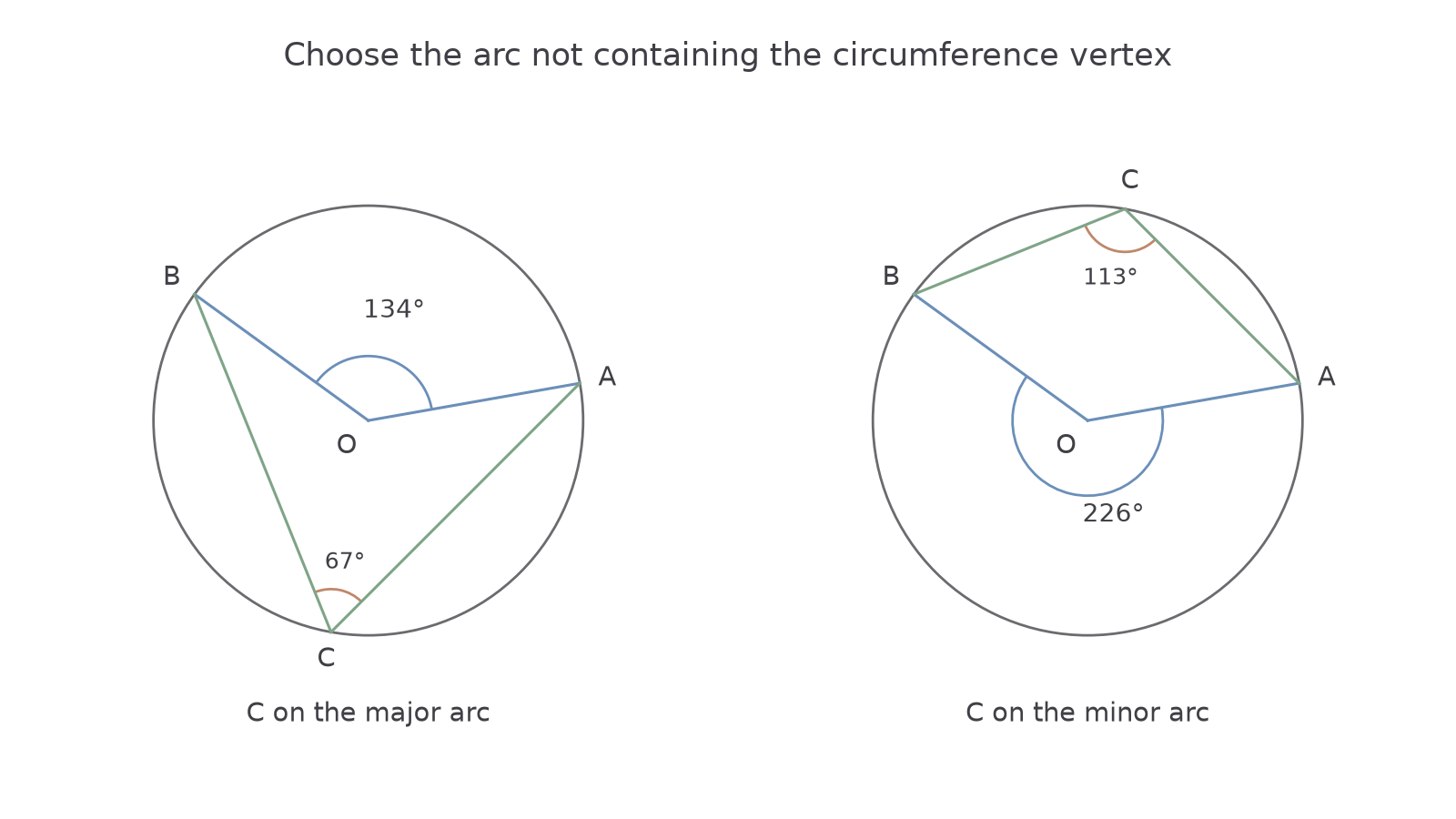
The central angle is the one sweeping the same arc that the circumference angle sees.
Centre, circumference and same segment
For angles subtended by the same arc,
The central angle may be reflex. Angles subtended by the same chord in the same segment are equal. An angle in a semicircle is , because a diameter subtends at the centre.
Not on the formulae sheet: learn it.
The phrase “same segment” matters: vertices on opposite sides of the chord do not generally give equal angles.
Worked example 5: the minor arc is seen
Question. The minor central angle is . Point lies on the major arc . Work out .
Plan. Halve the central angle subtended by the arc not containing .
Why this step? lies on the major arc, so its angle sees the minor arc with central angle .
Answer. .
Check. Any other vertex in the same segment gives too.
Continue this lesson.
You’re previewing NovaLearn without an account. Create a free account to read the rest.
Create free account