2.8 - Factorising fully
Turn algebraic sums into useful products, including expressions with bracketed squares and quadratics in two variables. You will learn to recognise a common factor, choose the right factorisation and keep going until every available factor has been taken out.
Taking out the whole common factor
How can you work out without squaring either number? Factorising will turn that subtraction into a tiny multiplication. First, we need to recognise what a factor actually is.
You already know
Expanding a product uses the distributive law. Reversing it gives . For example, : both terms contain .
A common factor can be a number, a letter, a power or a complete bracket. Take the highest common numerical factor and the lowest power present in every term. For and , that power is , because the first term contains one extra .
Factorising
Factorising rewrites a sum or difference as a product with the same value. For example, . Merely rewriting it as is not a factorisation of the whole expression: the terms are still separated by addition.
To check a factorisation, multiply it out. Dividing each original term by the proposed common factor tells you what belongs inside the new bracket.
Worked example 1: a common power
Question. Factorise fully .
Plan. Take out , then simplify and factorise the bracket that remains.
Why this step? Taking out leaves from the first term and the complete from the second. Neither factor disappears.
Answer. .
Check. Both the original and the answer expand to . At , both give .
Worked example 2 changes the common base from to the bracket . Treat that whole bracket as one object, just as you treated .
Worked example 2: a common bracketed power
Question. Factorise fully .
Plan. Take out , then collect the remaining linear terms.
Why this step? The fifth power contains five copies of . Removing four copies leaves one whole , rather than or .
Answer. .
Check. Expand only the last bracket: reproduces the two original terms. At , both forms give .
This method keeps high powers manageable. Expanding the fifth power first would create far more work without helping you see its shared factor.
Watch out
Wrong: . The first term still contributes a factor of inside the new bracket. The correct remaining bracket is .
Try the same common-bracket decision with a different base and outside multiplier.
Recognising a difference of two squares
A subtraction of two complete squares can be factorised as the difference of their bases multiplied by the sum of their bases.
You have already seen by expansion: the two middle products cancel. Read that identity in reverse to factorise. A picture gives the same result. Removing a -by- corner from a -by- square leaves two pieces that make a -by- rectangle.
[DIAGRAM: asset_name: Rearranging a difference of squares; asset_slug: l2fm-difference-squares-area; caption: Removing a square and rearranging the remaining pieces turns a difference of areas into a product; description: On the left a square of side 5 has a top-right square of side 2 removed. Its remaining blue strip has dimensions 5 by 3 and its sage strip has dimensions 3 by 2. On the right the sage strip is turned and placed beside the blue strip, forming a rectangle of height 3 and width 5 plus 2 equals 7. Labels show 5 squared minus 2 squared equals 21 and open bracket 5 minus 2 close bracket times open bracket 5 plus 2 close bracket equals 3 times 7 equals 21]
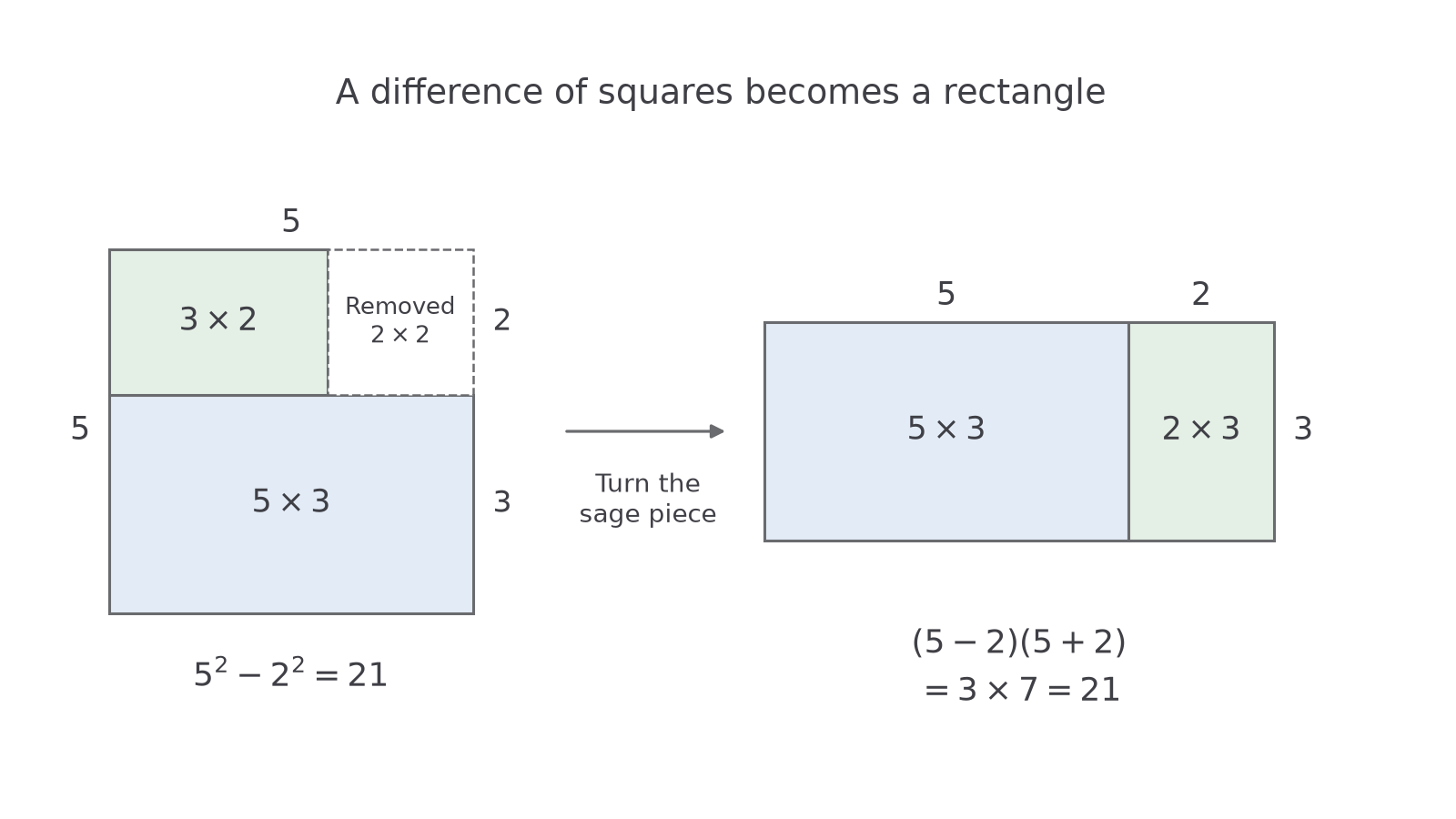
The picture needs positive lengths with . The algebraic identity works for all real and , including negative values and , when one factor is zero.
Difference of two squares
For all real numbers or expressions and ,
Identify the complete base of each square before writing the factors.
Not on the formulae sheet: learn it.
For , the bases are and , giving . When the bases themselves contain brackets, keep them intact for the subtraction.
Worked example 3: squared brackets as the two bases
Question. Factorise fully .
Plan. Use the difference of squares with and .
Why this step? Subtracting the whole changes its to , so the first factor is , not .
Answer. .
Check. Expanding the two squares gives . The answer expands to the same expression.
Change only the minus sign inside the second base to a plus. The difference of the bases is now negative, which is allowed.
Worked example 4: a negative first factor
Question. Factorise fully .
Plan. Form the difference and sum of the complete bases, then simplify.
Why this step? You must preserve the original order of subtraction. Swapping the two bases would change the sign of the answer.
Answer. .
Check. At , the original is , and the answer gives .
The opening calculation now takes one line: . There is a second pleasing consequence: every positive odd integer is a difference of consecutive squares, because for a nonnegative integer . For example, , since their difference is and their sum is .
Watch out
The sign between the squares must be minus. Wrong: . That product is . The sum does not factorise into real linear factors.
Keep both bases in brackets when you form their difference in this check.
Factorising quadratics in two variables
A quadratic such as can be factorised in the same way as a one-variable quadratic: the two middle products must combine to give its term.
For , look for two numbers whose product is and whose sum is . Use them to split the middle term, then factorise in pairs. The letter stays attached to the appropriate term; it is not an extra unknown you need to solve for.
Worked example 5: a positive final term
Question. Factorise .
Plan. Split the middle coefficient using two numbers with product and sum .
Why this step? The two grouped brackets must match. That common bracket is what allows the last factorisation.
Answer. .
Check. The outer and inner products are and , giving the required . The end products are and .
Worked example 6 changes only the final term, from to . The split numbers must now have opposite signs because their product is negative.
Worked example 6: opposite signs in the factors
Question. Factorise .
Plan. Look for product and sum , then factorise in pairs.
Why this step? Taking from the last pair leaves , matching the first bracket. Taking would leave both signs negative instead.
Answer. .
Check. The middle products are and , giving . The end products are and .
You can also choose the two brackets by inspection. Either route needs the same final check of both end terms and the middle term. Matching only the end terms is not enough.
Watch out
Wrong: . The middle terms of that product are . The correct factors are .
The next quadratic has a negative middle coefficient as well as a negative final term. The two split numbers still have opposite signs; their sum must now be negative.
Continuing until fully factorised
“Fully” means checking the factors you have just made, because the first factorisation may reveal another one.
For example, has a common factor removed, but the bracket is still a difference of squares. Continue to . Keep the outside : factorising an expression does not allow you to divide its value by .
| What you see | First step |
|---|---|
| A factor shared by every term | Take it out before doing anything else |
| Two complete squares being subtracted | Use difference times sum |
| A quadratic with three terms | Match the two middle products |
| A newly formed bracket that still fits a row above | Factorise that bracket again |
These are familiar tools, but choosing their order matters. Taking out a common factor first often exposes a much simpler bracket.
Worked example 7: a fourth power reduced in stages
Question. Factorise fully .
Plan. Take out the common , then factorise the remaining difference of squares.
Why this step? The original terms share . Removing it turns the fourth-power expression into a familiar quadratic factor.
Answer. .
Check. ; multiplying by restores . At , both forms give .
Worked example 8 multiplies the whole expression by . The algebraic factors stay the same, and the numerical factor must stay in the answer.
Worked example 8: retaining the numerical factor
Question. Factorise fully .
Plan. Take out the highest common factor , then use the same difference of squares.
Why this step? Taking out only would be valid but unfinished. Removing the highest common numerical factor immediately keeps the later bracket simpler.
Answer. .
Check. At , the original is , and the product is .
A power such as or is already a compact product of repeated linear factors; you may leave it as a power. Here the remaining linear brackets have no further common integer factor, so the factorisation is complete.
Exam tip
Factorising asks for a product, so stop at the fully factorised expression. Do not set it equal to zero and list solutions unless the question asks you to solve an equation. Show useful intermediate factors even if you cannot finish: they can earn partial credit.
Finish by recognising the common factor and the square that remains, using new coefficients.
Quick Recap
- Take out the highest common factor first; it may be a whole bracket raised to a power.
- A difference of squares becomes the difference of the bases times their sum. Keep bracketed bases intact when subtracting.
- In a two-variable quadratic, the two middle products must combine to the required term.
- Check every new bracket for another factorisation, retain numerical factors and verify by expanding.
The opening calculation is , using the difference of two squares.