2.22 - nth terms of quadratic sequences
Quadratic sequences have a changing step but a constant change in that step. You will use second differences or known term positions to build their nth terms, then solve quadratic equations to work out which positions have a given value.
Using constant second differences
The quadratic sequence begins by increasing. Could the next term also be , without the sequence becoming constant? Its nth term will explain how that can happen.
You already know
A linear sequence has a constant first difference and rule . Subtracting a known rule term by term can leave a simpler sequence. Sequence positions are positive integers unless another domain is stated.
For , the first differences are . Subtract those differences in turn: the second differences are . A quadratic sequence has exactly this kind of steady change in its first differences.
Quadratic sequence
A quadratic sequence has an nth term of the form , where are fixed constants and . At consecutive integer positions it has constant, non-zero second difference. If the second difference is zero, the sequence is linear or constant instead.
The second difference tells you . To see why, subtract the general term from the next one:
Increasing by increases this first difference by , whatever and are.
Second difference and leading coefficient
For , with , at consecutive integer positions,
Subtract from the terms. The remaining linear sequence has rule .
Not on the formulae sheet: learn it.
The diagram follows that subtraction for the first example. It removes the changing part of the differences, leaving a familiar linear sequence.
[DIAGRAM: asset_name: Removing the quadratic part; asset_slug: l2fm-quadratic-second-differences; caption: Second difference 4 gives a quadratic part of 2n squared; subtracting it leaves n plus 2; description: A difference layout shows terms 5, 12, 23, 38; first differences 7, 11, 15; and second differences 4, 4. Under it, aligned columns at positions 1 to 4 subtract 2, 8, 18, 32, the values of 2n squared, to leave 3, 4, 5, 6. A label identifies the remainder as n plus 2.]
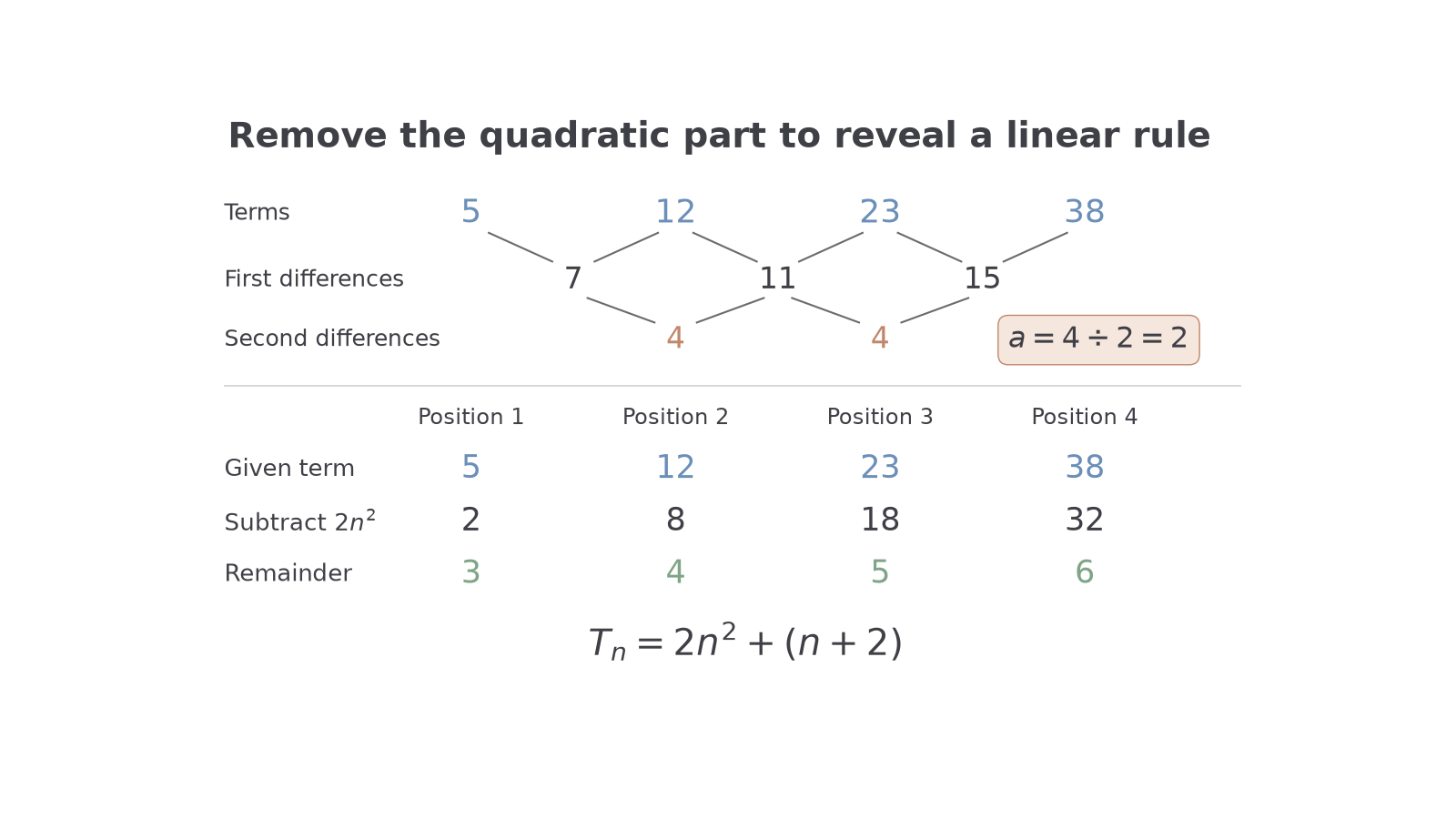
Worked example 1: a positive linear remainder
Question. Work out the nth term of the quadratic sequence .
Plan. Halve the second difference to get , then subtract and identify the linear remainder.
| Position | ||||
|---|---|---|---|---|
| Given term | ||||
| Subtract | ||||
| Remainder |
Why this step? The second difference determines only . The remainder is needed to recover the whole rule.
Answer. .
Check. and .
Change only the sign of the linear term in the rule, from to . Its quadratic and constant parts stay the same, so the second difference is still .
Worked example 2: a negative linear remainder
Question. Work out the nth term of the quadratic sequence .
Plan. Use the second difference to identify , then examine what remains.
| Position | ||||
|---|---|---|---|---|
| Given term | ||||
| Subtract | ||||
| Remainder |
Why this step? A decreasing remainder does not make the quadratic coefficient negative. Its first difference determines , separately from .
Answer. .
Check. and .
A negative second difference gives a negative , so a quadratic sequence can eventually fall. An odd second difference gives a fractional : for example, second difference means . Do not assume coefficients are integers unless the question says so. Also use the stated sequence type: a few listed terms alone do not determine how an unrestricted sequence must continue.
Watch out
Wrong: second difference means the rule starts . Right: it starts . Also, a zero linear remainder is allowed: a rule may have , , or both.
Use a new second difference and a decreasing linear remainder in the matched question.
Using terms at known positions
If some terms are missing but part of the rule is given, substitute known positions into that rule to make equations for its unknown coefficients.
The position matters as much as the value. If the third term is known, substitute , even when the second term is missing. Consecutive-difference tables are not the right shortcut for values taken from non-consecutive positions.
Worked example 3: two missing terms
Question. A quadratic sequence has nth term . Its first four terms are . Work out and .
Plan. Use positions and to solve for and , then evaluate positions and .
Why this step? The given term already fixes the linear coefficient. Two known term values are enough to determine the remaining two coefficients.
Answer. and .
Check. The completed sequence has differences , hence second difference .
Change only the given third term, from to . The first term and the known linear coefficient remain fixed.
Worked example 4: revising one known value
Question. A quadratic sequence has nth term . Its first four terms are . Work out and .
Plan. Form the revised equation for position and solve the same pair of unknown coefficients.
Why this step? A changed term value can change more than one coefficient. Re-solve for after obtaining the new .
Answer. and .
Check. The completed sequence has differences , hence second difference .
Continue this lesson.
You’re previewing NovaLearn without an account. Create a free account to read the rest.
Create free account