2.17 - Solving linear and quadratic inequalities
Describe whole sets of solutions using inequalities. You will solve linear inequalities without losing their direction, use quadratic roots as interval boundaries and combine the result with any restrictions in the question.
Linear inequalities and their direction
When does squaring a number make it smaller? Squaring gives , but squaring gives . By the end you will solve to describe every real number with this property.
Unlike an equation, an inequality usually has an interval of solutions. The statement includes , and , but excludes . The statement includes the boundary too. An open circle on a number line excludes an endpoint; a filled circle includes it.
Solution set
The solution set of an inequality contains every value that makes it true. A strict inequality, using or , excludes equality. An inequality using or includes equality. For example, means both and ; it is not just a list of the integers and .
Adding or subtracting the same number on both sides preserves order. Multiplication by a negative number reverses it: , but . Think of reflecting the number line through zero; left and right exchange places.
Multiplying or dividing an inequality
For real , and ,
The same direction rule applies to division by a non-zero number, and to inequalities that include equality. Do not multiply or divide by an unknown expression without knowing its sign.
Not on the formulae sheet: learn it.
Collect the unknown terms before dividing, so the sign of the divisor is visible.
Worked example 1: a positive divisor
Question. Solve .
Plan. Expand, collect the terms and divide by their positive coefficient.
Why this step? The divisor is positive, so values keep their order.
Answer. .
Check. At , is true. At the excluded boundary , both sides equal .
Worked example 2 changes only the right-hand coefficient of , from to . Collecting terms in the same direction now produces a negative divisor.
Worked example 2: a negative divisor
Question. Solve .
Plan. Expand and collect as before, then reverse the inequality when dividing by a negative number.
Why this step? Division by reverses the order, so the answer is less than , not greater than it.
Answer. .
Check. At , the original inequality is , which is true. At , is false.
You could instead collect the unknowns to get , or . Both routes give the same set of values when the direction is handled correctly.
Watch out
Wrong: gives . Right: . Check a value from your proposed interval in the original inequality if you are unsure.
The next question includes its boundary. Preserve that equality when you reverse the direction.
Quadratic inequalities between the roots
Solve the corresponding quadratic equation to locate boundaries, then use the sign of the quadratic to choose the intervals.
For , the roots are and . Between them, the first factor is positive and the second negative, giving a negative product. Outside, the two factors have the same sign, giving a positive product. The graph tells the same story: below the horizontal axis between the roots, above it outside.
[DIAGRAM: asset_name: Quadratic sign regions; asset_slug: l2fm-inequality-sign-regions; caption: The upward quadratic is negative between minus 2 and 3 and positive outside; description: Coordinate graph of y equals (x plus 2)(x minus 3), with labelled roots (minus 2, 0) and (3, 0). The part below the horizontal axis between the roots is shaded pale blue and labelled y less than 0. Both outside branches are labelled y greater than 0.]
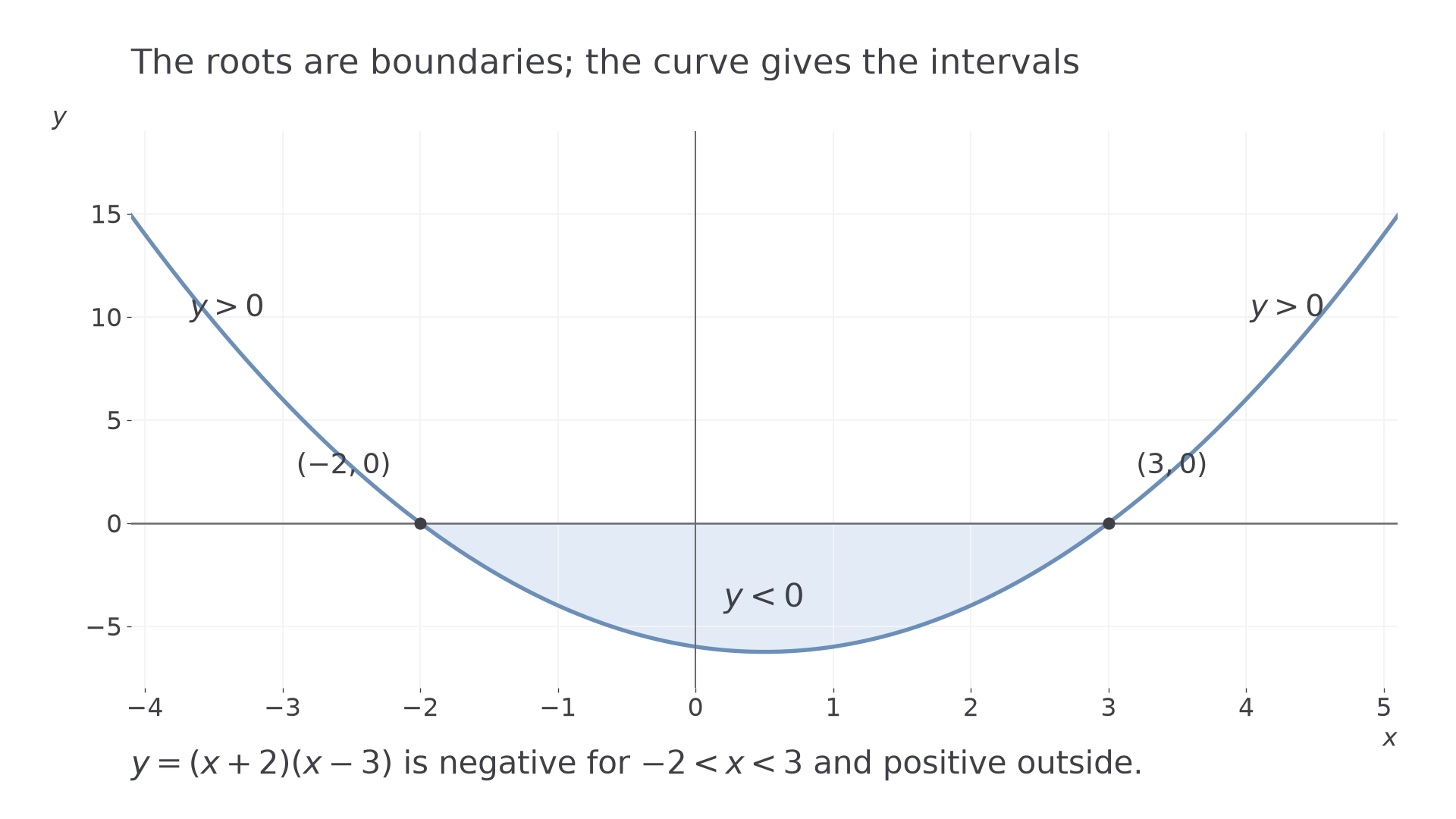
The roots tell you where the sign can change. They are boundaries of the solution, not automatically the whole answer.
Sign of an upward quadratic
For and two distinct real roots ,
The expression equals zero at and . Include these endpoints when the inequality allows equality.
Not on the formulae sheet: learn it.
Start by moving every term to one side, so the other side is zero.
Worked example 3: strictly below zero
Question. Solve .
Plan. Factorise, locate the roots and take the interval where the upward quadratic is negative.
Why this step? A negative product requires opposite signs; that happens between these two roots.
Answer. .
Check. At , the expression is . At or , it is , so those outside values do not work.
Worked example 4 changes only to . The interval stays the same, but its endpoints now belong to the solution.
Worked example 4: including the roots
Question. Solve .
Plan. Use the same factorisation and include the zero values as well as the negative values.
Why this step? At either root, the expression is exactly zero, which satisfies .
Answer. .
Check. Both boundary substitutions give zero. The same interior test still gives .
The special case has roots and , giving . The single statement would wrongly include .
Watch out
Wrong: answer or for . Those values make the expression zero, not negative. Right: use the roots as boundaries and answer .
Continue this lesson.
You’re previewing NovaLearn without an account. Create a free account to read the rest.
Create free account