4.8 - Maximum and minimum problems
Use calculus to choose the largest or smallest value that a problem actually allows. You will turn a geometric constraint into one expression, minimise positive reciprocal expressions and check domain boundaries as well as stationary points.
Maximising an area with a constraint
You have of fencing and a straight wall that provides one side of a rectangular enclosure. Would a square give the greatest area? The wall changes the problem: you pay for only three sides, so the best shape may surprise you.
You already know
An interior stationary point has zero first derivative. A negative second derivative there identifies a local maximum. Differentiate the quantity you want to optimise, then substitute into its original expression for the final value.
Let the two sides perpendicular to the wall each be metres, and the third fenced side be metres. The fencing constraint is , so . The area is . Both dimensions must be positive, giving .
[DIAGRAM: asset_name: A rectangle against a wall; asset_slug: l2fm-fencing-constraint; caption: Only three sides use fencing, so the total fenced length is two short sides plus one long side; description: A rectangle lies against a horizontal fixed wall. The two perpendicular fenced sides are each labelled x metres; the opposite fenced side is labelled l metres. A note gives 2x plus l equals 48 and area A equals xl. The wall is clearly distinguished from the three sage fenced sides]
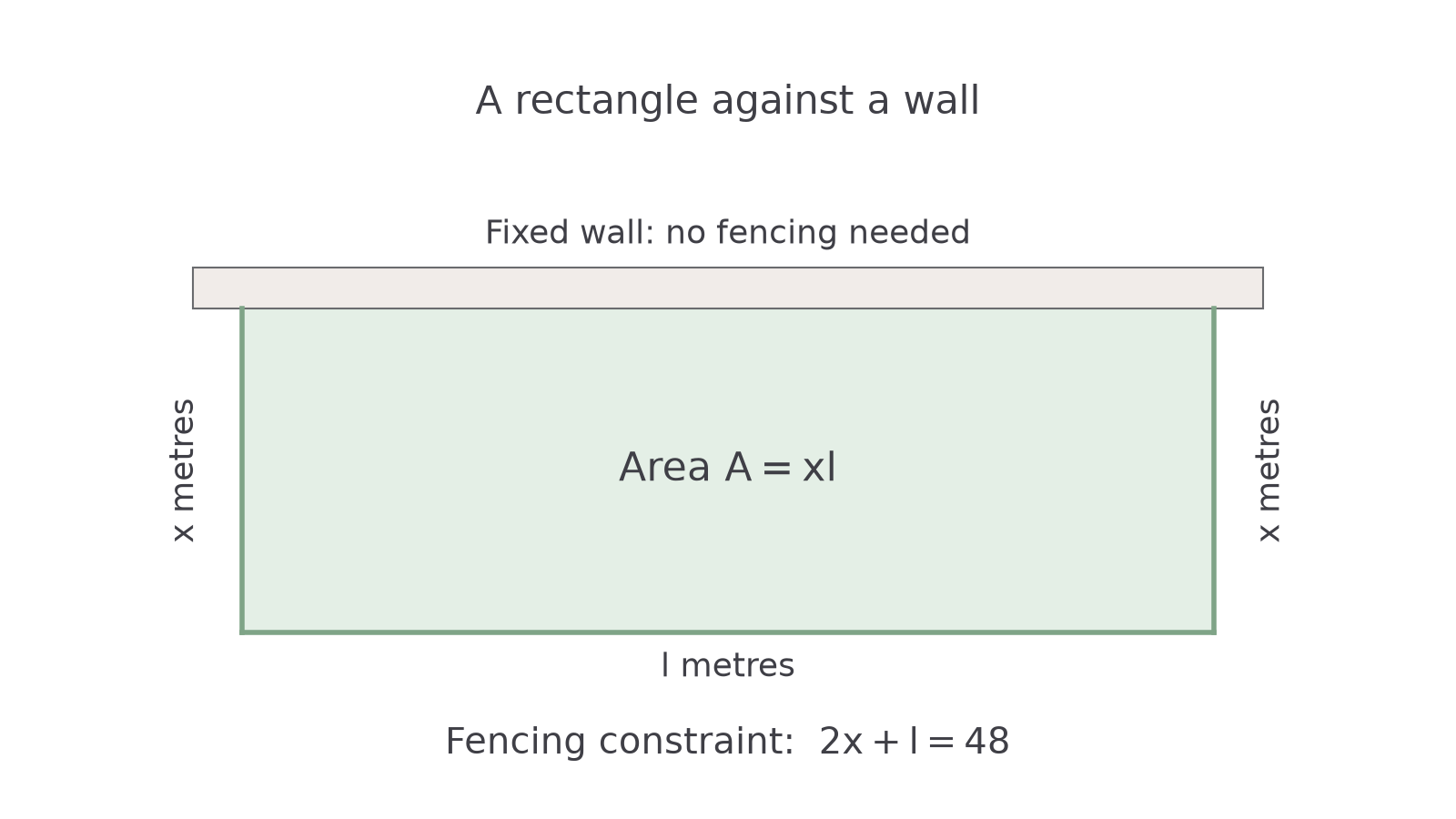
The constraint removes one variable. Once is written in terms of , you can use the differentiation you already know.
An interior optimum
For a differentiable quantity , an interior maximum or minimum must satisfy
Keep only solutions in the problem's domain, justify the nature and substitute into for the requested value. Compare included boundary values when the domain has endpoints.
Not on the formulae sheet: learn it.
In the enclosure problem the area is a downward-opening quadratic, so its one stationary point will be the maximum on the allowed interval.
Worked example 1: three fenced sides
Question. Use calculus to work out the dimensions and maximum area of the rectangular enclosure made with of fencing against a wall.
Plan. Differentiate the one-variable area, solve for and calculate the other dimension and area.
Why this step? measures a side length. The question asks for area too, so a final answer of just would leave the optimisation unfinished.
Answer. The dimensions are by , giving maximum area .
Check. , and lies in . The area tends to zero at either excluded end, so the interior maximum is also the greatest allowed area.
Worked example 2 changes only the amount of fencing to . Build the constraint again; do not change the optimum by guesswork.
Worked example 2: a longer fence
Question. Use calculus to work out the dimensions and maximum area when the same kind of enclosure uses of fencing.
Plan. Replace the total length in the constraint, then optimise the new area.
Why this step? The two copies of both consume fencing, so the constraint contains , not .
Answer. by , with maximum area .
Check. . Completing the square gives , confirming that no allowed area exceeds .
The wall has a striking benefit. With the original , fencing all four sides gives , at most . Letting the wall provide one side doubles the best possible area to , even though the amount of fencing is unchanged.
Watch out
Wrong: . There are two fenced sides of length , so the correct constraint is . Count the actual sides before forming the expression.
The next enclosure changes the total again. Show the model before using calculus.
Minimising a positive reciprocal expression
In an expression containing both and , increasing makes one positive term larger and the other smaller, so the smallest total balances the two effects.
The domain is essential. In the examples below : a negative stationary solution is not an alternative answer, and is not defined at all.
Differentiating a reciprocal term
For constant and ,
When and , the second derivative of this term is positive.
Not on the formulae sheet: learn it.
Write the negative power before differentiating, then keep the positive-domain restriction beside your solution.
Worked example 3: an exact fractional input
Question. For , . Use calculus to show that has a minimum and work out its minimum value.
Plan. Solve the zero-gradient equation, retain its positive solution and test it before evaluating .
Why this step? The equation for gives two algebraic roots, but only is in the domain. A length-like positive input cannot be replaced by its negative root.
Answer. The minimum value is , attained at .
Check. For , ; for , it is positive. Thus falls to this value and rises afterwards throughout the positive domain.
Continue this lesson.
You’re previewing NovaLearn without an account. Create a free account to read the rest.
Create free account