6.4 - Pythagoras' theorem in 2D and 3D
Use right-angled triangles to calculate exact lengths in flat diagrams and solids. You will recognise the specified Pythagorean triples, choose when to add or subtract squares and expose the two triangles behind a three-dimensional calculation. Keep roots exact until a question asks for rounding.
Choosing the hypotenuse
Could a box have whole-number edges and whole-number diagonals on every face, yet an irrational diagonal through its interior? The box with edges , and does exactly that. We will check its surprising lengths after building the method with smaller numbers.
You already know
The principal square root is non-negative. For example, ; a surd keeps a length exact. A length cannot be the negative solution of a squared equation.
The hypotenuse is the side opposite the right angle, and it is the longest side of that right-angled triangle. The other two sides are perpendicular. Pythagoras' theorem says that the square on the hypotenuse has the same area as the squares on the two shorter sides together.
Pythagoras' theorem
For a right-angled triangle with perpendicular sides and hypotenuse ,
On the formulae sheet.
If is unknown, add the two shorter-side squares. If a shorter side is unknown, rearrange first, for example . The converse also holds: if the longest side of a triangle satisfies , the angle opposite it is a right angle. That converse is not stated on the formulae sheet: learn it.
Worked example 1: the longest side is unknown
Question. A right-angled triangle has perpendicular sides and . Work out the hypotenuse exactly.
Plan. Add the squares of the perpendicular sides and take the positive square root.
Why this step? The unknown side is opposite the right angle, so its square is the sum rather than a difference.
Answer. .
Check. , and .
Worked example 2 changes only which length is unknown. The hypotenuse is now supplied, so subtraction is needed.
Worked example 2: a shorter side is unknown
Question. A right-angled triangle has hypotenuse and one shorter side . Work out its other side.
Plan. Subtract the known shorter-side square from the hypotenuse square.
Why this step? The hypotenuse remains the longest side regardless of where the unknown is written.
Answer. .
Check. .
Identify the right angle before trusting any apparent triangle in a diagram.
Watch out
Wrong: every unknown side is . Right: first label the hypotenuse, then write the equation with its square alone on one side. Pythagoras does not apply directly to a triangle with no right angle.
Keep the unknown on a shorter side in this check.
Recognising Pythagorean triples
Some right triangles have three integer side lengths, which lets you recognise a length before doing any square-root arithmetic.
Pythagorean triple
A Pythagorean triple is a set of positive integers satisfying , with the largest. For example, is a triple. Consecutive integers are not automatically a triple: .
These four triples and their simple multiples are particularly useful. Each check also tells you which entry is the hypotenuse.
| Triple | Square check |
|---|---|
Multiplying every side by the same positive scale factor preserves the right angle: . For integer , this gives another integer triple, such as , or . The triples and scaling rule are not on the formulae sheet: learn them.
Worked example 3: recognise a scaled triple
Question. A right-angled triangle has hypotenuse and a shorter side . Work out the other side.
Plan. Match and to a common multiple of a known triple.
Why this step? Both known sides have the same scale factor and the hypotenuse matches the largest entry.
Answer. .
Check. .
Worked example 4 keeps the hypotenuse but changes which shorter side is supplied.
Worked example 4: recognising the other leg
Question. A right-angled triangle has hypotenuse and one shorter side . Work out the other side.
Plan. Recognise the same scale factor in and .
Why this step? The triple's two legs are interchangeable, but its largest entry must still match the hypotenuse.
Answer. .
Check. .
Recognition is a shortcut, not a restriction: when the numbers do not match a triple, use Pythagoras and retain the exact root.
Watch out
Wrong: replace just one side of by its double to get another triple. Right: scale all three sides together. For example, fails because .
The next question uses a different one of the four named triples.
Face and space diagonals of a cuboid
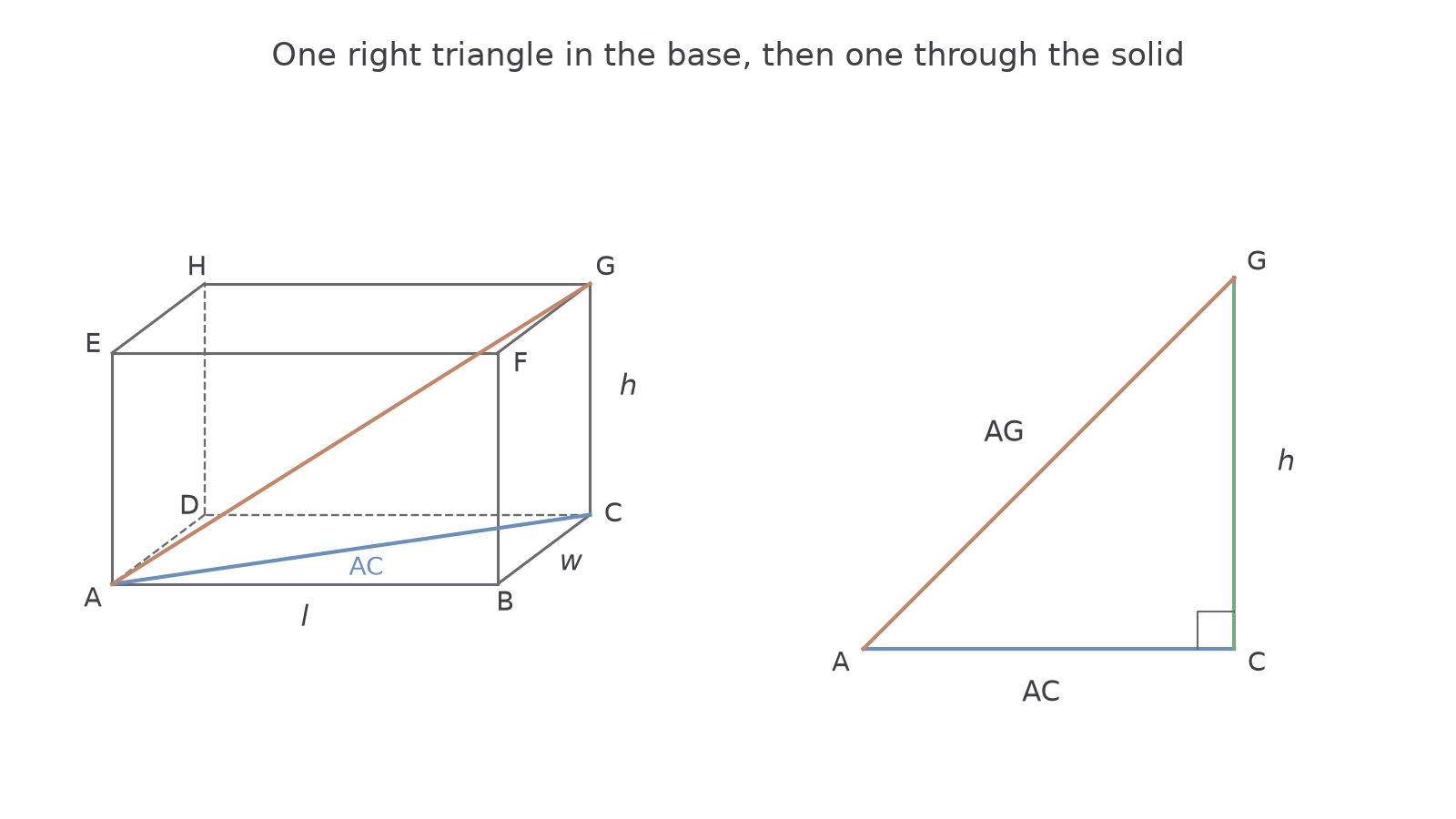
A space diagonal crosses a cuboid's interior, and two perpendicular triangles let you calculate it without pretending all three edges lie in one plane.
Label as the rectangular base, with directly above it: above , above , and so on. First calculate base diagonal . The vertical edge is perpendicular to the base plane, so is right-angled at .
[DIAGRAM: asset_name: Two triangles in a cuboid; asset_slug: l2fm-geometry-cuboid-pythagoras; caption: Calculate face diagonal AC, then use right triangle ACG for space diagonal AG; description: A perspective cuboid is labelled ABCD around its base and EFGH directly above. Base edges AB, BC and vertical CG are labelled l, w and h. Blue base diagonal AC and clay space diagonal AG are highlighted. Beside it, extracted right triangle ACG has legs AC and h, hypotenuse AG and a right-angle marker at C.]
Continue this lesson.
You’re previewing NovaLearn without an account. Create a free account to read the rest.
Create free account