3.9 - Tangents to a circle
Work out the equation of a tangent by using the radius to its point of contact. You will handle circles with any centre, recognise horizontal and vertical exceptions, and combine a tangent equation with intercepts and an exact area.
The radius determines the tangent's gradient
At on the circle , the tangent has equation . Why do the point's coordinates become the two coefficients? We will first build tangent equations from gradients, then explain that shortcut at the end.
A tangent needs both a direction and a point. Its contact point is given; its direction comes from the radius, which is perpendicular to it. Use the circle's centre as the radius's starting point, rather than automatically using the origin.
You already know
The radius is perpendicular to the tangent at contact; this circle fact is not on the formulae sheet. Non-zero perpendicular gradients are negative reciprocals. The point-gradient equation is on the formulae sheet.
Read the centre from . Check the proposed contact point lies on the circle, calculate the centre-to-point gradient, then use its negative reciprocal through the contact point. A point off the circle is not a contact point at which this method gives a tangent.
[DIAGRAM: asset_name: A shifted radius fixes a tangent direction; asset_slug: l2fm-circle-tangent-gradient; caption: Use coordinate changes from the actual centre, then take the perpendicular direction; description: Equal-scale axes show the circle with centre C at (2, 1), radius 5 and contact P at (6, 4). The sage radius CP has a dashed gradient triangle with horizontal change 4 and vertical change 3. The blue tangent is 4x plus 3y equals 36 and has an accurate right-angle marker with the radius at P. A side calculation states radius gradient 3 quarters and tangent gradient minus 4 thirds.]
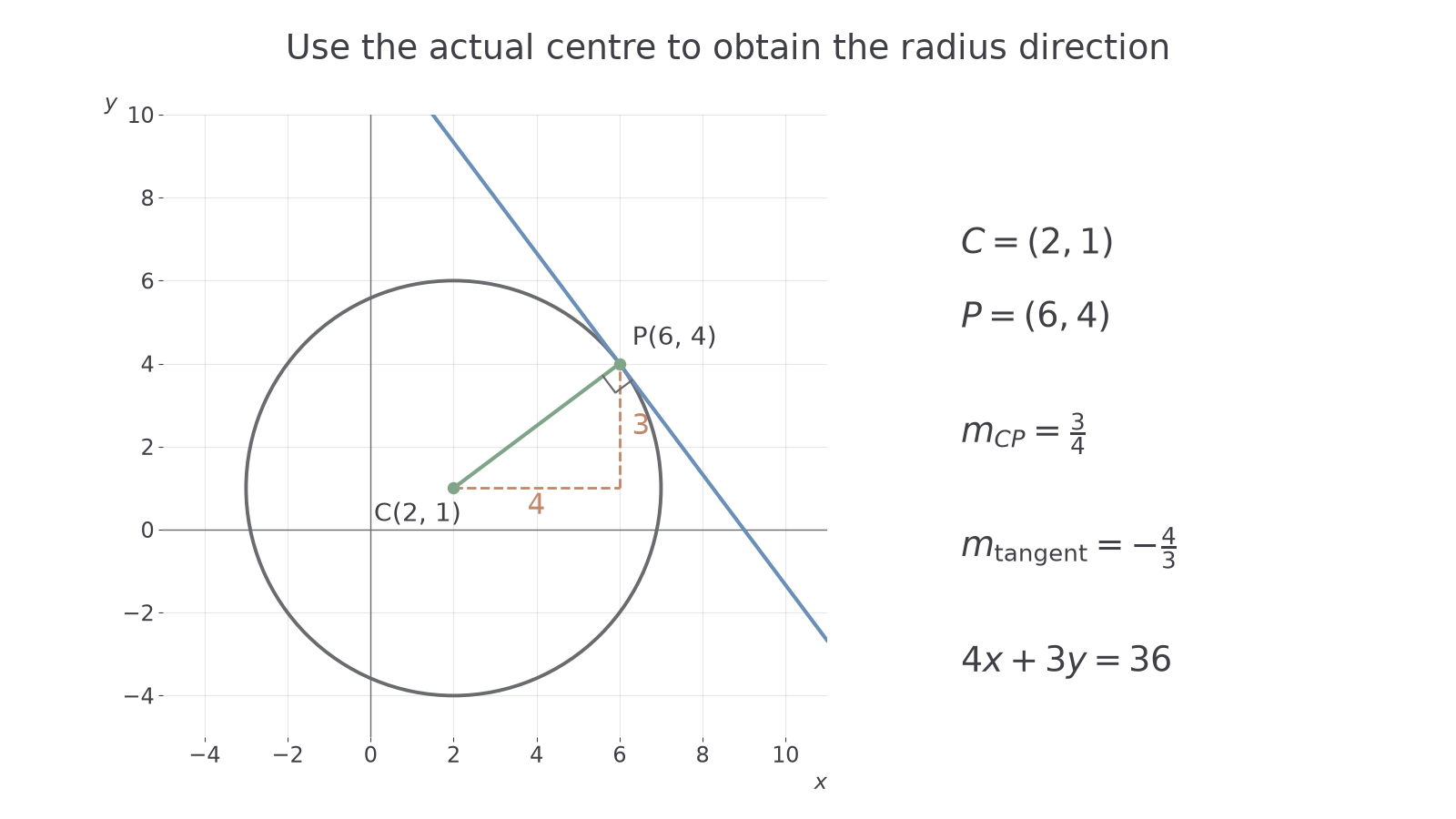
Worked example 1: a tangent to a shifted circle
Question. Work out the equation of the tangent to at .
Plan. Use the centre to obtain the radius gradient, then construct the perpendicular line through .
Why this step? The radius uses differences from . The ratio would describe a line from the origin instead.
Answer. , or any equivalent equation.
Check. , so the tangent contains . Its gradient multiplies the radius gradient to give .
Worked example 2 changes only the contact point, reflecting it across the horizontal line through the centre. The vertical radius change reverses sign.
Worked example 2: a positive tangent gradient
Question. Work out the tangent to at .
Plan. Calculate the new radius gradient and use the perpendicular direction through .
Why this step? A falling radius has a rising perpendicular tangent. Changing only one sign without taking the reciprocal would give the wrong direction.
Answer. .
Check. At , , and .
The centre fixes the radius direction but is not a point on the tangent. Substituting the centre into a tangent equation should not make it true for a circle with positive radius.
Watch out
Wrong: use in Worked example 1. That line goes through the centre. Right: use , through the contact point. The centre supplies the radius; the contact point locates the tangent.
Work out a tangent to a new shifted circle, showing which two points define its radius.
Horizontal and vertical tangents
When the radius is horizontal or vertical, choose the perpendicular tangent directly instead of trying to divide by zero.
A point directly above or below the centre has a vertical radius, so its tangent is horizontal. A point directly left or right of the centre has a horizontal radius, so its tangent is vertical. In either case, the tangent passes through the contact point's unchanged coordinate.
[DIAGRAM: asset_name: Axis-parallel circle tangents; asset_slug: l2fm-axis-circle-tangents; caption: A vertical radius gives a horizontal tangent; a horizontal radius gives a vertical tangent; description: Two equal-scale panels show the circle with centre C at (3, minus 2) and radius 5. Left: a vertical radius reaches P at (3, 3), and the horizontal tangent is y equals 3. Right: a horizontal radius reaches Q at (8, minus 2), and the vertical tangent is x equals 8. Both contact points have right-angle markers between radius and tangent, and the correct tangent equation is labelled.]
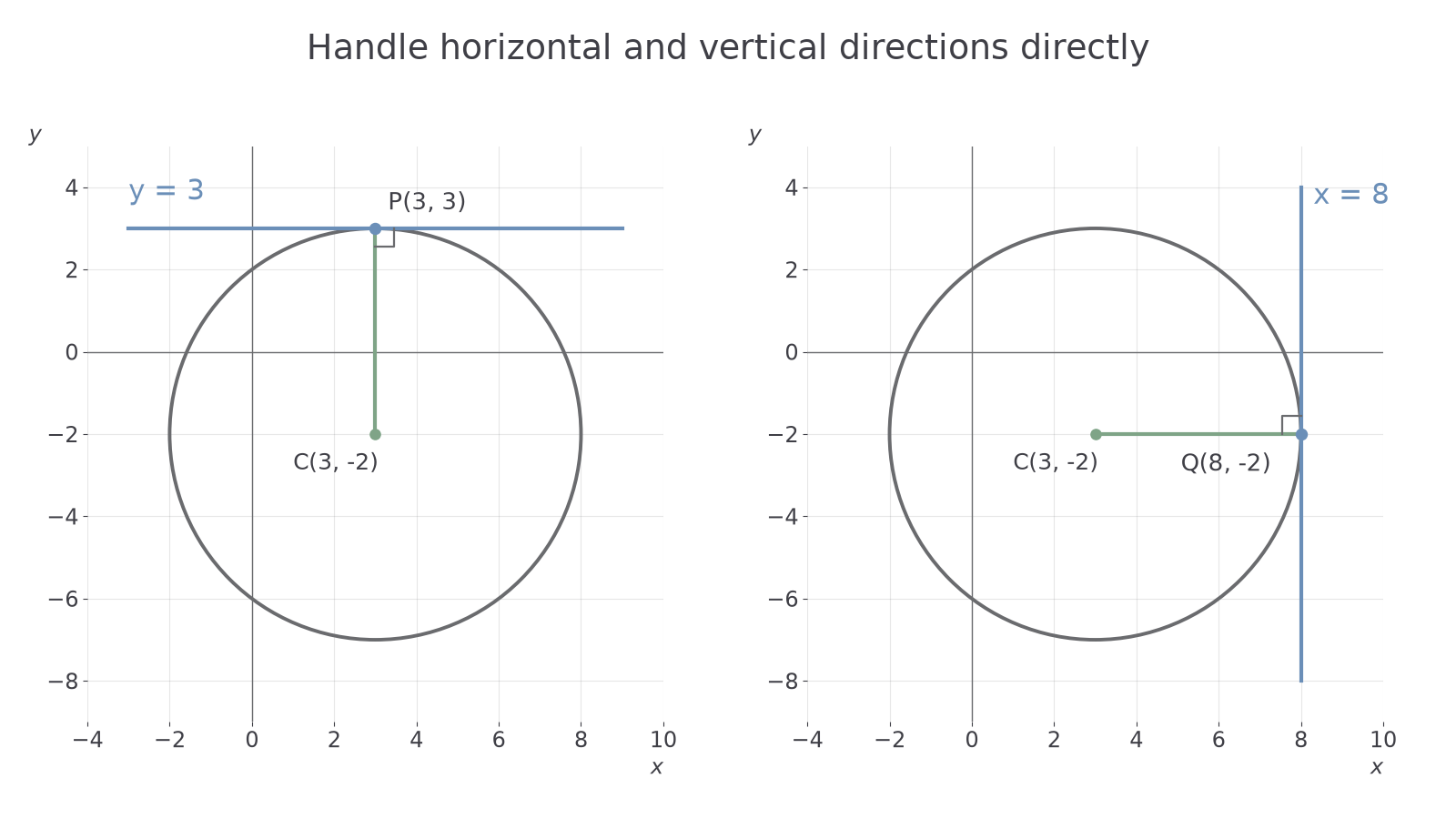
Axis-parallel tangents
For a circle with centre and radius ,
These are tangent lines, with contact points on the corresponding vertical or horizontal diameter.
Not on the formulae sheet: learn it.
The point-gradient formula needs a defined gradient. It works for a horizontal tangent with gradient , but a vertical tangent needs an equation .
Worked example 3: a horizontal tangent
Question. A circle has equation . Work out the tangent at .
Plan. Compare the centre and contact coordinates, then use their perpendicular directions.
Why this step? The radius has no defined gradient, so no reciprocal calculation is available. Its perpendicular direction is still clear.
Answer. .
Check. Substituting into the circle gives , so only. There is exactly one contact point.
Worked example 4 changes only the contact position, moving a quarter-turn from the top of the circle to its right-hand point.
Continue this lesson.
You’re previewing NovaLearn without an account. Create a free account to read the rest.
Create free account