5.3 - Transformations of the unit square
Build a transformation matrix by following two corners of a unit square, then use it to map the remaining corners and other points. You will connect the columns to enlargements, reflections and rotations about the origin, so the standard matrices have a reason behind them.
The unit square and its two defining images
How can the images of just two corners tell you what happens to all four corners of a square, and even to points outside it? Matrix columns carry exactly that information.
The unit square has vertices , , and , in that order around its boundary. The prime in , read “A prime”, names the image of .
You already know
Represent a point by the column . Multiply the transformation matrix on its left, using row times column. The first output entry is the image's horizontal coordinate; the second is its vertical coordinate.
Write . The special inputs for and select one column at a time:
That is why the images go down columns rather than across rows.
Building a transformation matrix
If maps to and maps to , then
The first column is the image of ; the second is the image of . Also, and .
Not on the formulae sheet: learn it.
The rule for follows by putting into the row-column calculation. Its image is forced once and are chosen. More surprisingly, every matrix fixes , because both row-column sums are zero when . Such a matrix cannot represent a translation that moves the origin.
For an enlargement centred on , multiply both coordinates by the scale factor. A negative scale factor puts the image on the opposite side of , at the corresponding multiple of its distance.
Enlargement centred on the origin
An enlargement of scale factor , centre , is represented by
For , each image lies on the same ray from ; for , it lies on the opposite ray. Distances from multiply by . At , every point collapses to , so the image is no longer a square.
Not on the formulae sheet: learn it.
Construct the matrix from the two unit directions before checking the far corner.
Worked example 1: a positive enlargement
Question. The unit square is enlarged with scale factor , centre . Work out the transformation matrix and the images of its vertices.
Plan. Map and , use their images as columns, then calculate .
Why this step? and are the two inputs that expose the columns directly.
Answer. , with , , , .
Check. The two side lengths are both , twice the original length , and stays fixed.
Worked example 2 changes only the sign of the scale factor. The size stays the same as before, but the square moves to the opposite side of .
Worked example 2: a negative enlargement
Question. Enlarge the unit square with scale factor , centre . Work out the matrix and vertex images.
Plan. Multiply both coordinates by , then arrange the two defining images as columns.
Why this step? The negative sign affects direction, not the positivity of a length: the new side length is , not .
Answer. , with , , , .
Check. Multiplying the coordinates of by recovers .
The two enlarged squares have the same size. Their labelled vertices show the change in direction.
[DIAGRAM: asset_name: Positive and negative origin enlargements; asset_slug: l2fm-unit-enlargements; caption: A negative scale factor places each image on the opposite side of the origin; description: Two coordinate panels show unit square OABC and its image. Left: scale factor 2 gives A prime (2,0), B prime (2,2), C prime (0,2). Right: scale factor minus 2 gives A prime (minus 2,0), B prime (minus 2,minus 2), C prime (0,minus 2). O equals O prime remains at (0,0). Original outlines are grey dashed and images are pale blue.]
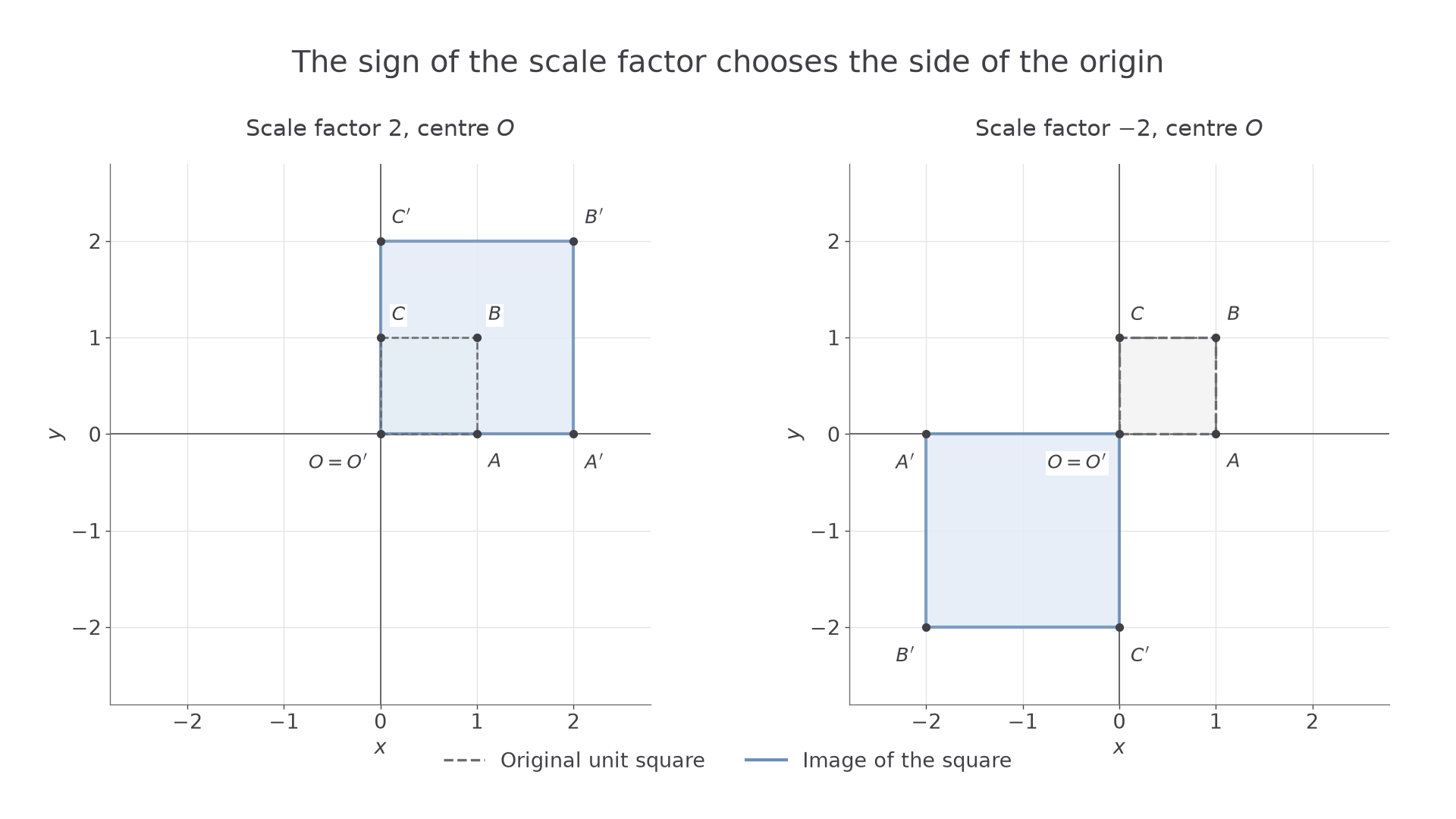
A fractional positive scale factor works in exactly the same way; it moves the image towards when it lies between and .
Watch out
Wrong: use for an enlargement. It sends both and to the same point. Right: use , scaling the two independent directions.
Try a smaller positive scale factor and check the far corner.
Reflections in the four mirror lines
A reflection places an image the same perpendicular distance on the opposite side of its mirror line, while points on the line stay fixed.
For the coordinate axes, one coordinate changes sign. For the diagonal lines, follow and carefully: their coordinates swap roles.
| Mirror line | Image of | Image of | Matrix |
|---|---|---|---|
| , the -axis | |||
| , the -axis | |||
Every matrix in the table comes from the two image columns. None is on the formulae sheet: learn how to reconstruct them from the mirror line.
For , reflection swaps coordinates: . For , it swaps them and changes both signs: . Points such as and stay on their respective diagonal mirror lines, which provides a quick check.
Worked example 3: reflection in an axis
Question. Work out the matrix for reflection in , and use it to work out the image of .
Plan. Keep horizontal coordinates, reverse vertical coordinates and use the images of and as columns.
Why this step? The equation names the horizontal mirror line, so vertical coordinates change sign.
Answer. , and .
Check. and are each unit from the line , on opposite sides.
Worked example 4 changes only the mirror line, to . Use its geometry rather than carrying over the axis reflection's sign pattern.
Continue this lesson.
You’re previewing NovaLearn without an account. Create a free account to read the rest.
Create free account